 Hot Stamper Pressings of the Music of Pink Floyd Available Now
When I was just getting up to speed in audio and exploring the world of music available on vinyl in the 70s, many of the stereo stores I frequented carried Japanese pressings. They were widely believed to have superior sound relative to their domestic counterparts — in this case, the mass-produced pressings I would see at the Tower Records right across from the Sports Arena in my hometown of San Diego. I went there at least once a week, probably more like two or three times.
Tower was far and away the best place to go record shopping in those days. The store was huge and they had dramatically more stock than Licorice Pizza or The Wherehouse.
They also had a separate section for Half-Speed mastered pressings from a number of labels, which of course was the first place in the store I would visit, digging through the bins to see what new remastered titles may have been produced for audiophiles searching for the ultimate in sound quality.
Of course, I identified as just such a person. In terms of sound quality, and with the extremely limited knowledge I had acquired at the time, I believed I set a high standard for the sound of the records I bought. I was willing — eager even, you could even say excited — to pay whatever premium price I had to for a record that was sure to deliver superior sound quality. To me, in the late 70s, that meant two things: direct to disc recordings, and Half-Speed mastered pressings.
(There was a another category of records that did not fall into the above two, best exemplified by American Grammaphone and the Fresh Aire series, but the less said about those schlocky releases the better, other than to point out that some of their titles are TAS list carryovers from HP’s time running the Super Disc list, specifically Fresh Aire 2 and 3, both best avoided.)
And, like any other open-minded individual, when it came to Japanese vinyl I was willing to give a few a spin.
However, the more of them I bought, the more clear it became to me that even the best of them sounded mediocre (veiled, smeary and dubby from second generation tapes) and more often than not they were just plain awful. (Second generation tape issues being the main problem, of course, with the additional insult of poor tonality, the result of being mastered using wacky equalization, typically with added brightness where none was needed.)
Pink Floyd
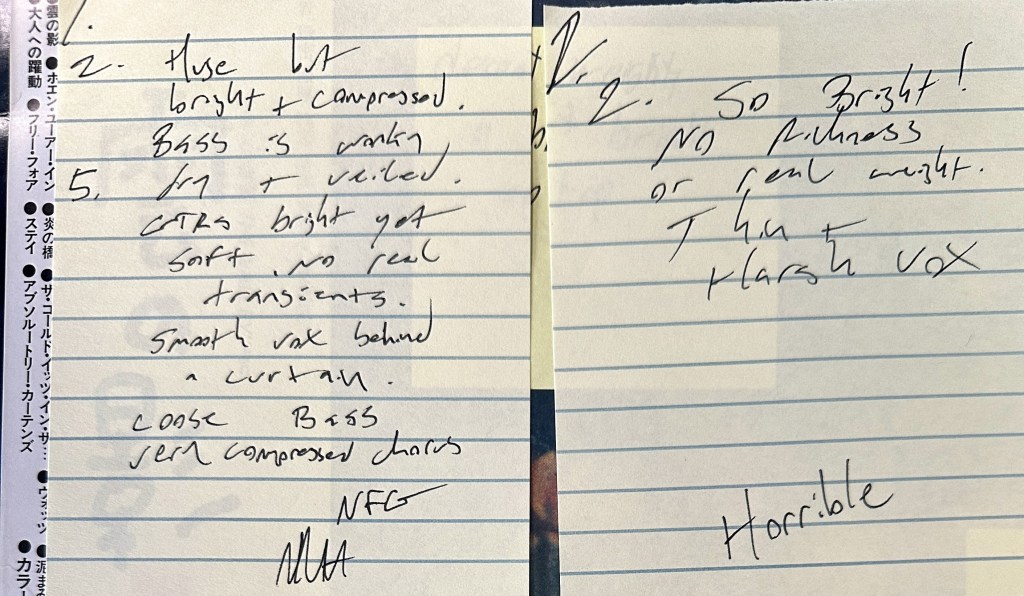
The notes for the Pink Floyd album you see below, Obscured by Clouds, were written sometime in March of 2025 as part of the shootout we conducted for the album.
If we assume it would be an audiophile who would be attracted to this pressing, perhaps for its quieter playing surfaces, perhaps operating under the assumption that the Japanese engineers mastering the record would be more likely to do a better job as well, then what we have here is a textbook case of an audiophile bullshit pressing.
One that sounds nothing like the album is supposed to, based on having played a number of exceptionally good sounding copies, all British and all on the Green Harvest label, mastered from good tapes, sometimes by the legendary Harry T. Moss. We feel we are more than qualified to make these judgments. If we can’t make them, nobody can.
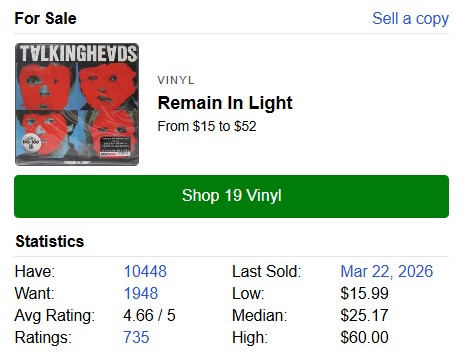
Discogs allows us to glean some information regarding the desirability of this Japanese reissue with the record buying public currently in the market for Pink Floyd vinyl who register on their site.
(more…)