Victoria Hall – Reviews and Commentaries

Coppelia and Sylvia / London Vs. Decca – Updated 2025

Hot Stamper Pressings of Music Conducted by Ernest Ansermet Available Now

Once again, the right Decca reissue blows the doors off the original London we played. This has lately become a pattern, but keep in mind it’s a pattern that’s reliable less than half the time, if memory is any guide. Many of the Decca reissues we’ve played over the last few years have failed badly in a head to head with their earlier-mastered and -pressed counterparts.

But the ones that beat all comers are the ones that stick in our minds and show up on our site.


UPDATE 2025

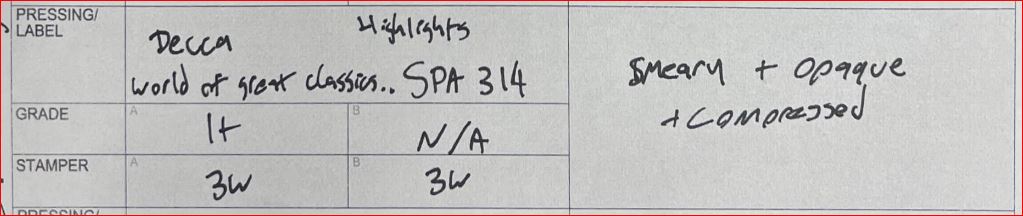
A copy of one of the SPA reissues we used to like shown above made it to our latest shootout and did not do nearly as well as a copy did years ago.

We don’t have those copies anymore and cannot say whether they actually did sound as good as we thought they did.

Our advice would be to assume that this is not the best way to buy this album. But neither is the original, as you will read below.


Clearly a case of confirmation bias, but at least we know something about our own biases, and that puts us well ahead of the audiophile pack.

Record collectors and record collecting audiophiles will tell you it shouldn’t happen, but fools like us, who refuse to accept the prognostications of those supposedly “in the know,” have done the work and come up with the experimental data that’s proven them wrong again and again.

Sort of. We had one, and only one, pressing of the original London (CS 6185), and boy was it a mess — crude as crude can be.

It sounded like an “old London record,” not the Decca engineered and mastered vintage collectible we know it to be.

We’ve played them by the hundreds, so we know that sound fairly well by now.

Are there copies that sound better? Surely there are, but how are you going to find them? Are you going to shell out the going rate of $25-50 on ebay for one (or more) clean copies, only to find that it/they sound every bit as bad as the one we auditioned? The question answers itself.

If, however, you are one of the lucky few who has a nice London or Decca original of this recording, please let us send you this copy so that you can do the shootout for yourself. You may be shocked at how good this music can sound on the right pressing. And if your copy sounds better than ours we will be very shocked indeed. [This offer was only good while we had the record, and it is long gone at this point. We still remember the sound though!]

Production and Engineering

James Walker was the producer, Roy Wallace the engineer for these sessions from April of 1959 in Geneva’s glorious Victoria Hall. It’s yet another remarkable disc from the Golden Age of Vacuum Tube Recording.

The hall the Suisse Romande recorded in was possibly the best recording venue of its day, possibly of all time. More amazing sounding recordings were made there than in any other hall we know of. There is a solidity and richness to the sound beyond all others, yet clarity and transparency are not sacrificed in the least.

It’s as wide, deep and three-dimensional as any, which is of course all to the good, but what makes the sound of these recordings so special is the weight and power of the brass, combined with unerring timbral accuracy of the instruments in every section of the orchestra.

(more…)

Ansermet’s Recording of Pines of Rome Did Not Make the Cut

Click Here to See Our Favorite Pines of Rome

This review was written at least ten years ago. Since then we have done extensive shootouts for both The Pines and The Fountains of Rome.

The London with Ernst Ansermet you see pictured, though good, did not make the cut.

No Hot Stamper pressings — correction, no Hot Stamper pressings hot enough to offer our customers — were found of this recording from 1964.

Below you will find our old review. Needless to say, we have learned a lot since then.

EXCELLENT SOUND! Not a Demo Disc by any means, but a well-recorded, well-mastered Pines.

The problem with Pines is normally too much close miking. This London places the orchestra in a more natural perspective, which I much prefer.

Side two, the Pines, also has the best sound. 

(more…)

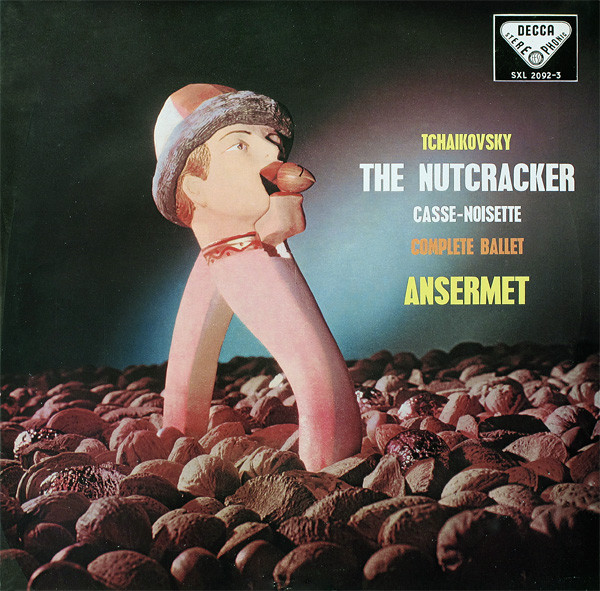
The Nutcracker on Speakers Corner

Hot Stamper Pressings of the Music of Tchaikovsky Available Now

Sonic Grade: B?

Not sure if we would still agree with what we wrote back in the ’90s when this record came out, but here it is anyway.

Superb! New records just don’t sound any better! This is the complete Nutcracker Ballet as conducted by Ansermet for Decca, a record that sets a standard of performance and sound that is unlikely ever to be equaled, and almost certainly not to be surpassed.

For those of you on a budget, if you can get your hands on one of these for a reasonable price, the Heavy Vinyl reissue would not be a bad way to go.

That’s assuming the copy you buy sounds at least good, similar to the one I played all those years ago, something that cannot be assumed.

But it would make for a good jumping off point.


A Must Own Classical Record (on Vintage Vinyl)

Ansermet breathes life into this ballet as only he can, and the Decca engineering team led by Kenneth Wilkinson do him proud.

It’s an Orchestral Spectacular that should have a place of honor in any audiophile’s collection.

Others that belong in that category can be found here.

Chabrier / Ansermet – The Best Espana on Record?

Hot Stamper Pressings of the Music of Chabrier Available Now

In 2021 we wrote:

Ansermet’s performance of Espana is still our favorite — nothing in our experience can touch it, musically or sonically.


UPDATE 2022

As of 2022 we slightly prefer the famous Argenta recording for Decca that’s on the TAS List, CS 6006.

Both are wonderful and both belong in any serious audiophile collection of orchestral music.


We created a special section for recordings of this quality. Classical and orchestral records that we’ve auditioned and found to have the best performances with the highest quality sound can be found here.

This has been a favorite recording of ours here at Better Records for a very long time, since at least the mid-’90s or thereabouts. We’ve mentioned how much we like the sound of Londons with catalog numbers ranging from about 6400 to 6500 or so (which are simply Decca recordings from the mid-’60s), and this one (CS 6438) is one of the best reasons to hold that view.

You get some of the Tubey Magic and golden age sound from Decca’s earlier days, coupled with the clarity and freedom from compression and tube smear of their later period. In other words, this record strikes the perfect sonic balance, retaining qualities from different periods that are normally at odds with each other. Here they work together wonderfully.


Further Reading

Carmen – Dry Strings on One Side, Rich on the Other

More of the music of Georges Bizet (1838-1875)

My notes for side two on a copy we recently auditioned read:

Could use more tubes.

Strings could be a bit smoother.

Needs a bit more weight down low.

My notes for side one:

Side one had all of this and more!

Some Common Issues with Londons and Deccas

Many London and Decca pressings lack weight down low, which thins out the overall sound and washes out the lower strings.

On some sides of some copies the strings are dry, lacking Tubey Magic. This is decidedly not our sound, although it can easily be heard on many London pressings, the kind we’ve played by the hundreds over the years.

If you have a rich sounding cartridge, perhaps with that little dip in the upper midrange that so many moving coils have these days, you will not notice this tonality issue nearly as much as we do.

Our 17Dx is ruler flat and quite unforgiving in this regard. It makes our shootouts much easier, but brings out the flaws in all but the best pressings, exactly the job we require it to do.

Here are some other records that are good for testing string tone and texture.

(more…)

Chabrier – Our Four Plus Shootout Winner

Hot Stamper Pressings of the Music of Chabrier Available Now

The Espana side earned our rare and coveted Four Plus A++++ grade, which is strictly limited to pressings (really, individual sides of pressings) that take a given recording to a level we’ve never experienced before and had no idea could even exist. We estimate that about one per cent of the Hot Stamper pressings we come across in our shootouts earn this grade. You can’t get much more rare than that.

Our lengthy commentary entitled Outliers & Out-of-This-World Sound talks about how rare these kinds of pressings are and how to go about finding them.

We no longer give Four Pluses out as a matter of policy, but that doesn’t mean we don’t come across records that deserve them from time to time.

Here you will find monstrous size and dynamic power, thanks to the brilliant Decca engineering of Roy Wallace. Without a doubt the most spectacular sound we’ve ever heard from CS 6438.

This Beyond White Hot Stamper London pressing has some of the loveliest orchestral music reproduction we know of. Man, this copy sure has it going on: it’s super clean and clear, tonally correct from top to bottom, with all of the weight of the orchestra down low on side one which is very, very hard to come by on this record!

And all that weight and energy down low is what really makes Espana magical. You won’t believe the sound!  (more…)

The Restorative Power of Classical Music on Vinyl

Hot Stamper Classical and Orchestral Pressings Available Now

We often mention the benefits to be gained from regularly listening to classical music. Once a week would make a good rule of thumb for playing a classical record or two I should think.

We all love our rock, jazz, folk and the rest, but there is something about classical music that has the power to restore a certain balance in your musical life that, for whatever reason, cannot be accomplished through other music. Perhaps it grounds your listening experience in something less immediately gratifying, something that grows deeper and more enriching over time. Once the effect has taken hold, the changes in one’s mood are easy to recognize.

Of course it should be pointed out that the average classical record is at best a mediocrity and more often than not a sonic disaster. There are many excellent pressings of rock and jazz, but when it comes to classical music — by its nature so much more difficult to record (and reproduce!) — the choices narrow substantially.

Most of what passed for good classical sound when I was coming up in audio — the DGs, EMIs, Sheffields and other audiophile pressings — are hard to take seriously when played on the modern high quality equipment of today.
We probably audition at least five records for every one we think might pass muster in a future shootout, and we’re pulling only from the labels we know to be good. We wouldn’t even waste our time playing the average Angel, Columbia or DG, or EMI for that matter. The losers vastly outweigh the winners, and there are only so many hours in a day. Who has the time to hunt for so few needles in so many haystacks?

Commitment of Resources

With the above in mind, it should be clear that assembling a top quality classical collection requires much more in the way of resources — money and time — than it would for any other genre of music.

We are happy to do some of that work for you — our best classical pressings are amazing in almost every way — potentially saving you a lifetime of work. But we do so at a price; the service we provide is labor-intensive. And, as you may have noticed, vintage classical records are not getting any cheaper or easier to find.

On the positive side, every Hot Stamper we sell is 100% guaranteed to satisfy in every way: music, sound, and playing condition. Ideally this means less work for you and more time for listening enjoyment, weekly or more if you can manage to carve it out of your schedule.

We’ve auditioned countless pressings in the 38 years we’ve been in business — buying, cleaning and playing them by the thousands.

This is how we find the best sounding vinyl pressings ever made, through trial and error. It may be expensive and time consuming, but there is simply no other method for finding better records that works. If you know of one, please write me!

We are not the least bit interested in records that are “known” to sound the best.

Known by whom? Which audiophiles — hobbyists or professionals, take your pick — can be trusted to know what they are talking about when it comes to the sound of records?

I have never met one, outside of those of us who work for Better Records. I remain skeptical of the existence of such a creature. The audiophile experts and reviewers I’ve encountered on the web seem hopelessly lost to me.


UPDATE 2024

Woops, I take that back. I have met one, a certain Mr. Robert Brook. He has been conducting his own shootouts for a few years now and has made his findings available on his blog, The Broken Record. You can trust the information he posts there.

(more…)

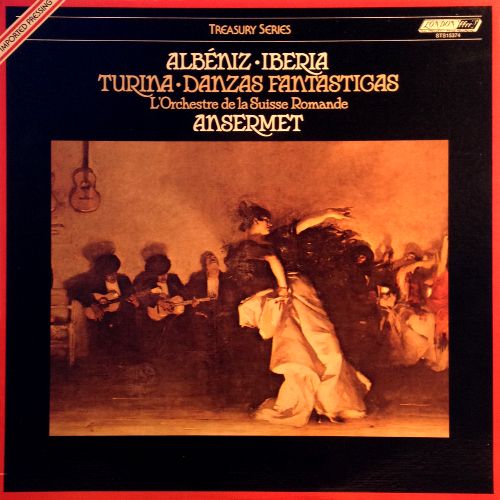
Albeniz / Iberia from 1960 – Amazing on the Original and the Right Reissues Too

xxx.jpg

More of the music of Isaac Albeniz (1860-1909)

Decca and London Hot Stamper Pressings Available Now

James Walker was the producer, Roy Wallace the engineer for these sessions from May of 1960 in Geneva’s glorious Victoria Hall.

It’s yet another remarkable Demo Disc from the Golden Age of Vacuum Tube Recording Technology, with the added benefit of mastering using the more modern cutting equipment of the ’70s. (We are of course here referring to the good modern mastering of 30+ years ago, not the bad modern mastering of today.)

The combination of old and new works wonders on this title as you will surely hear for yourself on both of these better than Super Hot sides.

The sound of this copy is so transparent, undistorted, three-dimensional and REAL, without any sacrifice in solidity, richness or Tubey Magic, that we knew we had a real winner on our hands as soon as the needle hit the groove.

We were impressed with the fact that it excelled in so many areas of reproduction. The illusion of disappearing speakers is one of the more attractive aspects of the sound here, pulling the listener into the space of the concert hall in an especially engrossing way.

Side One – Iberia (1-4)

A huge hall, correct string tone, spacious and open as practically any orchestral recording you can find! (more…)