Henry Lewy, Producer-Engineer – Reviews and Commentaries

What We Listened For on Blue

Hot Stamper Pressings of Joni Mitchell’s Albums Available Now

We recently auditioned the Mobile Fidelity One-Step pressing of Blue and made some notes regarding the sound. (You can read them in full here.)

We focussed on the quality of their pressing’s vocal reproduction, for the simple reason that a Joni Mitchell album that gets the vocals wrong is a Joni Mitchell album that no music lover and certainly no audiophile would ever want to play.

Notice that only the vocals are mentioned in the notes — not how deep the bass goes, not how high the highs are, not the tone of the piano, not the pluck of the lap dulcimer, not the black background, not the soundstaging — none of those things that audiophiles — including us! — like to talk about endlessly in our reviews so that everyone will know how attuned we were to every aspect of the recording.

For this album that kind of listening is unnecessary.

When the voice is wrong, the sound is wrong. What more do you need to know?

And when the voice is wrong on a Joni Mitchell record, you have a worthless piece of vinyl no matter how much you may have paid for it.

Other titles that get the voice wrong and therefore should be avoided by audiophiles of all stripes can be found here.

We’ve written quite a bit about the album, having played copies of it by the score, and you can find plenty of our reviews and commentaries for Blue on this very blog.

There is currently at least one Hot Stamper pressing on the site for those of you who really love the album and are willing to pay a premium-and-then-some price for it.

For everybody else, here is how to go about finding your own killer copy of Blue.

(more…)

Half-Speed Masters – Stopgaps and Benchmarks

Hot Stamper Pressings of the Music of Joan Baez Available Now

Mobile Fidelity released a version of Diamonds and Rust on Anadisq in 1995, and if you want to hear a pressing that’s not murky, compressed and opaque, you would be wise to avoid their remastered pressing.

To be fair, MoFi has made some reasonably good sounding records too. For those of you whose budget is on the limited side, if you find an affordable copy of any of these MoFis, you are probably not completely wasting your money.

Stopgaps and Benchmarks

Our advice for the longest time has been that, while you are actively improving your stereo, room and setup, the best way to use your remastered audiophile pressings is as stopgaps and benchmarks.

As you make more and more progress, eventually you will find the vintage pressings that can show you what your audiophile pressings don’t do well, or at the very least, not as well as they should.

The unfortunate reality — considering how much money you had invested in them — is that they were falling short in many ways for all the years you had been playing them, but until you improved your playback, those problems were hidden from you.

Charting Your Success

As your stereo improves, you can actually chart your success by how many of these kinds of records you are able to eliminate from your collection. Once you can count the number of modern reissues you still own on one or two hands, there is a good chance you have reached a much higher level of playback.

(more…)

If Only I Could Remember My Name – Hand Claps Are Key

Hot Stamper Pressings of the Music of David Crosby Available Now

Note how Crosby’s voice is “chesty” on the better sounding copies. Some make him sound like he’s all mouth and no diaphragm. When his voice is full-bodied and solid, that’s when he sounds more like a real person and less like a pop recording of a person.

All credit must go to Stephen Barncard.

Harry Pearson put this record on his TAS List of Super Discs, not exactly a tough call if you ask us. Who can’t hear that this is an amazing sounding recording? 

Listening Test

One of our key test tracks for side one is Cowboy Movie, and one thing that separated the best pressings from the lesser ones was the sound of the hand claps. It’s a dense mix and they are not easy to hear, but on the best copies there is audible echo and ambience around them, with a richer “flesh on flesh” quality to their sound.

Not many pressings had it, and the ones that did tended to do most other things well also.

Which is what makes it a good test! (more…)

Leonard Cohen Sure Sounds Better than He Used to

Hot Stamper Pressings of the Music of Leonard Cohen Available Now

Insanely good Shootout Winning Triple Plus (A+++) sound on both sides AND fairly quiet vinyl – the best copy to ever hit the site bar none.

Unbeatable richness and freedom from artificiality in the midrange allowed this one to tower over the rest of the field.

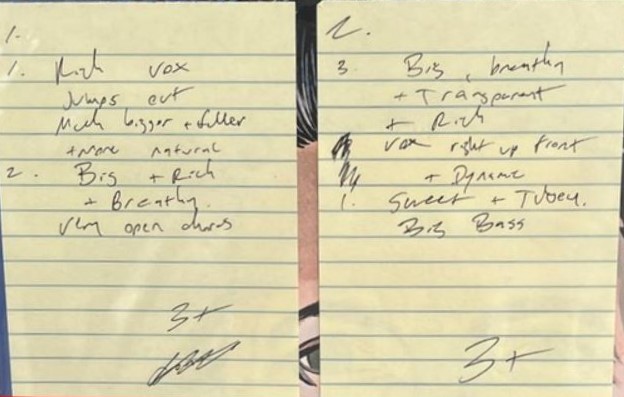
As you can see from the notes, both sides of our most recent White Hot stamper shootout winning copy were doing everything right. We marvelled at these specific qualities in the sound:

Side One

Track one

    • Rich vocals
    • Jumps out
    • Much bigger and fuller and more natural

Track two

    • Big and rich and breathy
    • Very open chorus

Side Two

Track three

    • Big, breathy and transparent and rich
    • Vocals are right up front and dynamic

Track one

    • Sweet and tubey
    • Big bass

Midrange presence is one of the most important qualities of any rock or pop recording we might be evaluating, and for a Leonard Cohen album it is absolutely essential.

You want Cohen to be front and center, neither recessed in space nor behind a veil.

The notes for track three on side two say it all:

Vocals are right up front and dynamic

That is what gets this music to sound the way it is supposed to. You can be very sure that no Heavy Vinyl remastered pressing is going to put Leonard Cohen front and center. They practically never do. (Here is an especially offensive remaster with a bad case of recessed vocals. Funny how none of the audiophile reviewers noticed. What does that say about the quality of their playback, or the standards to which they hold their records?)

DIY Advice

To aid you in doing your own evaluations, here is a list of records that we’ve found to be good for testing midrange presence.

This is exactly why we do shootouts. If you really want to be able to recognize subtle (and not so subtle!) differences between pressings, you must learn to do them too.

And make sure to take notes about what you are hearing, good and bad.

We love Cohen’s albums here at Better Records. No, they’re not audiophile spectaculars, but much like the best Dylan recordings, when they work the sound fits the music perfectly.


UPDATE 2025

In previous listings we had noted:

The vocals are right up front and fairly dry, throwing the words and phrasing into high relief.

But we would no longer agree with the vocals being dry. On the best copies they are rich, full-bodied and tubey.

What does that say about the quality of our playback? How about: It’s better now than it used to be!

(more…)

Why Is It So Hard for Mobile Fidelity to Get the Midrange Right?

Hot Stamper Pressings of the Music of Joni Mitchell Available Now

We recently auditioned the Mobile Fidelity One-Step pressing of Blue and made the notes regarding the sound you see below.

We focussed on the quality of their pressing’s vocal reproduction, for the simple reason that a Joni Mitchell album that gets the vocals wrong is a Joni Mitchell album that no music lover and certainly no audiophile  would ever want to play.

The fact that some audiophiles do want to play this record speaks poorly of their ability to reproduce it properly. Accurate playback will reveal the problems with Joni’s voice described in detail below. The post-it for side one is on the left, for side two on the right.

We try to be very specific about the shortcomings of these records, which is why we reproduce our notes whenever they are available.

Side One

  • Tonally not far off, a bit too stringy and flat. Not awful. Congested vocals at peaks, harsh. 1+

Side Two

  • Vocal peaks like “traveling, traveling, traveling…” or “California” get squashed and harsh, lacking the real dynamics, presence and space of the vocals. No grade. (Awful in other words.)

Notice that only the vocals are mentioned in the notes — not how deep the bass goes, not how high the highs are, not the tone of the piano, not the pluck of the lap dulcimer, not the black background, not the soundstaging — none of those things that audiophiles — including us! — like to talk about endlessly in our reviews so that everyone will know how attuned we were to every aspect of the recording.

For this album that kind of listening is unnecessary.

When the voice is wrong, the sound is wrong. What more do you need to know?

And when the voice is wrong on a Joni Mitchell record, you have a worthless piece of vinyl no matter how much you may have paid for it.

(Other titles that get the voice wrong and therefore should be avoided by audiophiles of all stripes can be found here.)

We noted in our first ever Hot Stamper listing for Blue what the best pressings of the album are able to offer the discriminating audiophile:

(more…)

Can Chris Bellman Cut Records As Well As Artisan Used to?

Robert Brook has a blog which he calls

A GUIDE FOR THE DEDICATED ANALOG AUDIOPHILE

Robert’s story begins:

Recently a friend and a frequent reader of my website suggested I review the 50th Anniversary Edition of David Crosby’s debut. He’d read my article from a while back in which I made comparisons between two different Hot Stamper copies of the record, and he knew I was a fan the album.

I’m sure he also knew, as any of my regular readers would, that I’m extremely skeptical of modern reissues. You can find many examples on this site of reissues I’ve written about that have failed miserably to impress me. But this friend was pretty insistent that this one, remastered by long time engineer Chris Bellman, was different. He also told me it was on par with original Monarch pressing of …My Name he also owned.

Bellman was responsible for cutting one of the few heavy vinyl reissues that my friend Tom Port has liked and recommended – a European pressing from 2020 of the Dire Straits record Brothers In Arms. Tom likes precious few “audiophile” reissues. He’s mentioned maybe 4 or 5 over the years as being worthy of any consideration. Given that, and the fact that my friend was so insistent, I figured why not give Bellman’s recut of . . .My Name a shot?

Click on the link to read the whole thing. I left some comments at the end you may enjoy reading. I hope to be able to address some of the other issues Robert brings up at a later date.

IF ONLY I COULD REMEMBER MY NAME: 50th Anniversary Edition

If you are interested in picking up an amazing Hot Stamper pressing of the album, we currently (as of 2/24) have some in stock. Click on this link to see what is available: If I Could Only Remember My Name.

On the website, we talk about just how much we love this album:

(more…)

What, You’re Selling Your TAS Super Disc List LPs? Say It Isn’t So!

More of the Music of David Crosby

[The bulk of this listing was written more than ten years ago and updated last year. Please to enjoy!]

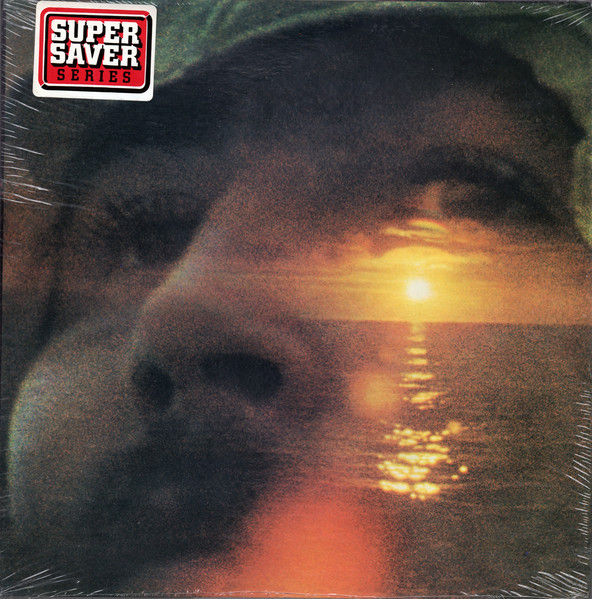
[Also, whatever you do, don’t buy the Super Saver pressing of David Crosby’s debut like the one you see pictured, assuming you want to hear the album sound the way it should. Original only, and the right one of course.]

We ran across a website years ago that confirmed our worst prejudices regarding audiophiles and their apparent desire to rely on gurus such as Harry Pearson to tell them which recordings sound good and which don’t.

This flies in the face of everything we stand for here at Better Records.

Since no two records sound the same, a list of so-called Super Discs is practically meaningless.

“Practically meaningless” hits the nail right on the head as far as we are concerned.

Picture yourself standing in your local record store with a record in your hands, one you happen to know is on the TAS List. This knowledge makes the record slightly more likely to sound better than any other record you might have randomly picked up in the store. Insignificantly, trivially more likely. In other words, as a practical matter, not all that much more likely.

Why is this? Three reasons:

  1. Many Super Discs are not on the TAS List;
  2. Some of the records on the TAS List are not deserving of Super Disc status; and most importantly,
  3. Most pressings of titles on the TAS List don’t sound especially good — only the right ones do. (I pictured the David Crosby album you see above with the cover you definitely don’t want in order to hammer home that point.)

But that’s not even the point. Ask yourself this:

Why on earth would anyone want to collect the records on The TAS List, when most of those records contain music that appeals to a very small group of people not named Harry Pearson?

The purpose of having an audiophile quality music system is that it allows you to hear your favorite music sound better than it would otherwise sound.

It’s not for playing someone else’s favorite records. It’s for playing your favorite records.

This is why we do our Hot Stamper shootouts for records nobody in his right mind would think of doing. Sergio Mendes? Zuma? Toulouse Street? You’ve got to be kidding.

No, we’re not. We love those albums. We sincerely want to find great sounding copies of them for our customers who love them too. 

Nobody else on the planet seems capable (or interested) in doing the kind of work it takes to find superior pressings of these albums, so if we don’t do it, who will?

But I digress. The website we ran across is no longer active.

Had you gone there back in the day, the page you would have seen first is a list of Marty’s Audiophile Vinyl Collection, which he introduces this way:

I have been a reader of The Absolute Sound since issue 33, (1982) one of the great journeys of my life. (I still have those old issues.) I was always an avid follower of the “Super disc list” that Harry Pearson had put together, a “Holy scripture” that I followed in earnest. I have amassed many of those titles knowing full well that I would be rewarded by sonic treats they lay ahead.

Thanks Harry !!

Holy scripture? Sonic treats? I think I just threw up in my mouth.

What followed was the TAS List, in all its vainglory, with Marty’s links to the copies he has been “fortunate” enough to acquire.

Just for fun you might have wanted to click on the Rock & Pop section. Here you would have found some of the worst sounding audiophile pressings ever made.

Mobile Fidelity Magical Mystery Tour?

Abbey Road and Rubber Soul on Japanese vinyl?

This is some real garbage. 

The more I browsed, the more I had the feeling that my head was going to explode. Records like these positively disgust me. They pretend to be audiophile records, when in fact they universally sound phony and wrong. They fool audiophiles easily enough, that’s pretty clear, but any music lover would recognize their junky qualities in a heartbeat.

Here’s the Kicker

If you’ve been reading our commentaries over the years, you know how mercilessly we bash musically-empty “audiophile” pressings. When you own dead-as-a-doornail-sounding audio equipment (the kind most audiophile equipment dealers have been selling as long as I have been around) or play musically inert LPs like Dafos, you have no reason to come home and turn on your stereo. Where is the enjoyment? Where is the emotional satisfaction? How much fun can it be to play somebody else’s favorite records?

So imagine my joy, my positive glee when I came to another page, which said:

“Alas, it is true… I am selling my entire collection of records!”

(That “Alas” is priceless, no?)

OF COURSE YOU ARE. You don’t have good records. You have what Harry and other audiophiles told you were good records. But they’re not. They are (often) Audiophile Bullshit records masquerading as good sounding records with music worth listening to.

And people into Audiophile Bullshit tend to get out of this hobby, or at least the record side of it, because there is very little musical satisfaction to be had by playing these kinds of LPs.

(more…)

Diamonds and Rust – Another TAS Listed Anadisq Disaster

Hot Stamper Pressings of the Music of Joan Baez Available Now

Mobile Fidelity released their version of Diamonds and Rust on Anadisq in 1995, and if you want to hear a pressing that’s not murky, compressed and opaque, you would be wise to avoid their Heavy Vinyl Half-Speed.

Somehow it ended up on the TAS Super Disc List, but we could find nothing “super” about it. We felt it more properly belonged on our list of records that have no business being called Super Discs.

It was a real muckfest, as was to be expected from a record mastered by this awful label during the Anadisq era, the darkest chapter in the disgraceful history of Mobile Fidelity, which, considering the consistently dismal quality of their output, is really saying something.

Ken Lee Strikes Again

Many of the worst of them were mastered by a Mr. Ken Lee. If you happen to come across a record in a store with his name in the credits, or his initials in the deadwax, you are best advised to drop it back in the bin and keep moving. Anything else is just asking for trouble.

To be fair, MoFi made some reasonably good sounding records too. For those of you whose budget is on the limited side, if you find an affordable copy of any of these MoFis, you are probably not wasting your money.

Our advice for the longest time has been that, while you are actively improving your stereo, room and setup, the best way to use your remastered audiophile pressings is as stopgaps and benchmarks. As you make more and more progress, eventually you will find the vintage pressing that can show you what your audiophile pressings don’t do well, or at the very least, not as well as they should.

They were falling short in many ways for all the years you’d owned them, but until you improved your playback, those problems were hidden from you.

As your stereo improves, you can actually chart your success by how many of these kinds of records you are able to eliminate from your collection. Once you can count the number of modern reissues you still own on one or at most two hands, there is a good chance you have reached a much higher level of playback quality.

Although I had a long way to go in this hobby in the early days of my audiophile record business, even then I could tell how bad the Anadisq series that Mobile Fidelity released in the 90s was. They produced one awful sounding record after another, with not a single winner that I knew of. I sold them — my bad, an ethical lapse I must apologize for — but I sure never recommended them or had anything good to say about them.

The typical album MoFi remastered on Anadisq suffered from a great many of the laundry list of shortcomings you see below.

If you want to avoid records with these faults — and you should — we advise you to avoid any of the records that are linked to here.

We play mediocre-to-bad sounding pressings so that you don’t have to, a public service from your record loving friends at Better Records.

Is this the worst sounding pressing of Diamonds and Rust ever made?

That’s hard to say. But it is the worst sounding version of the album we’ve ever played, and that should be fair warning for any audiophile contemplating spending money on this kind of trash.


Further Reading

If you are still buying these remastered pressings, making the same mistakes that I was making before I knew better, take the advice of some of our customers and stop throwing your money away on Heavy Vinyl and Half-Speed mastered LPs.

At the very least let us send you a Hot Stamper pressing — of any album you choose — that can show you what is lacking on your copy of the album.

And if for some reason you disagree with us that our record sounds better than yours, we will happily give you all your money back and wish you the very best.

If Only I Could Remember My Name – Fairly Consistent Differences from Side to Side

More of the Music of David Crosby

Those of you who’ve played a sufficient number of copies of the album surely know that side one has a marked tendency to be darker and duller than side two.

Finding a good side one is five times harder than finding a good side two. If your copy sounds recessed and lacks extension up top, don’t feel bad. Most of them do.

By the way, the first track has that “home recording” sound and always sounds weak compared to the rest of this album. Don’t expect any wonders. As a wannabe hit single, peaking at #95 on the charts, it may even be sourced here from a dub of the real master tape. That shit happens.

Your Reward Awaits You

As you may have read elsewhere on the site, records like this are the reward for owning the right stereo equipment and having it properly tweaked. There is no way in the world I could have played this album 20 years ago remotely as well as I can now. It only makes me appreciate the music even more.

(more…)

Joan Baez on Nautilus – The Half-Speed that Beats Most Pressings

Hot Stamper Pressings of the Music of Joan Baez Available Now

Sonic Grade: B+

This review is from many years ago, at least ten I would think, so take it for what it’s worth.

One of the best Half Speed mastered records we have ever played.

In our recent shootout we were shocked — shocked — to hear how good our old copy of Diamonds and Rust on Nautilus sounded head to head against some of the best pressings we could find.

If I hadn’t heard it with my own two ears, I wouldn’t have believed it.  (more…)