- With two STUNNING Shootout Winning Triple Plus (A+++) sides, this 60s Gold Label Prestige Mono pressing is certainly as good a copy as we have ever heard
- An especially good sounding recording and one that we rarely have on the site, and copies in true mono are the rarest of them all
- The sound is everything that’s good about Rudy Van Gelder‘s recordings – it’s present, spacious, full-bodied, Tubey Magical, dynamic and, most importantly, alive
- Need I even mention have completely this Hot Stamper pressing will obliterate any and all Heavy Vinyl contenders you may have heard? No? OK, good, I won’t mention it
- If the drum opening of “St. Thomas” doesn’t do it for you, I don’t know what will
- Marks in the vinyl are sometimes the nature of the beast with these vintage LPs – there simply is no way around them if the superior sound of vintage analog is important to you
- 5 stars: “Sonny Rollins recorded many memorable sessions during 1954-1958, but Saxophone Colossus is arguably his finest all-around set… Essential music[.]”
- This is a Must Own jazz album from 1957 that belongs in every jazz-loving audiophile’s collection
Mono=Best
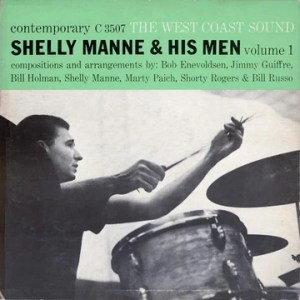
Shelly Manne & His Men – The West Coast Sound, Vol. 1
More Shelly Manne
- This early MONO pressing was doing practically everything right, with both sides earning INCREDIBLE Shootout Winning Triple Plus (A+++) grades or close to them
- The first track here is by far the best sounding — it’s amazing and the perfect illustration of just how good 1956 mono sound can be if you know what you are doing
- The sound may be a bit dated but the horns are enchantingly sweet and Tubey Magical, with solos that show off the jazz chops of “His Men” about as well as any Manne and His Men album ever has
- Tube mastering is essential for this recording – without vintage tubes in the chain, you end up with the kind of modern sound that the average OJC pressing suffers from (this is especially noticeable on side two of the OJC pressings we played, which were mostly awful)
- Contemporary in 1956 was making some awfully good jazz records, with room-filling, natural and realistic mono sound, the kind of sound that still holds up today and doesn’t need a lot of “mastering help” to do it
- Good luck finding quieter early copies of this title — we sure couldn’t do it, not with top quality sound anyway
- 5 stars: “The music has plenty of variety yet defines the era… Highly recommended and proof (if any is really needed) that West Coast jazz was far from bloodless.”
- If you’re a fan of West Coast Jazz, this is a Top Title from 1956, and one that certainly belongs in any right-thinking audiophile’s collection.
Sonny Rollins – Taking Care Of Business (Work Time, Tenor Madness and Tour de Force)
More of the Music of Sonny Rollins
- Taking Care Of Business returns to the site for only the second time in close to two and a half years, here with roughly Nearly Triple Plus (A++ to A+++) grades all FOUR sides of these vintage Prestige pressings – just shy of our Shootout Winner (side three actually won the shootout)
- The complete Tenor Madness album is found here, with big, full-bodied, MONO jazz sound at its best, courtesy of the great one, Rudy Van Gelder
- This is what classic 50s jazz is supposed to sound like – they knew how to do these kinds of records 70+ years ago, and those mastering skills are in short supply nowadays, if not downright extinct
- The transfers from 1978 by David Turner are in tune with the sound of these recordings – there’s not a trace of phony EQ on this entire record
- “Tenor Madness was the recording that, once and for all, established Newk as one of the premier tenor saxophonists, an accolade that in retrospect, has continued through six full decades and gives an indication why a young Rollins was so well liked, as his fluency, whimsical nature, and solid construct of melodies and solos gave him the title of the next Coleman Hawkins or Lester Young of mainstream jazz.”
This Two-Fer includes all of Tenor Madness and most of Work Time and Tour De Force.
Top jazz players such as Ray Bryant, John Coltrane, Red Garland, Kenny Drew, Max Roach and Paul Chambers can be heard on the album.
If you want all the tubey magic of the earlier pressings, a top quality pressing of the real Tenor Madness album on Prestige is going to give you more of that sound. David Turner’s mastering setup in the 70s has a healthy dose of tubes, but it can’t compete in that area with the All Tube cutting systems that were making records in the 50s and 60s.
Without one of those early pressing around to compare, we don’t think you’re going to feel you are missing out on anything in the sound with this killer copy.
And where can you find an early Prestige pressing with audiophile playing surfaces like these?
Lee Konitz With Warne Marsh in 1955
More Titles that Sound Better in Mono

- Outstanding MONO sound throughout this reissue copy of Lee Konitz with Warne Marsh (the first to hit the site in years), with both sides earning solid Double Plus (A++) grades or close to them
- This side one is remarkably spacious and three-dimensional, as well as relaxed and full-bodied, and side two is not far behind in all those areas
- If you want to hear the Tubey Magic, size and energy of this wonderful session from 1955 – originally recorded by Tom Dowd and expertly remastered by George Piros – this pressing will let you do that
- Our most recent shootout was a tough one – our top copy had too many issues to make it to the site, as did our only second-tier copy with Super Hot stampers on both sides
- Those of you looking for top quality sound may have to wait for a while, especially if it takes us as long to get our next shootout going as it did this last one
- 4 stars: “Altoist Lee Konitz and tenor-saxophonist Warne Marsh always made for a perfect team. Even by the mid-50s when they were not as influenced by Lennie Tristano as previously (particularly Konitz), their long melodic lines and unusual tones caused them to stand out from the crowd. This set is worth searching for, as are all of the Konitz-Marsh collaborations.”
- This is one of those records that we’ve “discovered” with audiophile quality sound — until we came along, who knew the album could sound this good? The originals are godawful.
The 1955 mono sound by Tom Dowd is Demo Disc quality. The horns are breathy and clear, yet full and rich as can be. There may be a good reason that this pressing sounds as good as it does: it was remastered by one of the greatest mastering engineers of all time, George Piros.
Tom Dowd is the original recording engineer, and this one album should be all the proof you need that when it comes to jazz in mono, the guy is hard to beat. Rock in stereo, there his record is quite a bit more spotty (see, or better yet, listen to Cream, The Young Rascals, Delaney and Bonnie and too many others to list).
Mel Torme – …Loves Fred Astaire aka …Sings Fred Astaire
More Pop and Jazz Vocal Recordings

- Torme’s 1957 release, here with solid Double Plus (A++) sound of BETTER throughout this vintage 70s Bethlehem reissue pressing
- Turn it up and The Velvet Fog will be standing right between your speakers, putting his heart and soul into these American standards
- Lovely richness and warmth, you may just find yourself using it as an analog Demo Disc – Mel is in his prime and magnificent throughout
- 5 stars: “Featuring an artist at the peak of his ability and talent, a collection of top-drawer songs from the best pop composers ever, and a swinging ten-piece that forms the perfect accompaniment, Sings Fred Astaire is one of the best up-tempo vocal albums ever recorded.”

The notes for the original pressing we played can be seen above. We’ve played them before with similar results, so I doubt we will be buying them in the future.
It’s not a bad sounding pressing — with grades of 1.5+ on both sides, it fits comfortably in our section for good, not great sounding LPs — but the right reissues from the 70s are a big step up in class sonically.
They represent yet another example of a vintage reissue — accent on the word “vintage” — handily beating the early pressings.
There are a number of budget reissues of vocal music with excellent sound that we’ve discovered over the years, and some of them, counterintuitively with respect to the conventional audiophile record collecting dogma from which many in our hobby suffer, are the best sounding versions that we know of.
What the Best Sides Of …Sings Fred Astaire aka …Loves Fred Astaire Have To Offer Is Not Hard To Hear
- The biggest, most immediate staging in the largest acoustic space
- The most Tubey Magic, without which you have almost nothing. CDs give you clean and clear. Only the best vintage vinyl pressings offer the kind of Tubey Magic that was on the tapes in 1957
- Tight, note-like, rich, full-bodied bass, with the correct amount of weight down low
- Natural tonality in the midrange — with all the instruments having the correct timbre
- Transparency and resolution, critical to hearing into the three-dimensional studio space
No doubt there’s more but we hope that should do for now. Playing the record is the only way to hear all of the qualities we discuss above, and playing the best pressings against a pile of other copies under rigorously controlled conditions is the only way to find a pressing that sounds as good as this one does.
Donald Byrd – House of Byrd
More Donald Byrd
- Two rare Donald Byrd albums in one, here with superb Double Plus (A++) grades on all FOUR sides
- The Tubey Magic is fully intact, making these two albums sound just the way a pair of classic All Tube 1956 Rudy Van Gelder jazz albums should
- Composed of two superb LPs – 2 Trumpets and The Young Bloods – these wonderful MONO pressings capture some of Byrd’s best music and with top quality sound
- “Art and Donald are in fine form, and if there is any competition it serves only to increase the musical yield.”
- “… These blowing sessions (typical of Prestige’s albums of the 1950s) have their enjoyable moments with Farmer and Woods taking overall solo honors.”
This reissue is spacious, open, transparent, rich and sweet. It’s yet another remarkable disc from the Golden Age of Vacuum Tube Recording Technology, with the added benefit of mastering using the more modern cutting equipment of the ’70s in this case. We are of course here referring to the good modern mastering of 40+ years ago, not the generally opaque, veiled and lifeless mastering so common today.
The combination of old and new works wonders on this title as you will surely hear for yourself on both of these superb sides.
We were impressed with the fact that these pressings excel in so many areas of reproduction. What was odd about it — odd to most audiophiles but not necessarily to us — was just how rich and Tubey Magical the reissue can be on the right pressing.
This leads me to think that most of the natural, full-bodied, lively, clear, rich sound of the recording was still on the tape decades later, and that all that was needed to get that vintage sound on to a record was simply to thread up the tape on the right machine and hit play.
The fact that practically nobody seems to be able to make a record nowadays that sounds remotely this good tells me that I’m wrong to think that such an approach tends to work, if our experience with hundreds of mediocre Heavy Vinyl reissues is relevant.
Joan Baez – Self-Titled in Mono
More Pure Folk Recordings

- Excellent sound for Baez’s debut album, with both sides of this early MONO Vanguard pressing earning Double Plus (A++) grades
- Both of these sides boast glorious All Tube chain recording quality that will be very hard to beat
- One of Joan Baez’s best sounding albums in our experience, shockingly free of artificiality – play it against your favorite female vocal album to hear the difference
- A TAS list Super Disc that actually deserves to be on a Super Disc list, how about that
- Problems in the vinyl are sometimes the nature of the beast with these early pressings, but once you hear just how superb sounding this copy is, you might be inclined, as we were, to stop counting ticks and pops and just be swept away by the music
- 140 weeks on the charts and Five Stars on AMG: “…a brace of traditional songs (most notably ‘East Virginia’ and ‘Mary Hamilton’) with an urgency and sincerity that makes the listener feel as though they were being sung for the first time…”
This former member of the TAS list is the kind of recording that has everything going for it: Golden Age equipment in a live acoustic with a simple arrangement for voice and guitar (or two).
The voice and the material come together nicely. If I were to recommend only one Joan Baez record it would surely have to be this one. Diamonds and Rust is a nice pop album but I think if you go back and play it today you will find that it sounds somewhat dated. Good folk tunes like the ones found on this album, however, never seem to go out of style.
The record sounds like a live demo session because that is exactly what it is:
In 1983 Baez described the making of the album to Rolling Stone’s Kurt Loder:”…It took four days. We recorded it in the ballroom of some hotel in New York, way up by the river. We could use the room every day except Tuesday, because they played Bingo there on Tuesdays. It was just me on this filthy rug. There were two microphones, one for the voice and one for the guitar. I just did my set. It was probably all I knew how to do at that point. I did ‘Mary Hamilton’ once and that was it…That’s the way we made ’em in the old days. As long as a dog didn’t run through the room or something, you had it…”
Miles Davis – Milestones
More Miles Davis
- Milestones appears on the site for only the second time ever, here with solid Double Plus (A++) sound or close to it throughout this vintage MONO 2-Eye pressing – exceptionally quiet vinyl too
- Huge amounts of three-dimensional space and ambience, along with boatloads of Tubey Magic (particularly on side two) – here’s a 30th Street recording from 1958 that demonstrates just how good Columbia’s engineers were back then
- Davis partners here with jazz greats, including John Coltrane, Cannonball Adderley and others
- Although the right 6-Eye mono originals will always win our shootouts, the 360 mono reissues still sound quite good to us, just not as good
- And don’t waste your money on most of the copies in clean enough condition to please an audiophile, meaning the reprocessed stereo pressings — they’re awful
- 5 stars: “What is immediately noticeable upon listening to Miles Davis’ classic first – and only – album with his original sextet is how deep the blues presence is on it. Though it’s true that the album’s title cut is rightfully credited with introducing modalism into jazz, and defining Davis’ music for years to come, it is the sole selection of its kind on the record. The rest is all blues in any flavor you wish you call your own.”
The New Miles Davis Quintet – Miles
More Miles Davis
- An excellent Prestige MONO reissue with solid Double Plus (A++) sound or close to it from the first note to the last – exceptionally quiet vinyl too
- If you want to hear a healthy dose of the Tubey Magic, size and energy of this wonderful session from 1956 – recorded by none other than Rudy Van Gelder – this pressing will let you do that
- “…Coltrane’s restless, turbulent lines show how Davis had finally found his perfect foil, much as the trumpeter’s introspective lyricism complemented Charlie Parker’s harmonic flights.”
Thelonious Monk / Brilliant Corners
More Thelonious Monk
More Jazz Recordings Featuring the Piano
- Boasting solid Double Plus (A++) grades or close to them from start to finish, this vintage MONO recording pressed on OJC vinyl was giving us the sound we were looking for on Monk’s 1957 release – fairly quiet vinyl too
- Rich, full-bodied and present yet still clear and spacious (particularly on side one) – we guarantee this copy sounds better than any pressing you’ve heard, and should beat the pricey originals hands down
- With masterful horn playing from Sonny Rollins and Clark Terry, and a rhythm section that can actually keep up with Monk – made up of Max Roach, Oscar Pettiford and Paul Chambers – this is a Must Own for any music loving audiophile
- 5 stars: “Brilliant Corners may well be considered the alpha and omega of post-World War II American jazz. No serious jazz collection should be without it.”
- If you’re a fan of Mr. Monk, this All Tube Recording from 1957 belongs in your collection.
- We’ve recently compiled a list of records we think every audiophile should get to know better, along the lines of “the 1001 records you need to hear before you die,” but with the accent on the joy these amazing audiophile-quality recordings can bring to your life. Brilliant Corners is a good example of a record most audiophiles probably don’t know well but would benefit from getting to know better
If you’re looking to demonstrate just how good a 1957 All Tube Analog recording can be, this superb copy should be just the record for you. Talk about Tubey Magic! The liquidity of the sound here is positively uncanny. This is vintage analog at its best, so full-bodied and relaxed you’ll wonder how it ever came to be that anyone seriously contemplated trying to improve it.
No recordings will ever be made like this again, and no CD will ever capture what is in the grooves of this record. There is of course a CD of the album, but those of us in possession of a working turntable could care less.