Alive Orchestral

These are records that really come to life on big speakers playing at loud levels.

They cannot be properly reproduced using small drivers, small speakers or screens, and they won’t sound the way they should unless the volume is up good and loud.

Leonard Bernstein – West Side Story (Original Soundtrack)

More of the music of Leonard Bernstein (1918-1990)

More Soundtrack Albums

  • You’ll find INCREDIBLE Shootout Winning Triple Plus (A+++) grades or close to them on both sides of this original Columbia 6-Eye Stereo pressing
  • Spacious, rich and smooth – only vintage analog seems capable of reproducing all three of these qualities without sacrificing resolution, staging, imaging or presence
  • Tonality is the hardest thing to get right on this album, and here it is right on the money, because if it were not, it would not have won the shootout
  • For those of you who like to do your own shootouts, good luck, you will need a lot of originals to find one that sounds as good as this one does
  • The biggest selling album of the ’60s – 54 weeks at Number One (!)
  • Marks and problems in the vinyl are sometimes the nature of the beast with these Classic Rock records – there simply is no way around them if the superior sound of vintage analog is important to you
  • 5 stars: “The soundtrack of the West Side Story film is deservedly one of the most popular soundtrack recordings of all time, and one of the relatively few to have attained long-term popularity beyond a specialized soundtrack/theatrical musical audience.”

This album is at least five times more common in mono than it is in stereo, and finding enough clean early stereo pressings takes us years nowadays.

(more…)

Respighi / Pines of Rome – Our Favorite for Performance and Sound

More Music Conducted by Fritz Reiner

  • This Shaded Dog pressing of Reiners’s excellent 1960 recording had the glorious Living Stereo sound we were looking for
  • It’s also fairly quiet at Mint Minus Minus, a grade that even our most well-cared-for vintage classical titles have trouble playing at
  • There were only three performances with audiophile quality sound in our shootout, and the Shaded Dog pressings not only had the best performances, but the sound that the team of Mohr/Layton managed to achieve was second to none
  • In other words, Harry was right to put this on his TAS Super Disc list – it really is a super disc
  • If you know anything about these works, you know that have tons of top and bottom end, and it is the rare pressing that can capture both
  • The texture and harmonic overtones of the Living Stereo strings are near perfection – as we listened we became completely immersed in the music on the record, transfixed by the remarkable virtuosity Reiner and the CSO brought to these difficult and demanding works so many years ago
  • There are roughly 150 orchestral recordings that we think offer the discriminating audiophile the best combination of superior performances with top quality soundThis record has moer than earned a place on that list.

This shootout has been at least five years in the making, and the case could be made that something like fifteen is closer to the truth. Around 2016 we surveyed the recordings of the work we had on hand — close to a dozen different performances, I think — and found them all wanting, save three: this one (which is still on the TAS list), a Reader’s Digest pressing with Kempe (our second favorite), and a London with Kertesz.

If a particular performance had any distortion or limitation problems in the higher frequencies, it was quickly rejected out of hand. Same with low end whomp and weight. On these works both are crucial.

No other pieces of music of which we are aware have so much going on up high and down low. This narrowed the field of potential Hot Stampers considerably. Great performances by top conductors could not get over these hurdles — high and low — time and time again.

For these reasons, it took us years to find the right recordings. We knew the Reiner would be hard to beat, but we kept trying record after record hoping that we could find one to wrest the crown away from what is widely considered the greatest recording of the works ever made.

We never did find something better. Our best Shaded Dog ended up winning the shootout. The best RCA pressings were doing everything right. There was plenty of top end, with virtually no harmonic distortion, and when I say plenty, I mean the right amount. Not many engineers managed to get all the highs correctly onto the tape, but Lewis Layton nailed it — in 1960!

So many recordings had screechy strings and horns. When the music would get loud — and both the Pines and the Fountains get very loud indeed, assuming the recording will let it — the sound would become unbearably harsh and unpleasant. This is the opposite of what should happen, and it was obvious that those recordings would not make it past the first round.

All three of the finalists could claim enthusiastic performances with powerful energy and top quality orchestral playing. Still, with the best copies going head to head with each other, Reiner had more of all the qualities we were looking for.

How did the famous 1S/1S pressing fare? No idea. I haven’t seen one in twenty years. It may be better than the White Hot copy we are offering here. I certainly would not make the mistake of saying what it sounds like without having played it. If someone has one and wants to send it to me to audition, I would love to give it a spin.

Some recordings we played lacked transparency, as well as the relaxed sense of involvement that eases one’s ability to be tricked into thinking “you (really) are there.”

The famous 1977 Maazel recording for Decca, which was on the TAS List for a long time, suffered from a bad case of multi-miking and the transparency issue mentioned above. What do you expect from 1977?

This is, of course, the knock on the Modern Heavy Vinyl Pressing — where is the transparency? The space? The three-dimensional depth? If your stereo can reproduce these qualities — a big if, since even as recently as twenty years ago mine could not — you should have given up on these opaque and airless frauds years ago.

(more…)

Tchaikovsky / 1812 Overture / Marche Slave / Alwyn

More of the music of Peter Ilyich Tchaikovsky (1840-1893)

More Orchestral Spectaculars

  • Outstanding sound from start to finish – this Decca recording of the 1812 from 1958 is the only one we know of that can show you the power of Live Music for this important work
  • This UK pressing is BIG, lively, clear, open and resolving of musical information like no copy of the 1812 you’ve heard
  • The two coupling pieces, Marche Slave and the Capriccio Italien, also have rich, powerful, weighty brass and lower strings
  • The most exciting and beautifully played 1812 we know of – we encourage you to compare this to the best orchestral recording in your collection and let the chips fall where they may
  •  When you hear how good this record sounds, you may have a hard time believing that it’s a budget reissue from 1970, but that’s precisely what it is. Even more extraordinary, the right copies are the ones that win shootouts
  • There are about 150 orchestral recordings we’ve awarded the honor of offering the Best Performances with the Highest Quality Sound, and this recording certainly deserve a place on that list.

There is some noticeable low frequency rumble under the quietest passages of the music for those of you with the big woofers to hear it!

The lower strings are rich and surrounded by lovely hall space. This is not a sound one hears on record often enough and it is glorious when a pressing as good as this one can help make that sound clear to you.

The string sections from top to bottom are shockingly rich and sweet — this pressing is yet another wonderful example of what the much-lauded Decca recording engineers (Kenneth Wilkinson in this case) were able to capture on analog tape all those years ago.

The 1958 master has been transferred brilliantly using “modern” cutting equipment (from 1970, not the low-rez junk they’re forced to make do with these days), giving you, the listener, sound that only the best of both worlds can offer.

(more…)

Stravinsky / The Rite of Spring – The Ultimate Recording of the Work

More of the music of Igor Stravinsky

  • An outstanding Shaded Dog pressing with superb sound from start to finish
  • Perhaps the greatest performance ever, certainly our favorite for performance and sound – this is not an easy piece of music to record judging by how many awful sounding versions exist — we should know, we played them
  • Monteux knows the work as well as anyone — he himself conducted the premier in 1913!
  • Mind boggling in its power to move the listener – a classic Decca Tree recording from 1956 by the master, Mr. Kenneth Wilkinson
  • There are about 150 orchestral recordings we’ve awarded the honor of having the best performances with top quality sound, and this recording certainly deserve a place on that list, close to the top I would think

It takes us three years — and a lot of hard work and a fair amount of luck — to get a shootout like this going.

The tympani and bass drum on this recording have few equals in our experience. This is the way HUGE and POWERFUL drums sound in concert. Those of you who go to classical concerts regularly will recognize that sound immediately. You probably also know that finding Golden Age recordings with this kind of deep bass is unusual to say the least.

The space and dynamic power of these sides are really something to hear on this groundbreaking work. Lush when quiet, clear and undistorted when loud, not many copies of Rite of Spring can do what these two sides can.

(more…)

Bernstein – The Music of Leonard Bernstein / Rogers

More music written or performed by Leonard Bernstein (1918-1990)

More Orchestral Spectaculars

  • A STUNNING pressing with Shootout Winning Triple Plus (A+++) sound or close to it throughout – a true Orchestral Demo Disc from 1970
  • As I write this, dollar for dollar this is probably the best sound for the money on the site
  • The Symphonic Dances from “West Side Story” sound superb here – big, rich and Tubey Magical
  • The performances are superb – energetic as befits most of the music, yet lyrical when the score calls for it
  • Vibrant orchestrations, top quality sound and fairly quiet surfaces combine for an astounding listening experience
  • Big speakers and loud levels are the sine qua non for the proper reproduction of this album
  • We’ve identified a number of Orchestral Demo Discs of superior quality, and they can be found here

This London Phase 4 British import has some of the most spectacular sound we have ever heard reproduced from disc. The sound is so BIG and BOLD that it handily puts to shame 95% or more of all the Golden Age Shaded Dogs, London Bluebacks, Mercury Living Presences, EMIs and Deccas we’ve ever played. If we had a Classical Top 100 list, this record would belong in the Top Ten, right near the top judging by what we heard when we played it.

If you have a system with the speed, power, and size to play this record properly (yes, you will need all three and a whole lot more), it’s hard to imagine it would not qualify as the best-sounding orchestral recording you’ve ever heard.

Demo Disc barely begins to do it justice. What sound. What music. What a record!

Side two is where the some of the best orchestral action can be found, and it is presented here with spectacular audio fidelity the likes of which you may have never experienced.

(more…)

Stravinsky / Song of the Nightingale / Ansermet

More of the Music of Stravinsky

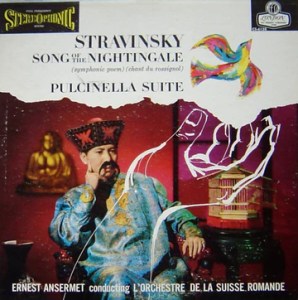
  • This vintage London stereo pressing of the L’Orchestre De La Suisse Romande‘s performance of Stravinsky’s symphonic poems earned STUNNING Shootout Winning Triple Plus (A+++) grades throughout
  • It’s also fairly quiet at Mint Minus Minus, a grade that even our most well-cared-for vintage classical titles have trouble playing at
  • Both of these sides of CS 6138 are BIGGER and RICHER than all the others we played – they’re clean and clear, tonally correct from top to bottom, and have all of the weight of the orchestra down low
  • Tons of energy, loads of detail and texture, superb transparency and excellent clarity – the very definition of demo disc sound
  • There are about 150 orchestral recordings we think offer the best performance coupled with the highest quality soundThis record has earned a place on that list.
  • More entries in our core collection of well recorded classical albums.

“Song of the Nightingale” is far more enjoyable in Ansermet’s hands than in Reiner’s or Dorati’s. The sound is significantly better on this pressing than on the Stereo Treasury, the RCA, and the Mercury versions.

Once past the obvious saturation that opens this recording, the sound is perfection. The percussion leaps off of this LP like it does with a good Direct To Disc recording.

The strength of this LP is “Song of the Nightingale.” The “Pulcinella Suite” never sounds as good. But what does?

(more…)

Borodin / Symphony No. 2 / Tchaikovsky / Francesca Da Rimini / Varviso

Hot Stamper Classical and Orchestral Imports on Decca & London

More Classical ‘Sleeper” Recordings We’ve Discovered with Demo Disc Sound

This London Whiteback pressing (CS 6578) has SHOCKINGLY GOOD sound; in many ways it deserves to be called a Demo Disc. It has at least one quality that one virtually never hears on an audiophile reissue: a smooth, natural top end. This record only sounds correct and “real” at louder volumes, in the same way that a live orchestra often sounds a bit lifeless in the quiet passages, only to get exciting, big and powerful when the score calls for it. For this to happen on record you need real dynamics and tonal neutrality.

We have not heard many audiophile reissues pull these things off either, just two of the reasons we no longer carry them.

And you can find all the other reasons on the site easily enough. We can’t stop talking about how disappointing Heavy Vinyl sounds to us now.

We graded both sides AT LEAST A++, a bit vague we admit; we just don’t have enough copies to know if the sound could get much better.

We played a good many vintage classical LPs that day and this was clearly one of the best sounding, so we feel this grade should be accurate, perhaps even conservative.

Credit for the sound must go to the Decca engineers, of course, but also to the hall that the L’Orchestre de la Suisse Romande played in, where so many of the great Ansermet recordings were made. This recording is from 1968. Ansermet died in 1969. One imagines that he was perhaps not able to conduct at this stage of his life and turned his wonderful orchestra and hall over to Varviso, a man better known for conducting operas at the time.

Side One – Borodin

At Least A++, with the kind of Golden Age sound that has rarely if ever been realized in the modern era. Big, wide and deep, with smooth, rich orchestral sound, these are the kind of records that let you forget the sound and just enjoy the music. The performance is taken a brisk pace, rarely a bad thing.

More reviews and commentaries for recordings of the Second Symphony.

Side Two – Tchaicovsky

At Least A++, and a lovely work that has never made it to the site in Hot Stamper form before, hint hint.

Rich, with deep bass, big stage, huge space and so 3-D, this is what we love about vintage recordings. And a great performance as well.

Khachaturian and Kabalevsky – Suites from Gayne and The Comedians / Golschmann

More Orchestral Spectaculars

  • With two Shootout Winning Triple Plus (A+++) sides, we guarantee you’ve never heard either of these works sound remotely as good as they do here
  • Yes, these are not the performances audiophiles have long known about from their inclusion on the TAS Super Disc List – these are actually BETTER performances, with better sound in almost every possible way
  • The Comedians in Living Stereo may have more hall, but the performance is lackluster and stilted compared to the energy and precision Golschmann brings to the work
  • The TAS List Khachaturian on London/Decca is a good record, but frankly it has never impressed us as much as it impressed HP, and now with this Vanguard you can hear just how good this exciting, glorious music can sound, with a performance that is every bit as good or better than the composer’s own

There is an interesting story behind this album.

I collected this title for a decade or more after hearing a really good sounding copy a long time ago, probably fifteen or twenty years ago now that I think about it.

I then proceeded to pick them up whenever I saw them in my local shops. I might have found one every two to three years in audiophile playing condition.

After having them cleaned, one day a few years back I sat down and played them all.

To my chagrin only one copy had the White Hot Stamper sound I knew was on the record, the copy I had played so long ago.

The others were good, probably Super Hot, but the real thing takes the recording to another level.

Only one had the right stampers, and all the rest of the also-rans had different stampers.

And when I went looking online I could find no copies with the stampers I knew to be the best.

This is that copy. There is nothing else like it. Not sure when we will ever see its like again. (more…)

Weber / Overtures / Ansermet

Decca and London Hot Stamper Pressings Available Now

GLORIOUS Super Hot Stamper sound or BETTER on side two of this original London Blueback UK pressing. Yes, it has the Decca / London sound we expect from Ansermet, the Suisse Romande orchestra, and the amazing Victoria Hall they recorded in — rich and spacious, with lovely texture to the strings.

But that’s not all. This record is exceptionally DYNAMIC. If you like listening to your records at realistic levels — the only way to fly to our way of thinking — then you had better watch your levels! The huge bottom end makes those dynamic passages a thrill to experience. Make sure your VTA is carefully adjusted — a big deal with us these days — and you will be in for the ride of your life.

Side Two

A++ to A+++. The only reason we did not award the full three pluses was that there is a touch of congestion in some of the loudest passages. Other than that there is practically nothing to fault with the sound! No smear, present and clear. (more…)