Electric Recording Company

Here Are Just a Few of the Signs You May Be a Crackpot

Skeptical Thinking Is the Foundation of Audio Advancement

Pete Hutchinson of The Electric Recording Company came up with a new idea that he believes can solve all the problems of the record world.

He wants people to understand that records don’t need to be mastered.

In order to make the best sounding pressings, you just buy the right old tube equipment, get it working, get hold of the master tapes, and then patiently and carefully transfer them as flatly as possible, with the least amount of meddling.

You see, in his world the meddling is the problem.

And, like all crackpots, he has a simple but wrong solution for a complicated problem.

If you think cooked food is the cause of human ailments, and raw food is the solution to the health problems of the modern world, you are a crackpot.

If you think the world is flat and not more or less spherical, you are a crackpot.

If you think you have an aura of energy surrounding you which no one can see but which is part of your true being, a sign of your true, spiritual self, you are a crackpot.

If you think that three-wheeled cars are the solution to transportation problems in the modern world, and you’ve built one in your garage, and now all you need are investors to get the word out, you are a crackpot.

And Your Point Is?

Pete Hutchinson is someone who fits nicely into this group, because he is also a crackpot. He is an audiophile crackpot.

His “solution“ to the problems of the sound of records may be novel in the sense that no one has ever tried it at scale, but there’s a reason no one would be foolish enough to transfer master tapes to vinyl without the benefit of equalization, level adjustment, compression and a host of the other interventions mastering engineers make use of.

Records some of those things — maybe not all of them, but certainly some of them — in order to sound their best.

The fact that he is unable to hear how bad his “unmastered” records sound — and we can lump him in with all his customers who appear to be equally hard of hearing — is both comical and pathetic in equal measure.

We heard how bad his pressings sound, and we wrote about their many faults here.

(more…)

The Personification of the Dunning-Kruger Effect

Presenting the poster boy for the Dunning-Kruger effect. Mr. Hutchison fancies himself an audiophile/mastering engineer.

Mind you, he’s a mastering engineer in the same sense that a person who makes mud pies is a piemaker.

I have not played any of his classical albums. I have in fact only played one title, a jazz record I happen to know well, and his remastered version is no better than the other records that get an F grade for sound and can currently be found in our bad sounding audiophile records section.

I will publish a review one of these days, but until then, I recommend you steer well clear of this man’s records.


Update 2024:

We’ve reviewed three of this man’s releases to date. None of them should be acceptable to anyone who describes himself as an audiophile. If you “love sound,” these titles should make you sick to your stomach.

We’ve reviewed ERC’s My Favorite Things. (For the benefit of our readers, this is what a good pressing should sound like.)

Robert Brook also reviewed the album, and you can find his review here. (He didn’t like it any more than we did.)

We’ve also reviewed ERC’s Forever Changes. (For the benefit of our readers, this is what a good pressing should sound like.)

And we’ve reviewed ERC’s Quiet Kenny. (Again, this is what a good pressing should sound like.)

(more…)

The Electric Recording Company Does My Favorite Things No Favors

Hot Stamper Pressings of the Music of John Coltrane Available Now

My Favorite Things happens to be one of our favorite Coltrane records, but we much prefer the stereo pressing of the album. (This is almost always the case when an album has been recorded in stereo, as My Favorite Things was in 1960, later released on Atlantic vinyl in 1961.)

We even tell you what to listen for to help you separate the best pressings from the merely good ones: the piano.

A solid, full-bodied, clear and powerful piano. As we focused on the sound of the instrument, we couldn’t help but notice how brilliant McCoy Tyner is. This may be John Coltrane’s album, but Tyner’s contribution is critically important to the success of My Favorite Things.

The engineering duties were handled by Tom Dowd (whose work you surely know well) and Phil Iehle, who happens to be the man who recorded some of Coltrane’s most iconic albums for Atlantic: Giant Steps (1960) and Coltrane Jazz (also in 1961).

Our last shootout for My Favorite Things was in 2018, not exactly yesterday, but in our defense let me just say that we have done plenty of other Coltrane albums from this period and feel as though we would have no trouble recognizing the sound his engineers were going for.

Unfortunately for those of you who have bought into the idea that the Electric Recording Company produces records with audiophile quality sound, you will find an utterly alien My Favorite Things, one nobody has ever heard before and one that no audiophile should want anything to do with.

Allow us to lay out the specifics of our complaints:

Notes for Side One

  • Big and full but smeary, flat and dull sax
  • No space or depth anywhere
  • Bloated bass
  • A mess

Notes for Side Two

  1. Side two is even worse
  2. Where is the breathy detail of the sax?

Electric Recording Company

We’ve played a few other ERC releases produced by the gentleman who owns The Electric Recording Company, a Mr. Pete Hutchison.

As you no doubt know, we would not be correct in using the term “mastered.” He does no mastering. He does “transferring.” He transfers the tapes to disc and puts them in nice jackets of his own design.

(more…)

Robert Brook Reviews the ERC Pressing of My Favorite Things

One of our good customers has a blog which he calls

A GUIDE FOR THE DEDICATED ANALOG AUDIOPHILE

Here is Robert’s review of ERC’s mono release of My Favorite Things. MFT happens to be one of our favorite Coltrane records, but we understandably prefer the stereo pressings, which is almost always the case when an album has been recorded in stereo, as My Favorite Things was in 1960.

ELECTRIC RECORDING COMPANY’s Reissue of MY FAVORITE THINGS

We even tell you what to listen for to help you separate the best pressings from the merely good ones: the piano.

A solid, full-bodied, clear and powerful piano. As we focused on the sound of the instrument, we couldn’t help but notice how brilliant McCoy Tyner is. This may be John Coltrane’s album, but Tyner’s contribution is critically important to the success of My Favorite Things.

The engineering duties were handled by Tom Dowd (whose work you surely know well) and Phil Iehle, who happens to be the man who recorded some of Coltrane’s most iconic albums for Atlantic: Giant Steps (1960) and Coltrane Jazz (also in 1961).

Electric Recording Company

We’ve played a number of ERC releases.

In the video embedded in the Washington Post article “In Search of the Perfect Sound,” at some point you can hear me exclaim “This guy makes mud pies!” while listening to the ERC pressing of Quiet Kenny.  I am happy to stand behind that judgment, and I think Robert Brook would agree with me about that.

Here is our review of ERC’s Forever Changes.

Our commentary making the case that these albums are aimed primarily at collectors and speculators, not audiophiles, can be found here.

We have now played the ERC pressing of My Favorite Things for ourselves and will be reviewing it soon.

Other Opinions

As much as we dislike these records, there are some music lovers who are quite pleased with them. A certain JLysaker wrote the following on discogs in 2021 about the ERC records a friend of his gave him (!) (edited for brevity).

I own 4 lps from this label. All sound amazing… The [Way] Out West pressing, stereo, is probably the best sounding LP I own… I also had an AP edition of one of the albums and the ERC pressing was hands down more natural sounding and imaged with greater clarity, and not just to my ears but to that of another buddy there for a listen.

Was it $500 better? I really doubt sonic differences translate into clear dollar amounts, but I would understand someone saying: ‘I’ll stick with damn good.’ Then again, some albums are dear to people and they want to hear it in the best possible fashion, and that probably won’t be through an original pressing — too rare, condition issues, and so forth as pointed out below. So they pop for one of these, as I did with My Favorite Things, which isn’t even a well recorded album.

And I am glad I did as Coltrane’s soprano never sounded better to me, and I have been listening to that recording for decades. So, from experience, these pressings are special. But acquiring them involves serious opportunity costs for anyone not rolling in the dough. And I doubt I ever would have sprung for one if an evil friend hadn’t given me some.

But here I am, feeling neither scammed nor screwed, and quite certain that those releasing these records are qualified to do so.

Others in the comments section were not so positive. Then again, nobody gave them the records and the price struck them as a bit high (median pricing for the album is currently $723.10).

We get similar complaints about our prices, but then again, we’re in the business of selling the best sounding pressings ever made, which is clearly not the case with ERC. They’re in the business of selling mud pies.

(more…)

Turning Master Tapes into Mud Pies – The Magic of the Electric Recording Company

Hot Stamper Pressings of Psychedelic Rock Recordings Available Now

““It’s magical what they’re doing, recreating these old records,” Fremer said as he swapped out more Electric Recording discs.”

Swapped them out? Anyone with an ounce of respect for Love’s music would have tossed them into the nearest trash bin.

We did a shootout for Love’s Forever Changes earlier this year, and it was our good luck to get hold of a copy of the Electric Recording Company’s pressing of the album in order to see how it would fare against our Gold Label Stereo original pressings.

As you can see from the notes, to say that we could hardly believe what we were hearing clearly understates the depth of our befuddlement.

We simply have no context for a record that sounds as bad as this record sounds. We’ve never heard anything like it, and we’ve played a lot of records in the 35 years we’ve been in business. After critically auditioning thousands upon thousands of pressings in our shootouts, all day every day for the last twenty years, we’ve worn out scores of cartridges and even our Triplanar tonearm.

But this is new ground for us. A quick recap:

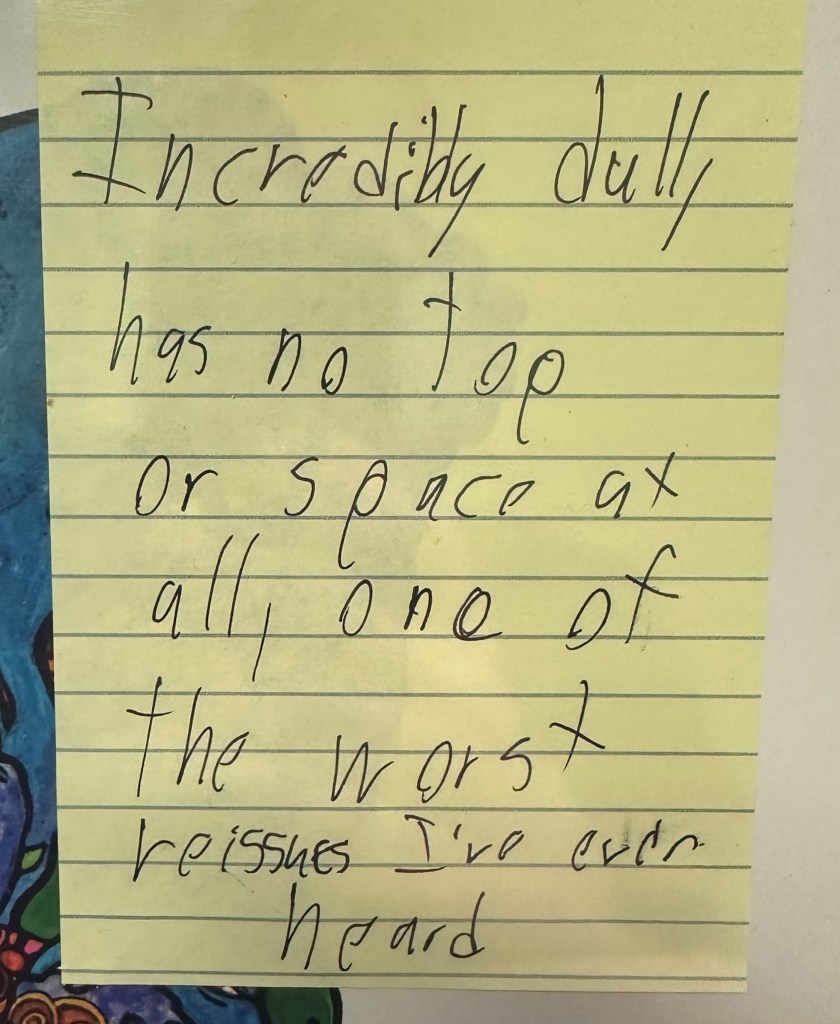
  • Incredibly dull,
  • Has no top or space at all,
  • One of the worst reissues I’ve ever heard.

You get the picture. What more needs be said? Last year I wrote the following:

Pete Hutchison of The Electric Recording Company makes some of the worst sounding records I have ever played in my life.

If you play me one of his awful records, and don’t tell me who made it, I can judge the record on its merits, the way we judge all records. We test records blindly for precisely this reason. We let the record tell us how well it was made, what it does right and wrong relative to other pressings of the same album, comparing apples to apples.

His records tell me he loves the sound of the murkiest, muddiest vintage tube equipment ever made, and wants every record he produces to have that sound.

In my book that is an egregious case of My-Fi, not Hi-Fi. We wrote about it here.

It’s astonishing to me that anyone takes this guy seriously.

In the Washington Post video, we did a little comparison on camera for two pressings of Quiet Kenny, a record I will have more to say about in Part Two of this commentary. Here is Geoff Edgers’ description in the article of how it all went down.

(more…)

Every Day Is Record Store Day at The Electric Recording Company

Our Review of The Electric Recording Company’s Release of Forever Changes

Recently we took the Electric Recording Company to task for their botched mastering of Love’s Forever Changes.

At ERC they like to point out they are doing things differently, and boy are they ever. They do not remaster the tapes, they simply transfer the tapes onto disc without any interference from equalizers, compressors and the like.

Naturally, they seem less willing to discuss the sludge-like sound their vintage tube cutting amplifiers bring to every tape that’s forced to go through them before it gets to the cutting stylus. I hope to discuss this issue in more depth down the road.

What Is It, Exactly

For now, let’s try to get to the heart of what this pressing is.

This is not an audiophile record, properly understood.

No member of the audiophile community, those lovers of sound you’ve heard so much about, could possibly put up with a record that sounds as bad as this one does.

Having played two of their releases and knowing how all of them are made, I would be surprised if any of this company’s records are any better than awful.

No, this is plain and simply a collectible.

It exists because it could be made as a very limited edition at a profit.

It exists because it could be made with exceptionally high quality packaging.

The vinyl inside the fancy packaging is only there to make sure that all the elements of a collectible release are accounted for.

All the value is tied up in the collector appeal of the release, none in the vinyl, because the vinyl is junk.

(more…)

A Kinder, Gentler Approach to Record Reviewing

Record Collecting for Audiophiles from A to Z

Allow me to respond to a comment left by a fellow named Ian Malone.

It was left in the comments section for the interview Steve Westman did with me.

He wrote:

Quite happy for you to promote your business Tom, but surely you are a better person than doing it in this way. I know that other people in the industry have said unkind things about you but you can rise above these insults.

My response:

I never say that the people making these modern records, as well as those reviewing them, are malicious or evil. I say they make or review bad sounding records and are simply misguided and, more than anything else, incompetent.

Am I being unkind? If Michael Bay makes one bad movie after another, are we unkind to point that out? I don’t know whether or not he is a bad person, but I do know that he is a bad filmmaker, and gets called out regularly for putting out a bad product.

Everyone understands that this is a matter of taste. If you always wished The Beatles albums had more bass, more compression and a smoother tonal balance overall, you can buy the new Heavy Vinyl pressings and get the sound you prefer on every title The Beatles ever released.

However, I hope you know that the sound I have just described does not exist on the master tapes.

I have no way of actually knowing that for a fact, but since no mastering engineer before 2014 had ever put that sound on an actual record, I think we can safely say that the evidence supports the idea that a completely “new sound” was specifically created for The Beatles when their catalog was remastered early in this century. [1]

A New Sound

Call it The New Beatles Sound. I am on record as not liking engineers who create a new sound for records that had perfectly good sound already. Those of us who do not like our Beatles album to have those qualities should not be buying these newly remastered versions.

We offer the consumer an alternative sound, and, since our Beatles Hot Stampers are far and away our best sellers, it seems our customers agree with us that they actually do sound better. Some come back, sure, but not many, and I don’t think anyone has ever said they liked the new pressings better, although I cannot rule out that possibility in the future, audiophiles being who they are.

In some ways we operate like Consumer Reports. Blender X is terrible at making margaritas and blender Y is good at making those delicious drinks. The company that makes bad blenders should be called to account. If there is a name attached to that company, then I guess we can say that that person who runs that company should learn how to make better blenders or find something else to do with his time.

(more…)