Labels We Love – Philips

The Dvorak Violin Concerto – Was Sound This Good Still Possible in 1980?

Hot Stamper Pressings of the Music of Dvorak Available Now

You’ll find amazing Hot Stamper sound on this exceptionally quiet Philips recording of the Dvorak Violin Concerto.

As well as a SUPERB performance from Salvatore Accardo, one that is certainly competitive with the best we have heard.

Yes, it was still possible to record classical music properly in 1980, though not many labels managed to pull it off.

(Londons from this era are especially opaque and airless. We find them as irritating and frustrating as most of the Heavy Vinyl releases being foisted on the audiophile public today.)

The orchestral passages are rich and sweet, the violin present, its harmonic colors gloriously intact. This is still ANALOG, with the better copies displaying much of the Tubey Magic of ’50s and ’60s vinyl without as much compressor distortion (the Achilles’ heel of so many of the great recordings from the Golden Era).

(more…)

Violin and Piano Concerto Recordings that Fall Apart

Hot Stamper Pressings Featuring the Violin Available Now

Hot Stamper Pressings of Piano Concerto Recordings Available Now

Many of the vintage orchestral recordings we’ve auditioned over the years did a good job of capturing the lead instrument in a concerto — for example, the piano or violin — but fell apart completely when the orchestra came in, with unacceptable levels of congestion and distortion.

Orchestras are hard to record. Pianos and violins, not so much.

Here are some titles that often have congestion problems when they get loud. If you play your orchestral recordings at moderate levels, you may not be as bothered by this problem as we are, because we do not have the luxury of listening at moderate levels.

We have to put the records through the ringer, and one of the ringers they must go through is they must sound right at loud levels, because live music gets loud, and it does it without getting distorted or congested.

Congestion and distortion are problems for practically all the titles you rarely see on our site, the vintage pressings of recordings by EMI, DG, Philips, Columbia and dozens of others.

We discussed the problem here in more detail.

Dvorak / Violin Concerto – A Killer Philips Recording

More of the Music of Antonin Dvorak

  • Stunning sound throughout this Philips import pressing of Dvorak’s Classical Masterpieces, with a Shootout Winning Triple Plus (A+++) side one mated to a solid Double Plus (A++) side two – exceptionally quiet vinyl too
  • The orchestral passages are rich and sweet, the violin present, its harmonics gloriously intact
  • We audiophiles are fortunate indeed that a violinist of Accardo’s skill and taste recorded this piece for Philips at a time when their recording technology was still capable of capturing the sound of his violin in rich, warm, sweet, clear analog
  • A superb performance from Salvatore Accardo, not only competitive with the best we have heard, but superior – we know of none better
  • These links will take you to some of the orchestral “sleeper” recordings we’ve discovered with Demo Disc sound

Yes, it was still possible to record classical music properly in 1980, though not many labels managed to pull it off. (Londons from this era are especially opaque and airless. We find them as irritating and frustrating as most of the Heavy Vinyl releases being foisted on the audiophile public today.)

This is still analog, with the better copies displaying much of the Tubey Magic of 50s and 60s vinyl without as much compressor distortion (the Achilles’ heel of so many of the great recordings from the Golden Era).

Accardo is an accomplished performer of the works of Paganini, but those recordings are on DG and we would not expect them to be of acceptable audio quality for our customers. We will investigate further of course, as Paganini’s works for violin are some of the most sublime in the repertoire.

(more…)

Liszt / Piano Concertos Nos. 1 and 2 / Kondrashin / Richter

More of the Music of Franz Liszt

  • A vintage Philips import pressing of these Classical Masterpieces that boasts two solid Double Plus (A++) sides, pressed on vinyl that’s as quiet as we’ve ever found
  • The finest Liszt 1st and 2nd Piano Concertos we know of for their performances, and unquestionably for sonics (when the sonics are this good)
  • The best pressings of this title are more like live music than any classical recording you own (outside of one of our Hot Stamper pressings, of course; those can be every bit as good) or your money back
  • So big, rich and transparent we guarantee you have never heard a better piano concerto recording

*NOTE: Unlike Concerto No. 1, The Second Piano Concerto opens very quietly, so there will likely never be a vintage pressing of the album that will get that opening to play like a CD. Expect to hear some random ticks, a small price to pay to hear this wonderful performance on top quality analog.

Richter and Kondrashin deliver the finest Liszt 1st & 2nd Piano Concertos I know of, musically, sonically and in every other way. Richter’s performance here is alternately energetic and lyrical, precisely as the work demands. The recording itself is explosively dynamic. The brass is unbelievably full, rich and powerful. You won’t find a better recording of this music anywhere, and this pressing just cannot be beat.

Big and rich (always a problem with piano recordings: you want to hear the percussive qualities of the instrument, but few copies can pull it off without sounding thin). We love the BIG, FAT, Tubey Magical sound of this recording! The piano is solid and powerful — like a real piano.

Huge amounts of hall space, weight and energy, this is DEMO DISC QUALITY SOUND by any standard. (more…)

Sorry, This Album of String Quartets Is Not As Good As We Thought

Hot Stamper Pressings of the Music of Claude Debussy Available Now

Hot Stamper Pressings of the Music of Maurice Ravel Available Now

UPDATE 2024

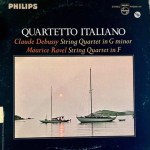
About ten years ago we were under the impression that the domestic Philips pressing you see pictured had exceptionally good sound, sound that would be difficult to beat.

Well, that just goes to show how little we knew about the sound of the various recordings of this music back then.

We needed to do a lot more homework, and the reason we started playing other recordings of these two string quartets is simply that the Philips record we liked so much was too hard to find on the domestic pressing.

The imports could be found, sure, but they sounded like a lot of Philips pressings — overly smooth, smeary, lifeless, recessed and veiled, like the Golden Imports Philips had made in the 70s. It was in those bad old days of the early 70s that Philips set about ruining the sound of phenomenally good Mercury master tapes. They should never be forgiven for it.

I bought one and fell in love with it, for both its music and its sound, a classic case of me not having any idea what I was missing.

How clueless was I? I was almost as clueless as the guy who thought the MoFi pressing of Star Wars and Close Encounters was a true audiophile Demo Disc. As foolish a MoFi fan as I was in the late-70s, even I knew was a piece of phony junk that record was.

Now there are dozens of outfits that make it their business to ruin phenomenally good master tapes by dint of their incompetent remastering, a story we never tire of telling.

Breaking Through

The key to our breakthrough was the rediscovery of a record we had played many years before, all the way back in 2005, and had simply lost track of in the ensuing years: LSC 2413. (It’s easy to lose track of rare Shaded Dogs. They’re not usually sitting in the bins of your local record store. Out of sight, out of mind.)

The best pressings of LSC 2413 are dramatically better sounding, and the performances are equal to or better than any we know.

Recently we finally got hold of another copy of the rare Philips pressing above and found to our dismay that the sound was not nearly as good as we remember it from our shootout years ago. The copy that came in was flat and badly lacked the presence and Tubey Magic of the Shaded Dog pressings we played of the RCA.

As the best of the RCA pressings demonstrate beyond all doubt, 1960 was a great year for classical and orchestral recordings. (What the shameful modern masterng engineers operating today do to such wonderful recordings is another thing altogether.)

(more…)

Handel / Water Music – Leppard

More of the Music of George Frederick Handel

  • An original Philips import pressing with KILLER Shootout Winning Triple Plus (A+++) sound or close to it from first note to last – exceptionally quiet vinyl too
  • This copy was simply bigger, more transparent, with more clarity and clearly layered depth to the orchestra than practically all others copies we played
  • Shockingly airy and warm, this is the kind of sound that makes it easy to fall in love with an oft-heard piece such as The Water Music
  • Note how far back the trumpets are in the hall, yet they are still clear, tonally correct and not smeared – that’s the sound one hears in a live performance (and too rarely on a record)
  • This is close to the best combination of performance and sound that we know of, and let me tell you, we’ve played an awful lot of pressing of this music over the last thirty years, none of which do what the better pressings of this recording can do
  • This recording should be part of any serious classical music collection. Others that belong in that category can be found here.
  • There are about 150 orchestral recordings we’ve found to offer the best performances with the finest in audiophile sound, and this record certainly deserve a place on that list.

The performance by the English Chamber Orchestra under the direction of Raymond Leppard is currently my favorite, owing in large part to the fact that it has the kind of sound I find the most natural and enjoyable.

In a way this may not be quite fair to other equally well-known, well-respected performances. We went through an elimination round for the work a while back, winnowing the recordings down to those that had the best sound, regardless of performance — perhaps some of the discarded records had even better performances than Leppard’s. At this late stage who can say?

We audiophiles want the music we play to sound its best, a requirement which more often than not involves compromises of one kind or another. We are happy to report that that does not appear to be the case with The Water Music (keeping in mind the caveat above). (more…)

Beethoven / Violin Concerto / Grumiaux

More of the music of Ludwig van Beethoven (1770-1827)

More Hot Stamper Pressings Featuring the Violin

The reproduction of the violin here is superb — harmonically rich, natural, clean, clear, resolving. What sets the truly killer pressings apart is the depth, width and three-dimensional quality of the sound, as well as the fact that they become less congested in the louder passages and don’t get shrill or blary. The best copies display a Tubey Magical richness — especially evident in the basses and celli — that is to die for.

Big space, a solid bottom, and plenty of dynamic energy are strongly in evidence throughout. Exceptional resolution, transparency, tremendous dynamics, a violin that is present and solid — this copy takes the sound of the recording right to the limits of what we thought possible from Philips.

As we listened, we became completely immersed in the music, transfixed by the remarkable virtuosity he brings to such a difficult and demanding work.

What to Listen For

This copy had very little smear on either the violin or the orchestra. Try to find a violin concerto record with no smear.

Let’s face it: records from every era more often than not have some smear and we can never really know what accounts for it. The key thing is to be able to recognize it for what it is. (We find modern records, especially those pressed at RTI, to be quite smeary as a rule. They also tend to be congested, blurry, thick, veiled, and ambience-challenged. For some reason most audiophiles — and the reviewers who write for them — rarely seem to notice these shortcomings.)

Of course, if your system itself has smear — practically every tube system I have ever heard has some smear, including the one I used to own — it becomes harder to hear smear on your records.

Our all transistor rig has no trouble showing it to us.

Keep in mind that one thing live music never has is smear of any kind. Live music is scompletely mear-free. It can be harmonically distorted, hard, edgy, thin, fat, dark, and all the rest, but one thing it never is, is smeary.

That is a shortcoming unique to the imperfect reproduction of music, and one for which many of the pressings we sell are downgraded.

(more…)

Elgar / Strauss – Enigma Variations / Don Juan / Haitink

More Classical and Orchestral Recordings

  • These two outstanding performances by Haitink and the London Phil (Enigma Variations) and the Concertgebouw Orchestra, Amsterdam (Don Juan) boast KILLER Shootout Winning Triple Plus (A+++) sound from start to finish
  • Both of these sides are doing everything right – they’re rich, clear, undistorted, open, spacious, and have depth and transparency to rival the best recordings you may have heard
  • You’d be hard-pressed to find a copy that’s this well-balanced, yet big and lively, with such wonderful clarity in the mids and highs

(more…)

Rachmaninoff / Three Symphonies / Waart – Reviewed in 2005

More of the music of Sergei Rachmaninoff (1873-1943)

Reviews and Commentaries for the Music of Rachmaninoff

Three Minty looking Philips Import LPs with EXCELLENT SOUND!

The sound is dark and rich. You may prefer it as I do to the famous Previn performances on EMI, which have that mid-hall, vague ’70s EMI sound. That sound never appealed to me. 

The performances are excellent as well. The second symphony belongs in any serious collection and you get a very good one in this box set. This set includes Rachmaninoff’s Symphonies 1-3 and ‘The Rock,’ Op. 7.


This is an Older Classical/Orchestral Review

Most of the older reviews you see are for records that did not go through the shootout process, the revolutionary approach to finding better sounding pressings we started developing in the early 2000s and have since turned into a veritable science.

We found the records you see in these older listings by cleaning and playing a pressing or two of the album, which we then described and priced based on how good the sound and surfaces were. (For out Hot Stamper listings, the Sonic Grades and Vinyl Playgrades are listed separately.)

We were often wrong back in those days, something we have no reason to hide. Audio equipment and record cleaning technologies have come a long way since those darker days, a subject we discuss here.

Currently, 99% (or more!) of the records we sell are cleaned, then auditioned under rigorously controlled conditions, up against a number of other pressings. We award them sonic grades, and then condition check them for surface noise.

(more…)

Debussy / La Mer / Haitink – Reviewed in 2011

The Music of Claude Debussy Available Now

This is an older review. When we revisited this title recently, we felt it was badly lacking in Tubey Magic, a real deal killer for us here at Better Records.

It’s a decent sounding record, not much more than that, but it does have a top performance. If you see one for cheap in the bins, pick it up and give it a spin.

We prefer Ansermet’s performances for Decca of both La Mer and Prelude to the Afternoon of a Faun.

Our review for the album from years ago can be seen below. As for other records we think we got wrong — we may change our minds again! — you can find more under the heading of Live and Learn.

(more…)