*Robert Brook’s Guide

Robert Brook’s Guide for the Dedicated Analog Audiophile

Robert Brook Has a Story to Tell on “The Skeptical Audiophiles”

More YouTube Videos (Including The Skeptical Audiophiles)

Robert and I have now started a YouTube channel. Its purpose is to help audiophiles gain a better understanding of analog records and the many difficulties one encounters when playing them. Here I speak from experience, as does Robert.

We felt that it would be worthwhile to briefly talk about our backstories, so that viewers could appreciate why we choose to call ourselves “Skeptical Audiophiles” in the first place. This is Episode 2. Episode 1 can be found here.

If you’re looking for a different take on the subjects we will be addressing with our new channel, we happily offer them for your viewing pleasure.

If you would like to know more about audio and records, please feel free to ask any questions you have in the comments section, or send them directly to me at tom@better-records.com. (The blog has hundreds of letters — from customers and critics alike — you may enjoy reading as well.)

One of the more popular pieces Robert has written recently was entitled: The Biggest Misconception about Modern Audiophile Records. We feel it is well worth reading.

Robert’s Approach

Robert has methodically and carefully — one might even say scientifically — approached the various problems he’s encountered in this hobby by doing the following:

(more…)

The Biggest Misconception about Modern Audiophile Records

Robert Brook runs a blog called The Broken Record, with a subtitle explaining that his blog is:

A GUIDE FOR THE DEDICATED ANALOG AUDIOPHILE

We know of none better, outside of our own humble attempt to enlighten that portion of the audiophile community who love hearing music reproduced with higher fidelity — and are willing to go the extra mile and pay the extra dollar to make that happen.

Here are Robert’s thoughts on the aforementioned misconception.

He begins:

I’ll save you the usual intro and get straight to the point. The biggest misconception about modern audiophile records is that advances in technology have rendered them sonically superior to the best vintage records, which they are not. In fact, they are rarely even competitive.

There. I said it. And just seeing those words on my screen I realize I’ve stepped right back into the same old trap with this tiresome topic. I say banana and you say “banauna.” I say vintage records sound better and you say modern audiophile reissues sound better. At best we must agree to disagree.

So maybe instead of diving right into this controversial topic I’ll start with a question. How do we change this conversation? How do we get out of the trap of this silly argument and actually make some headway towards a clearer understanding of what we’re actually debating?

To do that I think we need to acknowledge that the way a record sounds to us is extremely system dependent. I actually hate to say it because I wish it were not the case, but I can’t deny it is. Even small differences in systems can mean big differences in how those systems make a record sound.

Over the years that I’ve been making changes to my system, I’ve changed my mind about how much I like or don’t like the sound of many, many records. Even changes I thought would have little or no impact on how my records sound, did. If I had left my system as it was 10 years ago, or even 2 years ago, I’m certain I’d be singing the praises of records that I used to like a lot more than I do now. But I’m not satisfied to stay put. My system keeps getting better and better and which records have the best sound keeps getting easier to discern.

Meanwhile, it’s been ages since I played a heavy vinyl reissue and thought to myself “now that is a great sounding record.” The last one I can think of would be the UHQR of Steely Dan’s Can’t Buy A Thrill remastered by Bernie Grundman. When I played that record I liked it a lot, more than the vintage copy I had. But it wasn’t long before changes to my system had my vintage copy blowing the UHQR “out of the water,” to quote one banauna loving vinyl guy.

Robert tells a fascinating story, one that I myself have experienced many times over the years. I hope to have more comments to add soon.


Robert Brook Can Be a Guide

Robert has methodically and carefully — one might even say scientifically — approached the various problems he’s encountered in this hobby by doing the following:

(more…)

Zenith Error and Why You Should Care About It

Robert Brook runs a blog called The Broken Record, with a subtitle explaining that the aim of his blog is to serve as:

A GUIDE FOR THE DEDICATED ANALOG AUDIOPHILE

We know of none better, outside of our own humble attempt to enlighten that portion of the audiophile community who love hearing music reproduced with higher fidelity and are willing to go the extra mile to make that happen.

Here is Robert’s latest posting.

An excerpt:

Every so often I make a point of visiting the WAM Engineering website to check out J.R. Boisclair’s latest videos. J.R. is producing the most informative and useful content on turntable / tonearm setup I’ve run across, and as near as I can tell he’s at the cutting edge of advancements in analog transcription.

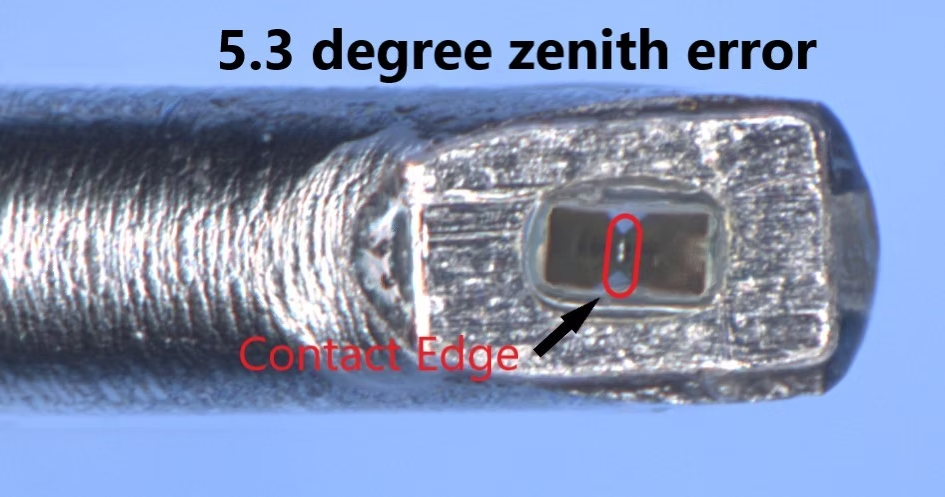
On my last visit to their website, I was reminded of a tonearm setup parameter that J.R. discusses at length but that myself and many other audiophiles are either unfamiliar with or know very little about – zenith error. Zenith error, also known as stylus yaw, refers to a manufacturing flaw that many cartridges suffer from where the stylus is not aligned precisely with the cantilever.

WAM Engineering offers a service using microscopy to analyze cartridges, and this has afforded them the opportunity to take a very close look at a fairly high number of a wide variety of cartridges. What they’ve learned doing this is that the majority of those fitted with fine-line contact styli, which are directional, have stylus yaw.

This flaw is not directly the fault of the cartridge manufacturers themselves. The cantilever assemblies that companies like Dynavector and Audio-Technica use to build their cartridges are made by other companies that specialize in making those assemblies. Dynavector, for instance, uses cantilever assemblies made by a company called Ogura. Audio-Technica buy theirs from Orbray, formerly Namiki.

From the standpoint of these manufacturers, this zenith error is not actually considered a flaw as it generally falls within their own manufacturing tolerances of 5 degrees. J.R. confirms in his video on zenith error that the average among the cartridges he’s analyzed is just 2.5 percent, well within that tolerance. But he also mentions that this error can in some cases reach above 17%.

After analysis, J.R. returns customer’s cartridges with shims that correct for VTA, SRA and azimuth, but he also provides us with the direction and the number of degrees by which our stylus is rotated off the axis of the cantilever. This way, with the help of a tool that WAM Engineering also sells called the WallyZenith, we can adjust for stylus yaw as part of our installation process.

We are in the process of testing this aspect of cartridge alignment and should be able to report our findings soon.

Until then we would encourage you to try adjusting the angle of the cartridge’s body in the headshell to see if any improvement is possible. My intuition is that it will be.

(more…)

Robert Brook Shoots Out Brilliant Corners

Robert Brook has a blog which he calls

A GUIDE FOR THE DEDICATED ANALOG AUDIOPHILE

Below you will find a link to the shootout Robert recently conducted for Thelonious Monk’s amazing Brilliant Corners album on OJC.

(more…)

Turntable Setup Guide Part 2: Dialing In Tracking Force By Ear

Robert Brook runs a blog called The Broken Record, with a subtitle explaining that the aim of his blog is to serve as:

A GUIDE FOR THE DEDICATED ANALOG AUDIOPHILE

We know of none better, outside of our own humble attempt to enlighten that portion of the audiophile community who love hearing music reproduced with the highest fidelity and are willing to go the extra mile to make that happen.

Below you will find a link to an article about turntable setup. I would have loved to write something along these lines myself, but never found the time to do it. Robert Brook took the job upon himself and has explained many aspects of it well, so if you would like to learn more about turntable setup, I encourage you to visit his blog and read more about it.

I do have some ideas of my own which I hope to be able to write about soon, but for now, check out what Robert has to say.

Turntable Setup Part 2: What To Do For EXCELLENT SOUND

Record Cleaning and Hearing the Gap

Robert Brook runs a blog called The Broken Record, with a subtitle explaining that the aim of his blog is to serve as:

A GUIDE FOR THE DEDICATED ANALOG AUDIOPHILE

Here is Robert’s latest posting.

What I’ve Learned About Record Cleaning

Robert gets right to the point here:

I’d say that the biggest misconception that I held about record cleaning previously was that it would not improve the bass. My thinking was that better cleaning would reveal more at the top end and upper midrange, but whatever bass was cut into the grooves was either there or it wasn’t, and cleaning those grooves better wasn’t going to bring it out.

This turned out to be completely wrong. Better cleaning makes it easier for our system to reveal what’s on our records, and this helps us hear more of what sits at the very back of the soundstage. These elements of the recording that reside further from our ears rely on an appropriate amount of bass to give them their correct size and weight. So when a record has more bass, it often has a bigger soundstage, and the performers will tend to sound more fleshed-out and have greater presence.

Robert gets his table and arm dialed in, then realizes:

I thought for a long while that the multi-step cleaning method I had developed using Walker Audio fluids was getting my records as clean as Better Records gets theirs. I had bought or borrowed quite a few Nearly White Hot and White Hot Stampers over the years, and then found and cleaned similar copies that, in several cases, equaled or even bettered the Hot Stampers. Or at least I thought they had.

With a new cartridge installed, Robert has an unexpected insight:

Finally I’d reached the full potential of my front end, and what was my reward? I could now hear that the records I’d cleaned with my method did not in fact sound as good as the ones the folks at Better Records had cleaned. I was forced to determine that the Hot Stampers had a level of transparency, top to bottom end extension and overall integration and cohesiveness that my other records lacked.

The differences Robert hears are not a mystery. They are the result of the way Robert cleans records and the number of copies he goes through to find “the one.”

Part of what makes our records sound better than the copies others own with the exact same stampers — when they do sound better, something that may not always be the case — is that even with the right machines and fluids and our step by step instructions, there is more to it than that.

There are some approaches to record cleaning that we use which we have never revealed to the public. We need our records to be a cut above, and the cleaning secrets we keep to ourselves make that not just a possibility, but a near certainty.

Robert points out that it took a lot of work to get to the point where it was no longer possible to ignore this reality. He asks how many other audiophiles have worked as hard and advanced as far. Would others be able to tell that the gap was real, that the difference between their best copy of a record and the one we sold them would be more than audible — that it would in fact be significant.

Not many is our answer, and it’s partly because of some other factually true aspects of record production, the kind that we take great pains to explain and then support with scientific evidence.

We may not know why records sound so different, but we are in a very good position to know that they clearly do.

(more…)

Robert Brook Says: No Azimuth? No Problem!

Robert Brook runs a blog called The Broken Record, with a subtitle explaining that the aim of his blog is to serve as:

A GUIDE FOR THE DEDICATED ANALOG AUDIOPHILE

We know of none better, outside of our own humble attempt to enlighten that portion of the audiophile community who love hearing music reproduced with the highest fidelity and are willing to go the extra mile to make that happen.

Here is Robert’s latest posting.

No Azimuth? No Problem!

After making some adjustments to the arm, getting it in the ballpark, Robert writes:

I changed records to a Jascha Heifetz violin concerto that I like to use for tonearm settings. As I’ve mentioned in an earlier article, I particularly like using concertos for adjusting tonearms because of the challenge of getting both the soloist and the orchestra to sound their best. When the azimuth is just right, the soloist will sound full and present, while the orchestra behind them will be clear and distinct.

A few more tweaks and it was sounding right. Robert continues:

Now it was my friend’s turn to play some of his records, most of which I’d heard before adding the shim. On “Mediocre Bad Guys,” Jack Johnson’s voice now sounded more natural, and the thwack of the drum stick had lost its annoying glare. Zeppelin’s “D’yer Mak’er” was now rocking the way it should with the drum kit sounding appropriately huge and the cymbals showing plenty of top end sparkle and with a long decay. And on Eagles “Take It Easy” I could now better make out the many instruments in the mix, as well as the backing vocals, which I’d been struggling to hear clearly before.

Here’s the first question that comes to mind: Could this tonearm/cartridge tweaking and testing have been done using these other albums instead of the violin concerto recording?

Possibly, but it would have taken all day, because nobody really knows exactly how these records actually sound. Were they good recordings? No doubt, at least in some ways. But were these good pressings of those recordings? Who can say? And we have no business assuming.

Houses of the Holy sounds very different from copy to copy to us. We’ve easily played more than fifty of them, maybe closer to a hundred, and we’ve heard them sound every which way.

(more…)

The Townshend Seismic Platform: Essential in Analog Playback

Robert Brook has a blog which he calls

A GUIDE FOR THE DEDICATED ANALOG AUDIOPHILE

The Townshend Seismic Platform: ESSENTIAL in ANALOG Playback

Robert mentions that his original commentary for the Seismic Platform has been lost. Here is what’s left of it.

I shared my story of starting out with the ‘bladder” version of the sink (now called a platform) back in the early 2000s, noting what a pain it was and how the amount of air in each of the three bladders changed the sound of the turntable.

Fortunately, those days are gone. It is now set and forget (although, like everything else in audio, you need to tweak it a bit to get the most benefit from it). You can contact Townshend for pricing and the cost of shipping direct to you, no middleman (that used to be us!) involved. We cannot recommend any piece of audio gear more highly.

(Please note that we do not make a dime from this product. We want you to buy them — yes, ideally you’re going to need more than one — so that your stereo can show you just how much better our vintage vinyl pressings are when directly compared to any and all others.)

Some background:

A few years back I discovered something wonderful about the Seismic Sink I was using under my turntable to control vibration. In our experience, vibration control is one of the most important revolutionary advancements in audio of the last twenty years or so. This commentary should help to give your tweaking efforts more context.

(more…)

Nina Simone Sings Ellington – Wow!

Robert Brook runs a blog called The Broken Record, with a subtitle explaining that the aim of his blog is to serve as:

A GUIDE FOR THE DEDICATED ANALOG AUDIOPHILE

Nina Simone Sings Ellington – WOW!

Robert gets off to a good start with his opening paragraph:

Even though I still regularly buy and add records to my collection, my long term goal is to have fewer and fewer of them. So from time to time I go looking through my bins for records that I might just as soon part with. When I recently ran across a copy of Nina Simone Sings Ellington sitting at the very back of my jazz section, I fully expected to give it one last spin and place it in the “sell” pile. Instead, it ended up landing right at the very front of my current rotation.

Readers of this blog know how often I stress that records that spend their lives sitting on a shelf aren’t doing anybody any good.

As for Nina herself, we rarely do shootouts for her records because they rarely sold well upon release, which means they are hard to find and they therefore command relatively high prices among collectors. They are also rarely in audiophile playing condition. (Colpix vinyl? We wish you good luck — you’re going to need it.)

For those who would like to know more about the lady and her recordings, here are reviews for the albums of Miss Nina Simone.

And the 2015 documentary What Happened, Miss Simone? comes highly recommended as well.

(more…)

With the Right VTF the Record Comes to Life

Robert Brook runs a blog called The Broken Record, with a subtitle explaining that the aim of his blog is to serve as:

A GUIDE FOR THE DEDICATED ANALOG AUDIOPHILE

We know of none better, outside of our own humble attempt to enlighten that portion of the audiophile community who love hearing music reproduced with the highest fidelity and are willing to go the extra mile to make that happen.

Here is Robert’s latest posting.

With the RIGHT VTF the Record COMES to LIFE

Robert writes:

The other day I checked the VTF, yet again, and my scale showed it was set at 1.807. I adjusted it to 1.800 and went back to playing records. Was it now actually at 1.800? Impossible to really know for sure.

But it did seem, if 1.800 is the indeed the magic number, that I’d finally hit it.

I was playing Miles Davis Friday Night At The Blackhawk, an extremely well recorded live album. My copy had generally sounded excellent. On this occasion, the record sounded . . . imagine this, exactly like a live performance.

Of course there was some occasional surface noise and, of course, I wasn’t actually listening to a live performance. It was a record after all.

But never before that moment had a record convinced me so completely I was hearing something I wasn’t. Somehow one tiny little change had managed to strip away just enough of the remaining artifice to lift the experience of hearing a record from very live sounding to uncannily real.

(more…)