Albums in Focus

A Killer Copy of Pictures at an Exhibition

Hot Stamper Pressings of the Music of Mussorgsky Available Now

We describe the better copies of Muti’s Pictures for EMI this way in our listings:

Our favorite performance by far, with big, bold and powerful sonics like no other recording we know.

The brass clarity, the dynamics, the deep bass and the sheer power of the orchestra are almost hard to believe. No vintage recording of these works compares with Muti’s – and Stravinsky’s Firebird Suite is an extra special added bonus on side two.

Here are the notes for our most recent Shootout Winning pressing to back up everything we say.
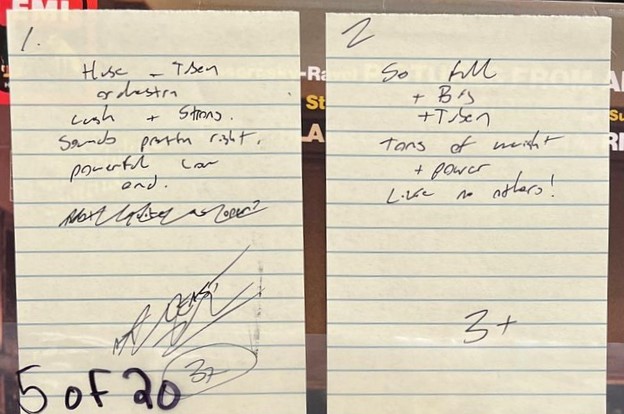
Side One

  • Huge and tubey orchestra
  • Lush and strong
  • Sounds pretty right
  • Powerful low end

Side Two

  • So full and big and tubey
  • Tons of weight and power
  • Like no others!

No doubt the enthusiastic nature of these notes is in response to the big finish for Pictures.

It is a very special piece of music, one that has thrilled me as an music-loving audiophile since I first heard it on record sometime in my twenties, and this was a very special pressing of the recording. In the old days a side two like this might have been given a grade of Four Pluses, but we don’t do that anymore, for reasons explained elsewhere on the blog.

Regardless of what grade we chose to give it, this side two was superior to either side of every other copy we played. It set a standard that no other side could meet. Yes, exceptional vintage pressings with sound that good are out there sitting in the record bins.

More from Our Listing

There is a slightly multi-miked quality to this recording. If you’ve been playing true Golden Age records all day you will notice that the instruments are more naturally and correctly spaced and sized on those recordings.

But, this is still a KNOCKOUT record which is guaranteed to bring any stereo to its knees. The dynamics, the deep bass and the sheer power of the orchestra have to be heard to be believed.

What does the typical EMI pressing of this album sound like? Not good. Sour brass, smeary or shrill strings, lacking in bass — mid-hall dead-as-a-doornail sound is fairly typical. Almost all the copies I’ve played are spacious, but so what? The sound of the instruments is often wrong and in my book that trumps any benefits concerning soundstaging or depth.

But the Hot Stampers give you the presence and immediacy you need to get involved in the work. The strings on the better copies have rosiny texture. The brass has weight — not the full measure of an RCA or London recording, but at least you get the impression that those instruments are trying to sound correct. And the bass drum really goes deep, unlike the Golden Age recordings I’ve heard.

(more…)

Suite Espanola – How Do the Remastered Pressings Sound?

Decca and London Hot Stamper Pressings Available Now

In 2011 we made the (usually pointless) effort to compare a London pressing to the 180 gram Speakers Corner reissue which we were carrying at the time. We noted simply that the Heavy Vinyl pressing “was a joke next to this copy.”

I wish I could tell you in what way it was a joke — we try to be specific about the shortcomings of these records, which is why we publish our notes for some of them — but the old notes are long gone.

Naturally, we don’t have the reissue to play this time around. Still, we are confident that the results of any comparison would be the same.

Mark Lehman in the Absolute Sound gave the ORG Heavy Vinyl remastering Five Stars, having this to say about the sound:

ORG’s 45rpm remastering is terrific (as indeed are all of the ORG vinyl reissues I’ve heard). Comparison with the late- 60s London LP on which the Suite first appeared reveals sharpened and clarified attacks and articulations, more tightly focused individual strands, fuller and warmer string choirs, more resonant brass, more pillowy air around flutes, clarinets, and oboes, and more nuance and opulence in the orchestral blends.

The total effect is to make Albeniz’s composition even more sweeping, rhapsodic, richly hued, evocative, and involving—and that’s saying something, considering how good the sonics are on this recording’s first incarnation.

If only any of this were true!

We readily admit we have never played the ORG pressing and have no plans to, but when has a Heavy Vinyl pressing ever had any of the qualities described above, let alone in such abundance?

Never in our experience, and our experience extends to more than four hundred of them.

Enough Already

Enough about records we’ve never played. Let’s discuss some of the pressings of this very recording that we actually have played, it being a favorite of ours for which we have done a number of shootouts.

The Super Analogue remaster from the 90s was awful. I would give it an F if I were grading it today.

The Speakers Corner pressing earned a B grade from us, which makes it one of the better releases on that label. I would guess that one or two out of ten would rate a B. I don’t know of any record of theirs that rates a grade higher than B.

Using letter grades, our grading system of White Hot, Super Hot and Hot would translate to something like A Plus, A and A Minus.

Which means that there is no Heavy Vinyl pressing, from any era, on any label, that should be able to beat any Hot Stamper pressing on our site, and we back that up with a 100% money back guarantee.


UPDATE 2024

Stop the presses and hold your horses.

As of 2024 we actually know of more than one Shootout Winning title pressed on modern Heavy Vinyl. You can read about one of them here.

There is another one as well and we will be writing about that one soon.

We now return you to our old commentary.

(more…)

English Settlement – A Sonic Tour de Force

More of the Music of XTC

This is an AMAZINGLY well-recorded album, with huge amounts of open studio space and that Tubey Magical, rich, fat, dense British Rock Sound. That sound isn’t easy to reproduce, but this copy absolutely nails it. Nothing else in our shootout came close to it!

If you have big speakers and the room to play them, this is quite the sonic tour de force. Credit Hugh Padgham, producer and engineer, who’s worked with the likes of Peter Gabriel, Genesis, The Police, Yes and Emerson, Lake and Palmer. Those bands make the kind of music that make good use of Padgham trademark sound: wall-to-wall, deep, layered, smooth, rich and stuffed to the gills. XTC with Padgham’s help have here produced a real steamroller of an album in English Settlement.

The big hit on this album is one that most audiophiles will probably know: Senses Working Overtime. Even over the radio you can hear how dense the production is. Imagine what it sounds like on an original British pressing with Hot Stampers, played on a modern audiophile rig. We can tell you: IT ROCKS. (more…)

Two Qualities Are Hard to Come By on Dad Loves His Work

Hot Stamper Pressings of the Music of James Taylor Available Now

As usually happens in one of our shootouts, we learned that there’s so much more to this album than just great songs.

What really made this music work on the best copies was the result of two qualities we found were in fairly short supply:

Correct Tonality

Most copies have a phony MoFi-like top end boost in the 10k region that we found irritating as hell. The longer we listened the less we liked the copies that had that boost, which adds a kind of “sparkle” to cymbals and guitars that has no business being there.

Now if you’re a MoFi fan, and you like the boosted highs that that label is famous for, don’t waste your money buying a Hot Stamper copy from us. Our copies are the ones with the correct and more natural-sounding top end. The guitars will sound like real guitars and the voices will sound like real voices.

Lower Midrange and Bottom End Weight

When the vocals sound thin, bright and phony, as they do on so many copies of this album (partly no doubt the result of the grainy crap vinyl Columbia is infamous for) that hi-fi-ish sound takes all the fun out of the music.

Many tracks have background vocals and big choruses, and the best copies make all the singers sound like they are standing in a big room, shoulder to shoulder, with the full lower midrange weight that that image implies.

The good copies capture that energy and bring it into the mix with the full-bodied sound it no doubt had live in the studio. When the EQ or the vinyl goes awry, causing Taylor and crew’s voices to take on a lean or gritty quality, the party’s over.

This is one of our favorite Taylor albums here at Better Records.

It’s the last album by the man that bears any resemblance to the genius of his early work. It’s steeply, steeply downhill after DLHW. (Case in point: His specials for PBS of the last few years [make that twenty or more] are a positive cure for insomnia, with every song slowed down and all the energy drained from the material.)

But he still had fire in his belly when he made this one — one listen to Stand and Fight is all the evidence you need; the song rocks as hard as anything the guy ever did. (And it’s got plenty of cowbell, always a good sign.)

(more…)

Siren on Import Vinyl? Not So Fast

Hot Stamper Pressings of the Music of Roxy Music Available Now

Siren is one of our favorite Roxy albums, right up there with the first album and well ahead of the commercially appealing Avalon.

After reading a rave review in Rolling Stone of the album back in 1975, I took the plunge, bought a copy at my local Tower Records and instantly fell in love with it.

As is my wont, I then proceeded to work my way through their earlier catalog, which was quite an adventure. It takes scores of plays to understand where the band is coming from on the early albums and what it is they’re trying to do. Now I listen to each of the first five releases on a regular basis.

Somehow they never seem to get old, even after more than forty years.

Of all the Roxy albums (with the exception of Avalon) this is probably the best way “in” to the band’s music. The earlier albums are more raucous, the later ones more rhythmically driven — Siren catches them at their peak, with, as other reviewers have noted, all good songs and no bad ones.

Imports? Not So Fast

The British and German copies of Siren are clearly made from dub tapes and sound smeary, small and lifeless.

To be fair, Siren has never impressed us as an exceptionally good sounding recording. Like other middle period Roxy, records such as Country Life and Manifesto (the albums just before and after), it simply does not have Demo Disc analog sound the way Avalon, Stranded or the Self-Titled albums do (the latter two clearly being the best sounding in their catalog).

One would be tempted to assume that the import pressings of Siren would be better sounding, the way the imports of the first four Roxy albums are clearly better sounding. (There has never been a domestic Hot Stamper pressing of any of those titles and, since we never buy them or play them, there probably never will be.)

But in the case of Siren it’s the imports that are made from dubs. It may be a British band, recorded in British studios with a British producer, but the British pressed LPs are clearly made from sub-generation tapes, whereas the domestic copies sound like they’re made from the real masters.

Go Figure. And another thing: when it comes to records, never assume anything.

The typical domestic pressing is flat, bass-shy and opaque, sounding more like compressed cardboard than analog vinyl.

Unsurprisingly, the CD, whether imported or produced domestically, is clean and clear and tonally correct but lacks the warmth and richness of the better vinyl pressings.

(more…)

Taking Tiger Mountain – Peak Art Rock

Hot Stamper Pressings of the Music of Brian Eno Available Now

This is Brian Eno’s Masterpiece as well as a personal favorite of yours truly.

On the right pressing, Taking Tiger Mountain is a twisted pop Big Speaker Demo Disc like nothing you have ever heard.

If you have a big speaker and the kind of high quality playback that is capable of unraveling the most complicated studio creations, with all the weight and power of live music at practically live levels, this is the record that will make all your audio effort and expense worthwhile.

That’s the kind of stereo I’ve been working on for forty fifty years and this album just plain KILLS over here.

Art Rock

That being said, it may not be the kind of thing most music loving audiophiles will be able to make sense of if they have no history with this kind of arty rock from the 70s. I grew up on Roxy Music, 10cc, Eno, The Talking Heads, Peter Gabriel, Ambrosia, Supertramp, Yes and the like, bands that wanted to play rock music but felt shackled by the chains of the conventional pop song.

This was and still is my favorite kind of music. Experts who study these things say that the music you discover between the ages of 17 and 23 stays with you for your entire life. For me that’s the music I fell in love from 1971 to 1977. I was 20 when this album came out.

When it comes to the genre, I put this album right at the top of the heap, along with several other landmark albums from the period: More Songs About Buildings and Food, Siren, The Original Soundtrack, Crisis? What Crisis?, Ambrosia’s first two releases, The Yes Album, 801 Live, A New World Order and plenty of others, many more than I have room to describe here.

It should be noted that most of these album don’t sell all that well. We do shootouts for them anyway, partly in the hopes that at least some of our more adventurous customers will get turned on to this music and have their lives changed in the same way mine was.

One difference I could be forgiven for pointing to in this regard is that I had available to me random copies of unknown quality, unlike our customers who get offered nothing but great sounding pressings.

(more…)

On Waka/Jawaka Transparency Is Key

Hot Stamper Pressings of the Music of Frank Zappa Available Now

Not long ago we discovered the secret to separating the men from the boys on side one: TRANSPARENCY.

On the lively, punchy, dynamic copies — which are of course the best ones — you can follow the drumming at the beginning of ‘Big Swifty’ note for note: every beat, every kick of the kick drum, every fill, every roll.

It’s all there to be heard and appreciated. If that track on this copy doesn’t make you a huge fan of Aynsley Dunbar, I can’t imagine what would. The guy had a real gift.

Big Swifty!

The 17-plus-minute-long Big Swifty is a suite in which each section slowly, almost imperceptibly blends into the next, so that you find yourself in a completely new and different section without knowing how you got there — that is, until you go back and play the album and listen for just those transistions, which is what makes it worth playing hundreds and hundreds and hundreds of times.

Big Swifty is a jazz suite with amazingly innovative work by Sal Marquez on trumpet. He single-handedly turns this music into a work of brilliance. I can’t imagine a more talented player.

Zappa on guitar is excellent as well. Aynsley Dunbar plays his ass off, only falling short when it comes time to do his drum solo on Waka/Jawaka.

The interplay of each of these rock musicians is in the tradition of the greatest jazz artists stretching all the way back to the 50s.

And since the drumming throughout this record is so crucial to the music itself, a copy that really gets that right is one that probably gets everything right.

(more…)

An Extraordinary Recording of the Carmen Fantasie – This Is Why You Must Do Shootouts

It has been years since a Whiteback pressing on the later label won a shootout. Some reissue copies of CS 6165 have earned Nearly White Hot Stamper grades, but we would be very surprised if one of the Blueback originals we play in the next shootout does not come out on top. They are just too good.


This London Whiteback LP has DEMO DISC sound like you will not believe, especially on side two, which earned our coveted A Triple Plus rating. The sound is warm, sweet and transparent; in short, absolutely GORGEOUS. We call it AGAIG — As Good As It Gets!

As this is one of the Greatest Violin Showpiece Albums of All Time, it is certainly a record that belongs in every right-thinking audiophle’s collection. (If you’re on our site and taking the time to read this, that probably means you.) Ruggiero Ricci is superb throughout.

And side one was just a step below the second side in terms of sound quality, with very solid A++ sound. To find two sides of this caliber, on quiet vinyl no less, is no mean feat. You could easily go through ten copies without finding one as consistently good sounding as this one.

A True Demo Disc, Or Was It?

Ricci’s playing of the Bizet-Sarasate Carmen Fantasie is OUT OF THIS WORLD. There is no greater perforrmance on record in my opinion, and few works that have as much Audiophile Appeal.

Which is why I’ve had a copy of this record in my own collection for about fifteen years marked “My Demo Disc.” But this copy KILLED it. How could that be?

It just goes to show: No matter how good a particular copy of a record may sound to you, when you clean and play enough of them you will almost always find one that’s better, and often surprisingly better.

Shootouts are the only way to find these kinds of records. That’s why you must do them.

Nothing else works. If you’re not doing shootouts (or buying the winners of shootouts from us) you simply don’t have top quality copies in your collection, except in the rare instances where you just got lucky. In the world of records luck can only take you so far. The rest of the journey requires effort.

(more…)

London Calling – A Killer Bill Price Recording

Hot Stamper Pressings of the Music of The Clash Available Now

What sets this album apart sonically is The Clash’s use of reggae and dub influences. You can really hear it when you tune in to the bottom end. Your average late-70s punk record won’t have this kind of rich and meaty bass, that’s for sure.

Drop the needle on The Guns Of Brixton (last track on side two) to hear exactly what I’m talking about. On a Hot Stamper copy played at the correct levels (read: loud) the effect is positively hypnotic.

Nobody in 1979 would have accused The Clash of being an audiophile-friendly band, but the best pressings will make you think twice about that.

Bill Price engineered and, as we never tire of saying about recordings with the potential to sound as good as this one does, he knocked it out of the park. The best sounding record from 1979? Probably not, but one of the best for sure.

1979

1979 sure was an interesting year for pop/rock music.

The Wall, Breakfast in America, London Calling, Off the Wall, Get the Knack, Damn the Torpedoes, Armed Forces, Spirits Having Flown, Reggatta de Blanc, Fear of Music, Tusk, The B-52s, Lodger, Rust Never Sleeps, Rickie Lee Jones, Candy-O — the variety is remarkable.

Even more remarkable is the number of albums recorded in 79 that sound fresh and engaging to this day, more than 40 years after they were released. I could sit down in front of my speakers today and play any one of them all the way through. Try that with your ten favorite albums from 1989, 1999, 2009 or 2019 (assuming you can find ten. I sure couldn’t). (more…)

Striving for Orchestral Clarity on Finlandia with Decca and Failing with RCA

More of the Music of Jean Sibelius

More of the Music of Edvard Grieg

The original RCA Living Stereo pressings we played in our 2014 shootout were not competitive with the best Deccas and London reissues of Finlandia.

Is the original the best way to go? In our experience with Finlandia, it is not. And it’s not even close.

The Decca reissue you see here is yet another wonderful example of what the much-lauded Decca recording engineers were able to capture on analog tape all those years ago. The 1961 master tapes have been transferred brilliantly using “modern” cutting equipment (from 1970, not the low-rez junk they’re forced to make do with these days), giving you, the listener, sound that only the best of both worlds can offer. [Not true, see Two Things below.)

When you hear how good this record sounds, you may have a hard time believing that it’s a budget reissue from 1970, but that’s precisely what it is.

Even more extraordinary, the right copies are the ones that win shootouts

Side One

Correct from top to bottom, and there are not many records we can say that about. So natural in every way.

The brass is HUGE and POWERFUL on this side. Not many recordings capture the brass this well. Ansermet on London comes to mind of course but many of his performances leave much to be desired. Here Mackerras is on top of his game with performances that are definitive.

The brass is big and clear and weighty, just the way it should be, as that is precisely the sound you hear in the concert hall, especially that part about being clear: live music is more than anything else completely clear. We should all strive for that sound in our reproduction of orchestral music.

The opening track on side one, Wedding Day at Troldhaugen, is one of my favorite pieces of orchestral music. Mackerras and the London Proms make it magical.

Side Two

The richness on this side is awesome. So 3-D, with depth and transparency to rival any recording you may own.

Two Things

When you hear a record of this quality, you can be pretty sure of two things: one, the original is unlikely to sound as good, having been cut on cruder equipment.


UPDATE

Let me stop myself right there. I no longer subscribe to this view. There are many original pressings mastered in the 50s that are as hi-rez and undistorted as anything made after them. Here’s one example. It would be easy to name a great many more. Live and learn I say.


And two, no modern recutting of the tapes (by the likes of Speakers Corner for example, but you can substitute any company you care to choose) could begin to capture this kind of naturalistic orchestral sound. [Mostly still true.]

I have never heard a Heavy Vinyl pressing begin to do what this record is doing. The Decca we have here may be a budget reissue pressing, but it was mastered by real Decca engineers (a few different ones in fact), pressed in England on high quality vinyl, and from fairly fresh tapes (nine years old, not fifty years old!), then mastered about as well as a record can be mastered.

The sound is, above all, real and believable.

The brass has weight, the top extends beautifully for those glorious cymbal crashes, the hall is huge and the staging very three-dimensional — there is little to fault in the sound on either side.

(more…)