Testing Big, Clear and Lively Choruses

Listening in Depth to Aja

Hot Stamper Pressings of the Music of Steely Dan Available Now

Generally, what you try to get on side one is a copy with ambience, because most copies are flat, lifeless and dry as a bone.

You want a copy with good punchy bass — many are lean, and the first two tracks simply don’t work at all without good bass. And then you want a copy that has a natural top end, where the cymbals ring sweetly and Wayne Shorter’s saxophone isn’t hard or honky or dull, which it often is on the bad domestic copies.

The truly amazing side twos — and they are pretty darn rare — have an extended top end and breathy vocals on the first track, Peg, a track that is dull on nine out of ten copies. (The ridiculously bright MoFi actually kind of works on Peg because of the fact that the mix is somewhat lacking in top end. This is faint praise though: MoFi managed to fix that problem and ruin practically everything else on the album.)

If you play Peg against the tracks that follow it on side two, most of the time the highs come back. On the best of the best, the highs are there all the way through.

Side One

Black Cow

Fagen’s voice on the first line will always sound grainy – it’s that way on the CD and every LP I have ever played, which means it’s on the tape that way. It will quickly pass, and the rest of the vocals will sound amazing if you have a Hot Stamper Copy.

This song is as BIG and BOLD sounding as any pop song I know. This is Demo Disc material if you have the system to do it justice.

And don’t you just love the way it starts on the upbeat? Now that’s the way to kick off an album!

Aja

Got a big speaker? Lots of power? You will need both to play this song right. Note how the percussion comes through the dense mix, without being abrasive in any way. That’s a sure sign that you have a copy with the transparency and resolution you need to bring out the track’s best qualities. The mix needs that percussion; it’s there for a reason. You, dear audiophile, need an LP that lets that percussion be heard. Many are called; few are chosen.

Deacon Blues

It’s the rare copy that gets the top end for the first two tracks right and still has enough presence and top end for this song, which will tend to sound dull even if the first two tracks don’t. The truly killer pressings get all three tracks to sound amazing, no mean feat.

Side Two

For some reason, side two is almost always cut at a lower level than side one. Pump up the volume a db or two in order to get the full Aja effect for the songs on this side.


UPDATE 2022

The commentary about Peg you see below was written many years ago, and I no longer agree with the claim it makes.

The MoFi is so bad in so many ways that whatever it fixes on the top end, it destroys everywhere else.

It’s one of the greatest audio disasters of the 80s, along with the equally awful Cisco pressing, which qualifies as one of the great audio disasters of the modern Heavy Vinyl era.
(more…)

Two Qualities Are Hard to Come By on Dad Loves His Work

Hot Stamper Pressings of the Music of James Taylor Available Now

As usually happens in one of our shootouts, we learned that there’s so much more to this album than just great songs.

What really made this music work on the best copies was the result of two qualities we found were in fairly short supply:

Correct Tonality

Most copies have a phony MoFi-like top end boost in the 10k region that we found irritating as hell. The longer we listened the less we liked the copies that had that boost, which adds a kind of “sparkle” to cymbals and guitars that has no business being there.

Now if you’re a MoFi fan, and you like the boosted highs that that label is famous for, don’t waste your money buying a Hot Stamper copy from us. Our copies are the ones with the correct and more natural-sounding top end. The guitars will sound like real guitars and the voices will sound like real voices.

Lower Midrange and Bottom End Weight

When the vocals sound thin, bright and phony, as they do on so many copies of this album (partly no doubt the result of the grainy crap vinyl Columbia is infamous for) that hi-fi-ish sound takes all the fun out of the music.

Many tracks have background vocals and big choruses, and the best copies make all the singers sound like they are standing in a big room, shoulder to shoulder, with the full lower midrange weight that that image implies.

The good copies capture that energy and bring it into the mix with the full-bodied sound it no doubt had live in the studio. When the EQ or the vinyl goes awry, causing Taylor and crew’s voices to take on a lean or gritty quality, the party’s over.

This is one of our favorite Taylor albums here at Better Records.

It’s the last album by the man that bears any resemblance to the genius of his early work. It’s steeply, steeply downhill after DLHW. (Case in point: His specials for PBS of the last few years [make that twenty or more] are a positive cure for insomnia, with every song slowed down and all the energy drained from the material.)

But he still had fire in his belly when he made this one — one listen to Stand and Fight is all the evidence you need; the song rocks as hard as anything the guy ever did. (And it’s got plenty of cowbell, always a good sign.)

(more…)

I Ask You: What Album from 1985 Has Better Sound than Little Creatures?

Hot Stamper Pressings of the Music of Talking Heads Available Now

We’re huge fans of Little Creatures here at Better Records. When you hear one of our Hot Stamper copies you’ll know exactly what we love about it.

Not many records from this era sound as amazingly rich as this one, not in our experience anyway. (As I write this there are four Hot Stamper pressings from 1985 on the site, and one of them is Brothers in Arms, hardly anyone’s idea of audiophile quality sound I venture to say.)

[I was being much too harsh to Brothers in Arms above. The best pressings have superb — albeit modern — sound.]

The recording is simply outstanding — punchy, smooth & so ANALOG, with an especially beefy bottom end, the kind a good Big Beat Pop Album record needs. (For a reference think Get The Knack or Parallel Lines.)

The best copies boast the kind of tight, punchy, surprisingly deep note-like bass that absolutely makes or breaks the sound on Little Creatures. Without the proper bass foundation this funky beat-crazy Talking Heads album can’t BEGIN to do what it’s trying to do: get your feet tappin’ and your body rockin’ to the music.

Top Sound from 1985 – Yes, It IS, or WAS, Possible

The best pressings are amazingly dynamic, with a sweet, often silky top end. The drums are very well recorded throughout — you can really hear the room around that big kit.

On the best copies such as this one David Byrne’s vocals have the presence and breathy texture they need. The overall sound is open, spacious, and sweet, even three-dimensional.

(more…)

The Yes Album – What a Recording!

Hot Stamper Pressings of the Music of Yes Available Now

At its best, this album is a Big Speaker Prog-Rock opus with tremendous power and dynamic range, but it takes a special pressing to really bring the album to life. 

These guys — and by that I mean this particular iteration of the band, the actual players that were involved in the making of this album — came together for the first time and created the sound of Yes on this very album, rather aptly titled when you think about it.

With the amazing Eddie Offord at the board, as well as the best batch of songs ever to appear on a single Yes album, they produced both their sonic and musical masterpiece — good news for audiophiles with Big Speakers!

Drop the needle on a top copy and you will find yourself on a Yes journey the likes of which you have never known.

And that’s what I’m in this audiophile game for.

The Heavy Vinyl crowd can have their dead-as-a-doornail, wake-me-when-it’s-over pressings that are typically cheap to buy and tend to play quietly.  Here’s one I couldn’t sit through with a gun to my head.

The amount of effort that went into the recording of this album is comparable to that expended by the engineers and producers of bands like Supertramp, ELP, The Who, Jethro Tull, Ambrosia, Pink Floyd and far too many others to list.

It seems that no effort or cost was spared in making the home listening experience as compelling as the recording technology of the day permitted. Tubey Magical British Prog Rock just doesn’t get any better.

Obsession

Yes, we admit to being obsessed with The Yes Album.

It is our belief that to reach the most advanced levels of audio,you have to do two things:

  1. You must become obsessed with getting your favorite albums to sound their best, and,
  2. You must then turn your obsession into concrete action.

What kind of action?

Finding better sounding pressings and improving your stereo and room.

(more…)

On Brighter Days, The Best Pressings Have Choruses that Really Soar

Hot Stamper Pressings with Big, Clear and Lively Choruses Available Now

A recent White Hot Stamper pressing of L&M’s fourth release demonstrated pretty convincingly just what an amazing Demo Disc this album can be.

At about the 1:15 mark (and again at 3:10), the song’s chorus is a great test for weight, resolution, dynamic energy, and freedom from strain in the loudest parts.

When the whole band is really belting it out, the shortcomings of any copy will be exposed, assuming you are playing the album at good loud levels on big dynamic speakers.

It was a key test every pressing had to pass. That’s what makes it a good test disc.

When the music gets loud you want it to get better, with more size, energy and, especially, emotional power, just the way that song would be heard in concert.

Any strain or congestion in the choruses we hear in our shootout results in the pressing being downgraded substantially.

Hot Stampers are all about the life of the music, and when this music gets lively, it needs to be clear and clean.

This is of course one of the biggest issues we have with Heavy Vinyl.

Heavy Vinyl almost never gets up and almost never gets going the way vintage records do.

“Lifelss and boring” are the adjectives we most commonly use to describe those we audition, and who wants to listen to lifeless, boring records?

(more…)

Save the Life of My Child Is One Tough Test

Hot Stamper Pressings of the Music of Simon and Garfunkel Available Now

The big production songs on Bookends have a tendency to get congested on even the best pressings, which is not uncommon for four track recordings from the 60s.

Those of you with properly set up high-dollar front ends should have less of a problem than those of you without them. $3000 cartridges can usually deal with this kind of complex information better than $300 ones.

But not always. Expensive does not always mean better, since painstaking and exacting setup is so essential to proper playback.

Save the Life of My Child — A Tough Test

I used to think this track would never sound good enough to use as an evaluation track. It’s a huge production that I had heretofore found all but impossible to get to sound right on even the best original copies of the album. Even as recently as ten years ago I had basically given up on reproducing it right.

Thankfully things have changed. Nowadays, with carefully cleaned top copies at our disposal and a system that is really cooking, virtually all of the harmonic distortion in the big chorus near the opening has disappeared. It takes a very special pressing and a very special stereo to play this song. That’s precisely what makes it a good test!

America — Another Tough Test

America is another one of the toughest tracks to get right. The big ending with its powerful orchestral elements is positively stunning on the rare copies that have little or no congestion in the loudest passages.

On virtually every copy you will ever hear the voices on this track are a little sibilant. Modern records are made with what is known as a de-essing limiter. This limiter recognizes sibilance and keeps it under control, because once the cutter head sees that kind of high frequency information, which is already boosted for the RIAA curve, it will try to cut it onto the record and the result will be this kind of spitty distortion.

(more…)

Listening in Depth to Famous Blue Raincoat

Hot Stamper Pressings of the Music of Leonard Cohen Available Now
I’m a huge fan of this FBR. It’s the only album Jennifer Warnes ever made that I would consider a Must Own recording or a Desert Island Disc. Without question this is her Masterpiece.

Key Test for Side One

Listen to the snare drum on Bird on a Wire. On most copies it sound thin and bright, not very much like a real snare. Let’s face it: most copies of this record are thin and bright, and that’s just not our sound here at Better Records. If the snare on Bird sounds solid and meaty, at the very least you have a copy that is probably not too bright, and on this album that puts it well ahead of the pack.

While you’re listening for the sound of that snare, notice the amazing drum work of Vinnie Colaiuta, session drummer extraordinaire. The guy’s work on this track — especially with the high hat — is genius.

Key Test for Side Two

Listen to the sound of the piano on Song of Bernadette. If it’s rich and full-bodied with the weight of a real piano, you might just have yourself a winner. At the very least you won’t have to suffer through the anemically thin sound of the average copy.

Side One

First We Take Manhattan

Don’t expect this song to be tonally correct. It runs the gamut from bright to too bright to excrutiatingly bright. Steve Hoffman told me that he took out something like 6 DB at 6K when he mastered it for a compilation he made, and I’m guessing that that’s the minimum that would need to come out. It’s made to be a hit single, and like so many hit single wannabes, it’s mixed brighter than we audiophiles might like.

(more…)

Minute By Minute – Donn Landee at His Best

If you could only have one Doobies album, assuming you prefer the Michael McDonald era as we do, wouldn’t it have to be this one?

An audiophile quality pop music production as close to perfect as one could possibly wish for, thanks to Ted Templeman and Donn Landee .

This is Donn Landee at his best — tonally correct, spacious, clear and sweet, with vocal choruses that can really take off when called upon.

The sound may be too heavily processed and glossy for some, but we find that, at least on the best copies, that sound really works for the music on this album.

It’s one our favorite titles from 1979.

Grammys

1979 Record Of The Year for “What A Fool Believes” 
1979 Song Of The Year for “What A Fool Believes” 
1979 Best Pop Vocal Performance By A Duo, Group Or Chorus for “Minute By Minute” 
1979 Best Arrangement Accompanying Vocals for “What A Fool Believes” 

(more…)

The Greatest Beethoven Ninth on Vinyl – Ansermet in 1960

Hot Stamper Pressings of the Music of Beethoven Available Now

The legendary Ansermet recording from 1960 you see to the left is the best sounding Beethoven 9th we have ever had the pleasure to play here at Better Records.

Ansermet’s performance is clearly definitive to my ear as well. The gorgeous hall the Suisse Romande recorded in was possibly the best recording venue of its day, possibly of all time. More amazing sounding recordings were made there than in any other hall we know of.

Both sides are big, rich and clear, and both were showing us pretty much everything that’s good about a vintage symphonic recording.

There is a solidity and richness to the sound beyond all others, yet clarity and transparency are not sacrificed in the least.

It’s as wide, deep and three-dimensional as any, which is of course all to the good, but what makes the sound of these recordings so special is the weight and power of the brass, combined with unerring timbral accuracy of the instruments in every section of the orchestra.

The Chorus — Always a Tough Test

To get the chorus to play cleanly right to the very end is difficult for any pressing and this one is no exception. The chorus should play mostly without distortion or congestion even in the loudest parts, but we can’t say there won’t be a trace of one or both.

A good test of your turntable setup!

Production and Engineering

James Walker was the producer, Roy Wallace the engineer for these sessions from April of 1959 in Geneva’s glorious Victoria Hall.

The album came out in 1960, along with a great many other exceptional titles from the Golden Age of vacuum tube recording.

(more…)

Leonard Cohen Sure Sounds Better than He Used to

Hot Stamper Pressings of the Music of Leonard Cohen Available Now

Insanely good Shootout Winning Triple Plus (A+++) sound on both sides AND fairly quiet vinyl – the best copy to ever hit the site bar none.

Unbeatable richness and freedom from artificiality in the midrange allowed this one to tower over the rest of the field.

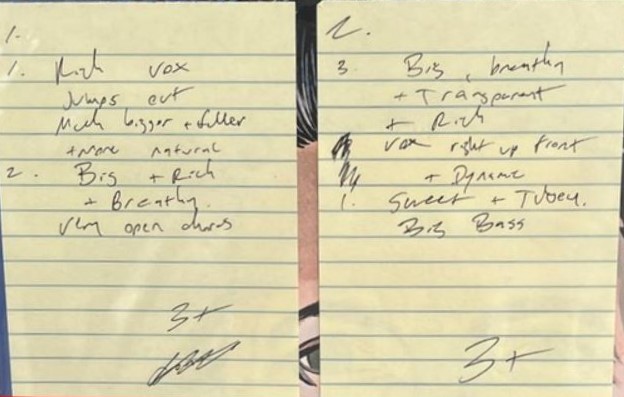
As you can see from the notes, both sides of our most recent White Hot stamper shootout winning copy were doing everything right. We marvelled at these specific qualities in the sound:

Side One

Track one

    • Rich vocals
    • Jumps out
    • Much bigger and fuller and more natural

Track two

    • Big and rich and breathy
    • Very open chorus

Side Two

Track three

    • Big, breathy and transparent and rich
    • Vocals are right up front and dynamic

Track one

    • Sweet and tubey
    • Big bass

Midrange presence is one of the most important qualities of any rock or pop recording we might be evaluating, and for a Leonard Cohen album it is absolutely essential.

You want Cohen to be front and center, neither recessed in space nor behind a veil.

The notes for track three on side two say it all:

Vocals are right up front and dynamic

That is what gets this music to sound the way it is supposed to. You can be very sure that no Heavy Vinyl remastered pressing is going to put Leonard Cohen front and center. They practically never do. (Here is an especially offensive remaster with a bad case of recessed vocals. Funny how none of the audiophile reviewers noticed. What does that say about the quality of their playback, or the standards to which they hold their records?)

DIY Advice

To aid you in doing your own evaluations, here is a list of records that we’ve found to be good for testing midrange presence.

This is exactly why we do shootouts. If you really want to be able to recognize subtle (and not so subtle!) differences between pressings, you must learn to do them too.

And make sure to take notes about what you are hearing, good and bad.

We love Cohen’s albums here at Better Records. No, they’re not audiophile spectaculars, but much like the best Dylan recordings, when they work the sound fits the music perfectly.


UPDATE 2025

In previous listings we had noted:

The vocals are right up front and fairly dry, throwing the words and phrasing into high relief.

But we would no longer agree with the vocals being dry. On the best copies they are rich, full-bodied and tubey.

What does that say about the quality of our playback? How about: It’s better now than it used to be!

(more…)