More of the Music of The Moody Blues
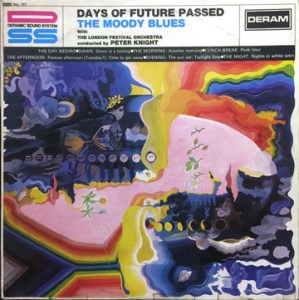
- With two solid Double Plus (A++) sides or close to them, you’ll have a hard time finding a copy that sounds remotely as good as this vintage UK import
- The sonics are huge, rich and lively throughout (particularly on side one) – you need this kind of space for the orchestral parts to work their Moody Magic
- An album experience beyond practically anything that had come before (Sgt. Pepper excluded)
- 4 1/2 stars: “Days of Future Passed became one of the defining documents of the blossoming psychedelic era, and one of the most enduringly popular albums of its era.”
- If you’re a fan of the Moodies, this vintage UK pressing from 1967 surely belongs in your collection
- We’ve recently compiled a list of records we think every audiophile should get to know better, along the lines of “the 1001 records you need to hear before you die,” but with the accent on the joy these amazing audiophile-quality recordings can bring to your life
This album is more than 50 years old, for god’s sake! In those 50+ years I’d forgotten how good it is.
“Tuesday Afternoon” is the Perfect Pop Song, with the whole of side two flowing effortlessly from it as each song (each day) is linked by means of the surrounding orchestrations until it reaches its zenith with the climax of “Nights in White Satin.”
The sound is very much a part of the entire experience. The strings of the orchestra sound as sweet as any Decca, the soundstage wide and deep as a symphony. For those of you who still think Mobile Fidelity is the king on this one, here’s a record that demonstrates what a real orchestra sounds like.
What The Best Sides Of Days of Future Passed Have To Offer Is Not Hard To Hear
- The biggest, most immediate staging in the largest acoustic space
- The most Tubey Magic, without which you have almost nothing. CDs give you clean and clear. Only the best vintage vinyl pressings offer the kind of Tubey Magic that was on the tapes in 1967
- Tight, note-like, rich, full-bodied bass, with the correct amount of weight down low
- Natural tonality in the midrange — with all the instruments having the correct timbre
- Transparency and resolution, critical to hearing into the three-dimensional studio space
No doubt there’s more but we hope that should do for now. Playing the record is the only way to hear all of the qualities we discuss above, and playing the best pressings against a pile of other copies under rigorously controlled conditions is the only way to find a pressing that sounds as good as this one does.
Balance
Achieving just the right balance of “Moody Blues Sound” and transparency is no mean feat. You have to be using the real master tape for starters. Then you need top end extension, a somewhat rare quality to find on most imports, and finally, good bass definition to keep the bottom end from blurring into the midrange.
No domestic copy in our experience has ever had these three qualities, and only the best of the imports manages to get all three on the same LP.
Like we’ve said about other great Moodies pressings in the past, all the clarity and resolution comes WITHOUT SACRIFICING the Tubey Magical richness, warmth and lushness for which the Moody Blues recordings are justifiably famous.
This vintage pressing has the kind of Tubey Magical Midrange that modern records rarely begin to reproduce. Folks, that sound is pretty much gone and sure doesn’t seem to be coming back. If you love hearing INTO a recording, actually being able to “see” the performers, and feeling as if you are sitting in the studio with the band, this is the record for you. It’s what vintage all analog recordings are known for — this sound.
If you exclusively play modern repressings of vintage recordings, I can say without fear of contradiction that you have never heard this kind of sound on vinyl. Old records have it — not often, and certainly not always — but maybe one out of a hundred new records do, and those are some pretty long odds.
What We’re Listening For On Days of Future Passed
- Energy for starters. What could be more important than the life of the music?
- Then: presence and immediacy. The vocals aren’t “back there” somewhere, lost in the mix. They’re front and center where any recording engineer worth his salt would put them.
- The Big Sound comes next — wall to wall, lots of depth, huge space, three-dimensionality, all that sort of thing.
- Then transient information — fast, clear, sharp attacks, not the smear and thickness so common to these LPs.
- Tight punchy bass — which ties in with good transient information, also the issue of frequency extension further down.
- Next: transparency — the quality that allows you to hear deep into the soundfield, showing you the space and air around all the instruments.
- Extend the top and bottom and voila, you have The Real Thing — an honest to goodness Hot Stamper.
A Big Group of Musicians Needs This Kind of Space
One of the qualities that we don’t talk about on the site nearly enough is the SIZE of the record’s presentation. Some copies of the album just sound small — they don’t extend all the way to the outside edges of the speakers, and they don’t seem to take up all the space from the floor to the ceiling. In addition, the sound can often be recessed, with a lack of presence and immediacy in the center.
Other copies — my notes for these copies often read “BIG and BOLD” — create a huge soundfield, with the music positively jumping out of the speakers. They’re not brighter, they’re not more aggressive, they’re not hyped-up in any way, they’re just bigger and clearer.
And most of the time those very special pressings are just plain more involving. When you hear a copy that does all that — a copy like this one — it’s an entirely different listening experience.
A Must Own Pop Record
We consider this Moodies album their Masterpiece. It’s a recording that should be part of any serious popular Music Collection.
Others that belong in that category can be found here.
Discography
Hot Stamper shootouts have been done for all the Moodie’s records with the exception of Go Now (which never sounds good as far as we know).
- Go Now! (a.k.a. The Magnificent Moodies) (1965)
- Days of Future Passed (1967)
- In Search of the Lost Chord (1968)
- On the Threshold of a Dream (1969)
- To Our Children’s Children’s Children (1969)
- A Question of Balance (1970)
- Every Good Boy Deserves Favour (1971)
- Seventh Sojourn (1972)
Side One
The Day Begins, Dawn
Cold-hearted orb that rules the night,
Removes the colours from our sight.
Red is grey and yellow white,
But we decide which is right.
And which is an illusion?
Pinprick holes in a colourless sky,
Let insipid figures of light pass by.
The mighty light of ten thousand suns,
Challenges infinity and is soon gone.
Nighttime, to some, a brief interlude,
To others, the fear of solitude.
Brave Helios wake up your steeds,
Bring the warmth the countryside needs.
Dawn Is A Feeling, The Morning
Another Morning, Lunch Break
Peak Hour, The Afternoon
Side Two
Forever Afternoon (Tuesday?)
Time To Get Away, Evening
The Sun Set
Twilight Time, The Night
Nights In White Satin
Breathe deep the gathering gloom
Watch lights fade from every room
Bedsitter people look back and lament
Another day’s useless energy spent
Impassioned lovers wrestle as one
Lonely man cries for love and has none
New mother picks up and suckles her son
Senior citizens wish they were young
Cold hearted orb that rules the night
Removes the colors from our sight
Red is grey and yellow white
But we decide which is right
And which is an illusion?
AMG 4 1/2 Star Rave Review
This album marked the formal debut of the psychedelic-era Moody Blues; though they’d made a pair of singles featuring new (as of 1966) members Justin Hayward and John Lodge, Days of Future Passed was a lot bolder and more ambitious. What surprises first-time listeners — and delighted them at the time — is the degree to which the group shares the spotlight with the London Festival Orchestra without compromising their sound or getting lost in the lush mix of sounds.
That’s mostly because they came to this album with the strongest, most cohesive body of songs in their history, having spent the previous year working up a new stage act and a new body of material (and working the bugs out of it on-stage), the best of which ended up here. Decca Records had wanted a rock version of Dvorak’s “New World Symphony” to showcase its enhanced stereo-sound technology, but at the behest of the band, producer Tony Clarke (with engineer Derek Varnals aiding and abetting) hijacked the project and instead cut the group’s new repertory, with conductor/arranger Peter Knight adding the orchestral accompaniment and devising the bridge sections between the songs and the album’s grandiose opening and closing sections. The record company didn’t know what to do with the resulting album, which was neither classical nor pop, but following its release in December of 1967, audiences found their way to it as one of the first pieces of heavily orchestrated, album-length psychedelic rock to come out of England in the wake of the Beatles’ Sgt. Pepper and Magical Mystery Tour albums.
What’s more, it was refreshingly original, rather than an attempt to mimic the Beatles; sandwiched among the playful lyricism of “Another Morning” and the mysticism of “The Sunset,” songs like “Tuesday Afternoon” and “Twilight Time” (which remained in their concert repertory for three years) were pounding rockers within the British psychedelic milieu, and the harmony singing (another new attribute for the group) made the band’s sound unique. With “Tuesday Afternoon” and “Nights In White Satin” to drive sales, Days of Future Passed became one of the defining documents of the blossoming psychedelic era, and one of the most enduringly popular albums of its era.
LINER NOTES
The Moody Blues
with The London Festival Orchestra
conducted by Peter Knight
In Days Of Future Passed the Moody Blues have at last done what many others have dreamed of and talked about; they have extended the range of pop music, and found the point where it becomes one of the world of the classics. Here, where emotion and creativity blend – where poetry, the beat group and the symphony orchestra feed on each other’s inspiration – the Moodys have chosen to paint their picture of everyman’s day, which takes nothing from the nostalgia for the past – and adds nothing to the probabilities of the future.
For such a fusion of pop composition and classical writing, it seemed obvious that the Deramic Sound System of ‘all-round sound’ it has, we believe, become more possible than in any other way to be totally submerged – and hence totally committed to such a deeply emotional statement of the human condition today.