
Hot Stamper Pressings of Music on Island Records Available Now
Below you will see the bottom part of the stamper sheet for a shootout we did recently.
Please note that the album you see pictured is not the one we are discussing here.
It very well could have been been a Jethro Tull album, but all we can say for sure is that it was definitely an album on Island, which just happens to be one of our favorite labels, for sound and music.
The earliest pressings for many records on the Island label are not very good. This one — again, not for This Was, for some other record — is not a bad sounding pressing.
With grades of 1.5+ on both sides, it fits comfortably in our section for good, not great sounding LPs — but the right reissues from the 70s are a big step up in class sonically. They’re the ones that win shootouts, not these Pink Label LPs.
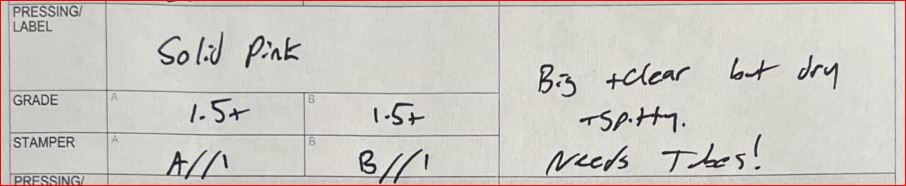
It’s big and clear but dry and spitty and badly needs tubes in the cutting chain.
Do the record collectors who prize the Pink Label pressings above all others notice these things?
Do the audiophiles who play them?
Been There, Done That
We’ve run into so many sonically-flawed Pink Label Islands by now that hearing one sound lackluster if not actually awful doesn’t phase us in the least. Some of the other Pink Labels that never win shootouts can be found here.
But before that, back in the dark days of the early 2000s, we clearly were lacking a comprehensive understanding of the various UK pressings of this mystery album by a mystery British band.
There was obviously a great deal of research and development left to be done. For the next twenty years, this is the kind of work we have been undertaking.
Why? Because we get paid to do it.
We may just be the most knowledgable experts on the planet when it comes to the best sounding pressings of audiophile-quality recordings.
If we’re not I’d sure like to know who is, and how they came by the equivalent of the volumes and volumes of information we’ve compiled over the twenty years we’ve been doing regular shootouts, the only source for reliable information that has ever been invented.
But that doesn’t mean we know it all. If we come across that way, it’s the result no doubt of our enthusiastic responses to the hundreds of amazing records we’ve had the pleasure to hear. For example, here’s a good one, and of course there are literally hundreds and hundreds of others with similarly over-the-top notes.
One thing we do know: all knowledge, of records or anything else you care to name, is provisional.
If somehow we did know it all, there would not be a hundred entries in our live and learn section.
How We Do It
We’ve learned what we think we know from the records we’ve played. Our record experiments, conducted using the shootout process we’ve painstakingly developed and refined over the course of the last twenty years, produces all the data we need: the winners, the losers, and rankings for all the records in between.
We’ve achieved our results by purposefully ignoring everything there is to know about a record — who made it, how they made it, when they made it — everything, that is, but the sound coming out of the speakers of our reference system.
Further Reading