tonally-correct-mids-but

We have a new link for audiophile pressings that are tonally correct in the midrange but have serious faults in other areas, as they almost always do.

You can assume that our Hot Stamper pressings are tonally correct, since correct tonality is critical to high fidelity sound. Not essential, but certainly very important.

MoFi Sure Added Plenty of Sparkle to These Acoustic Guitars

Hot Stamper Pressing of the Music of Ry Cooder Available Now

This review is from many years ago. Hard to imagine I would not still agree with it though.

As you probably know, the MoFi of Jazz goes for big bucks nowadays — $500 and up. Is it worth it? 

You’ve got to be kidding. It’s a nice record as far as it goes, but it suffers from the same shortcomings as just about every Mobile Fidelity pressing we bother to play these days (with some obvious exceptions of course).

We have a test pressing, and knowing that the MoFi is the standard against which many audiophiles prefer to judge our Hot Stampers, we listened to it first before going about our comparison test.

Our MoFi copy is actually tonally correct, which was a bit of a surprise. (Yours of course could very well be otherwise.)

Right away we could hear exactly what people like about it, the same thing that has always impressed audiophiles about half-speed mastered records: their often outstanding transparency.

Jazz on MoFi has zero-distortion, utterly clear, spacious, see-through sound.

But listen past that and what do you hear?

Don’t those guitars seem to have that MoFi Tea-for-the-Tillerman “sparkly” quality you hate: all pluck and no body, all detail and no substance?

Nothing has any weight.

Nothing has any solidity.

Nothing has any real life.

It’s pretty, maybe, but it sure ain’t right.

It’s the kind of sound that shouts out to the world “Hey, look at me, I’m an audiophile record! See how I sound? So clear! So clean!”

Which isn’t bad for about two minutes, and then it’s positively insufferable.

(more…)

Also Sprach Zarathustra by Way of Zubin Mehta – No Great Shakes

More of the music of Richard Strauss

A very good performance, with passable sonics.

But passable sonics are not going to cut it at the prices we charge.

Unlike many audiophiles and the reviewers who write for them, we have never been taken with most of the recordings of Zubin Mehta and the LA Philharmonic.

They almost always suffer from exactly the same problems that we heard on this album. We had about five copies on hand in preparation for a shootout, some of which I had noted seemed to sound fine, but once we listened more critically we started to hear the problems that eventually caused us to abandon the shootout. We ended up giving away the stock to our good customers for free.

Here is what my notes say:

By the way, if you do have some of these and want to play them, the 4G side two was the best we played, much better than any 6G side two.

This link will take you to our current favorite recording of the work.

Opacity Vs. Transparency

Note that we have been especially anti-heavy vinyl in our recent commentaries for their consistently opaque character, the opposite of what is necessary in order to hear into the music, deep into the soundstage, to see and hear ALL the instruments, even the ones at the back.

Try that with any Classic Record or Speakers Corner pressing. Our Hot Stamper pressings can show you precisely what you have been missing all these years if you have been collecting and playing releases from those labels and others like them.

(more…)

Can You Believe I Actually Used to Like this CBS Half-Speed?

More of the Music of Boston

Reviews and Commentaries for the Music of Boston

Sonic Grade: D

Lack of weight down low — or as we like to call it, lack of whomp factor [1] — is the main reason Half-Speed mastered records so often come up short when played against their real-time-mastered competition. The highs can be good, the mids can be good, but the bottom end is almost always lacking, which is exactly the problem here.

You can be sure that Boston would not have wanted, nor would they have ever been willing to accept, the kind of anemic sound that the CBS Half-Speed delivers.

The CBS is cut clean from a good tape, so it easily beats the bad domestic pressings, of which there are many.

But it doesn’t rock.

What good is a Boston record that doesn’t rock? It’s a contradiction in terms; they’re a rock band.

The band, as well as their amazingly well recorded debut album, have no other reason to exist.

Transparency is a nice quality, but when it comes at the expense of the energy and power of the music, especially down low, then it comes at too high a price, especially for those of us who have full-range systems and like to play them loud.

We talk about the shortcomings of transparent audiophile records here:

(more…)

Another “Problematical” Classic Records Reissue

Hot Stamper Pressings of Living Stereo Titles Available Now

It’s been quite a while since I played the Classic pressing of these works by Shostakovich, but I remember it as nothing special.

Like a lot of the records put out by this label, it’s tonally fine but low-rez and lacking spacewarmth and above all, Tubey Magic.

I don’t think I’ve ever played an original or a Victrola reissue that didn’t sound better, and that means that the best grade to give Classic’s pressing is probably a D for below average.

The Classic Records pressing can currently be found on the TAS list, but we don’t think it has any business being there, along with a great many others, far more than we could ever find the time to play and review.

(more…)

After the Gold Rush – Because Sound Matters?

Hot Stamper Pressings of the Music of Neil Young Available Now

I don’t know why I wasted so much time critiquing the sound of this remastered (2009) pressing. Frankly, it really wasn’t worth it.

However, since I listen to records for a living, I figured I might as well listen to this one, head to head with an excellent vintage pressing, of course. What other way to do it is there?

Since we do shootouts for this album regularly, we know just how good the best pressings of After the Gold Rush can sound, and this newly remastered vinyl is missing almost everything that makes the album essential to any right thinking music lover’s collection.

We can summarize the sound of this dreadful record in one word: boring.

Since some of you reading this review are no doubt fans of Chris Bellman, the engineer credited on the album, and a man apparently held in some esteem by a great many audiophiles, perhaps we owe it to his fans to break down the sonic strengths and weaknesses of this pressing in more detail.

What It Does Right

It’s tonally correct. Unlike many modern pressings, it is not overly smooth.

Uh, can’t think of anything else…

What It Does Wrong

Where to begin?

(more…)

Physical Graffiti on Classic Records

More of the Music of Led Zeppelin

An Audiophile Hall of Shame pressing and another Classic Records Rock LP badly mastered for the benefit of audiophiles looking for easy answers and quick fixes.

Tonally correct, which is one thing you can’t say for most of the Zeps in this series, that’s for sure. Those of you with crappy domestic copies, crappy imported reissues and crappy CDs, which make up the bulk of offerings available for this recording, probably do not know what you’re missing.

What’s Lost

What is lost in these newly remastered recordings? Lots of things, but the most obvious and bothersome is transparency.

Modern records are just so damn opaque.

We can’t stand that sound. It drives us crazy. Important musical information — the kind we hear on even second-rate regular pressings — is simply nowhere to be found. That audiophiles as a group — including those that pass themselves off as champions of analog in the audio press — do not notice these failings does not speak well for either their equipment or their critical listening skills.

It is our contention that almost no one alive today is capable of making records that sound as good as the vintage ones we sell.

Once you hear a Hot Stamper pressing, those 180 gram records you own may never sound right to you again. They sure don’t sound right to us, but we are in the enviable position of being able to play the best properly-cleaned older pressings (reissues included) side by side with the newer ones.

(more…)

A Cosmo’s Factory Shootout from Way Back When

Hot Stamper Pressings of the Music of Creedence Clearwater Revival Available Now

UPDATE 2020

This is a very old commentary describing a shootout we had done more than a decade ago. Some of what you see below would probably still be true. The cutting system used to make the AP pressing no doubt lacked Tubey Magic. It’s also true that many of the records mastered on it were as lifeless and boring as we describe.

The only way to be clear about what is going on with the audiophile pressings in this group is to do another shootout with them, and we just can’t see taking the time to do that when there are so many good vintage pressings we don’t have time to play as it is.

There are only so many hours in the day, why waste them playing this crap?
We do occasionally throw the modern remastered pressings we manage to get hold of into our shootouts when time permits. You can read all about the half-speeds we’ve reviewed here and some of the Heavy Vinyl pressings we’ve played here.

Our latest thinking about this Analogue Productions repress can be found here.


Now, on to our old shootout.

Years ago a customer sent me his copy of the Analogue Productions LP (mastered by Hoffman and Gray) in order to carry out a little shootout I had planned among the five copies I could pull together: two MoFi’s, the Fantasy ORC reissue, a blue label original, the AP, and another reissue. 

Let’s just say there were no real winners, but there sure were some losers.

My take on the Hoffman version is simply this: it has virtually no trace of Tubey Analog Magic. None that I can find anyway.

It sounds like a clean, tonally correct but fairly bass-shy CD.

No pressing I played managed to be so tonally correct and so boring at the same time.

The MoFi has plenty of weird EQ colorations, the kind that bug the hell out of me on 98% of their crappy catalog, but at least it sounds like analog. It’s warm, rich and sweet.

The AP copy has none of those qualities.

More pointless 180 gram vinyl sound, to my ear anyway. I couldn’t sit through it with a gun to my head.

You would need a lot of vintage tubes in your system to get the AP record to sound right, and then every properly-mastered record in your collection would sound worse.

(more…)

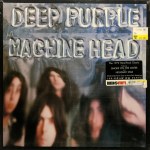
Machine Head on Rhino Vinyl Sounds Like a CD

Hot Stamper Pressings of the Music of Deep Purple Available Now
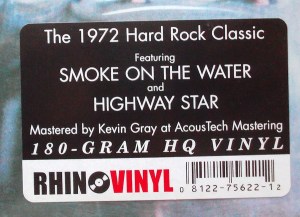
Mastered by Kevin Gray, this record has what we would call ”modern” sound, which is to say it’s clean and tonally correct, but it’s missing the Tubey Magic the British originals are swimming in.

In other words, it sounds like a CD.

I’m guessing that very few people have ever heard this record sound the way our best Hot Stamper pressings can sound.

For one thing, the domestic pressings are made from dubbed tapes, and that’s what most of us Americans would have owned. The original domestic pressings are smeary, veiled and small as a rule

Yes, the average copy may be nothing special, but this one is a boring, lifeless mess, so save your money.

Rhino Records has really made a mockery of the analog medium. Rhino touts their releases as being pressed on “180 gram High Performance Vinyl.” However, if they are using “performance” as a synonym “sound quality,” we have found the performance of their vinyl to be quite low, lower than the average copy one might stumble upon in the used record bins.

Who can be bothered to play a record that has so few of the qualities audiophiles should be looking for on vinyl?

Back in 2007 we put the question this way: why own a turntable if you’re going to play mediocrities like these?


Further Reading

Records are getting awfully expensive these days, and it’s not just our Hot Stampers that seem priced for perfection.

If you are still buying these modern remastered pressings, making the same kind of mistakes that I was making before I knew better, take the advice of some of our customers and stop throwing your money away on Heavy Vinyl and Half-Speed mastered LPs.

(more…)

Francis Albert Sinatra & Antonio Carlos Jobim on Bad Rhino Heavy Vinyl

More of the Music of Frank Sinatra

Reviews and Commentaries for the Music of Frank Sinatra

Sonic Grade: C-

The Rhino 180 gram LP mastered by Kevin Gray is passable, but the real thing is the real thing and just can’t be beat by some wannabe reissue.

There is a richness, a sweetness and a relaxed naturalness on the best early pressings that are virtually never found on modern remasterings.

Rhino Records has really made a mockery of the analog medium. Rhino touts their releases as being pressed on “180 gram High Performance Vinyl.” However, if they are using performance to refer to sound quality, we have found the performance of their vinyl to be quite low, lower than the average copy one might stumble upon in the used record bins.

Mastered by Kevin Gray, this record has what we would call ”modern” sound, which is to say it’s clean and tonally correct, but it’s missing the analog qualities the better originals have plenty of, most notably Tubey Magic. [1]

In other words, it sounds like a CD.

Who can be bothered to play a record that has so few of the qualities audiophiles are looking for on vinyl?

Back in 2007 we put the question this way: Why own a turntable if you’re going to play mediocrities like these?


[1] Some records are so completely lacking in Analog Warmth, Richness and Sweetness that they sound like CDs, and bad ones at that. They have so little Tubey Magic that you might as well peg the figure at ZERO.

This is decidedly not our sound. No Hot Stamper pressing could possibly lack Tubey Magic — it’s one of the things that sets our records apart from the modern mediocrity known as the Heavy Vinyl LP.

The Voice (Isn’t What It Should Be) on Heavy Vinyl

More of the Music of Frank Sinatra

Reviews and Commentaries for the Music of Frank Sinatra

Sonic Grade: D

An audiophile hall of shame pressing and another Classic Records popular music LP badly remastered for the benefit of audiophiles looking for easy answers and quick fixes.

There is a boatload of TUBEY MAGIC to be heard on the early pressings, no doubt due to the fact that they are mastered with tube equipment, but you would never know it by playing this barely passable Classic repressing.

The difference is night and day.

It’s been quite a while since I played the Classic pressing, but I remember it as nothing special. Like a lot of the records put out by this label, it’s tonally fine but low-rez and lacking spacewarmth and above all, Tubey Magic.

I don’t think I’ve ever played an original that didn’t sound better, and that means that the best grade to give Classic’s pressing is probably a D, for below average. It sounds far too much like a CD.

Who can be bothered to play a record that has so few of the qualities we audiophiles are looking for on vinyl?

Back in 2007 we put the question this way: Why own a turntable if you’re going to play mediocrities like these?

(more…)