kg-bad-solo

We often criticize Kevin Gray’s mastering approach on this blog, and for good reason: his records rarely sound any better than tolerable, and most of them are just plain awful.

We encourage the reader to read about his work in the many reviews and commentaries we’ve linked to below.

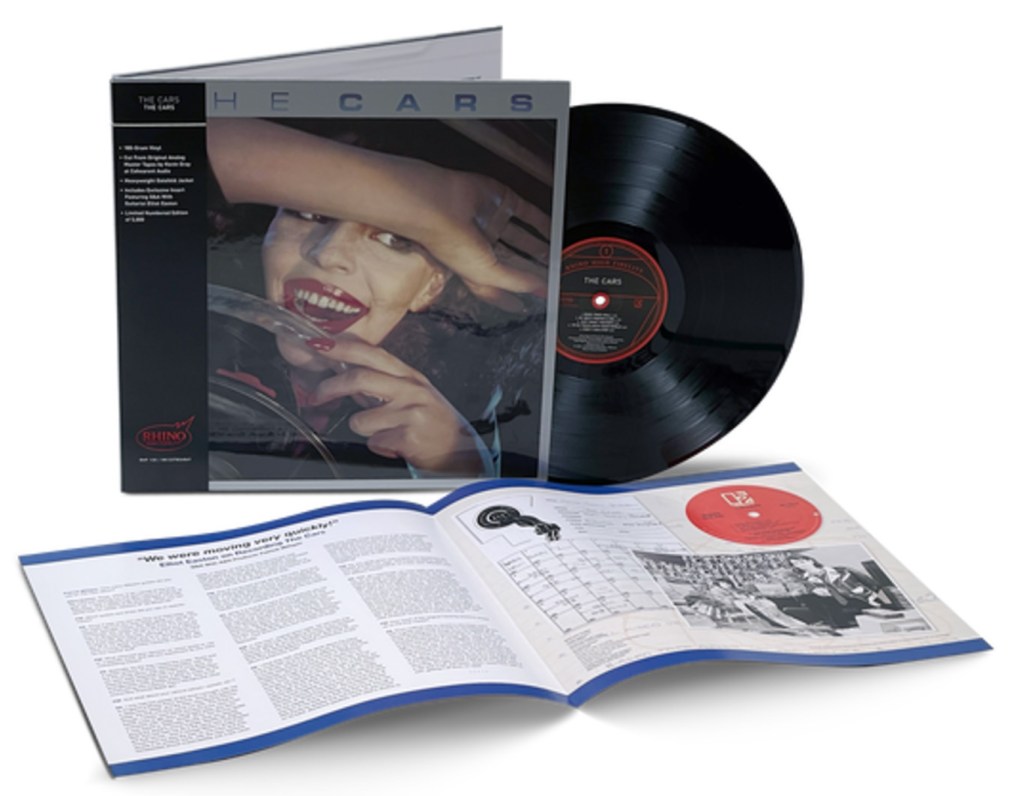
The Cars on Rhino – Man, This Record Is Bad

Hot Stamper Pressings of the Music of The Cars Available Now

I mean, really bad.

Kevin Gray has struck again. He’s a modern one man demolition crew, taking exceptionally well recorded analog albums and turning them into the vinyl equivalent of CDs, and bad CDs at that.

Steve Hoffman did the first Cars album on Gold CD and it sounds quite good. I still own mine. How can Kevin Gray, his former assistant, make such a mess of the album on vinyl?

This question has a rather obvious answer, and much of what we have to say about this record was said in our review of the disastrous Stand Up Gray cut for Analogue Productions.

Allow us to repeat ourselves:

We were finally able to get our hands on the newly remastered Cars first album, a record we know well, having played them by the score. Our notes for the sound can be seen nearby.

If ever a record deserved a “no” grade, as in “not acceptable,” this new pressing mastered by Kevin Gray deserves such a grade, because it’s just awful.
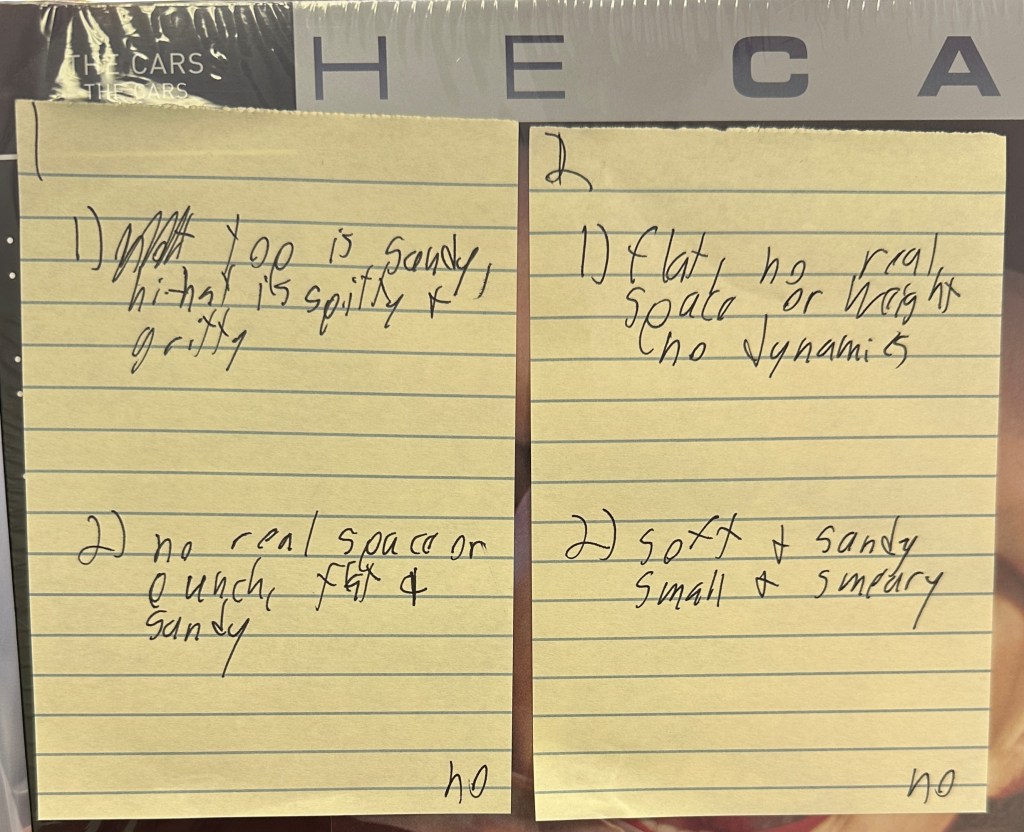
Here is what we heard on side one of the new Cars remaster.

Good Times Roll

  • Top is sandy  [Sandy typically refers to transistory, dry, grainy, or gritty sound.]
  • Hi-hat is spitty and gritty

My Best Friend’s Girl

  • No real space or punch
  • Flat and sandy

You’re All I’ve Got Tonight

  • Flat
  • No real space or weight
  • No dynamics

Bye Bye Love

  • Soft and sandy
  • Small and smeary

Grant Green on Music Matters had many of these same problems. Unsurprisingly, it too was mastered by Kevin Gray.

How this guy is still getting work is beyond me.

I am clearly being facetious here. These guys get work because audiophiles will buy the records they master. The market has decided these records sound just fine, and who am I to say otherwise?

Of course, people can say anything they want about these records, opinions being worth what you pay for them.

We take a different approach. We will sell you the pressing of the album that can mop the floor with this Heavy Vinyl trash. We rarely have the first album in stock, but if you want one, just let us know and we will be glad to put you on the waiting list. Email Fred at fred@better-records.com.

Compared to What?

Is the Rhino pressing the worst version of the album ever made? In our view, it’s only competition would be this disaster, a record that also sold well back in the day. The more things change…
If I were to try to reverse engineer the sound of a system that could play this record and hide its many faults, I would look for a system that was thick, dark and fat, with plenty of tube colorations and no real top end to speak of.

I know that sound. I actually had a system thirty years ago with many of these shortcomings, but of course I didn’t have a clue about any of that. Like every audio enthusiast I met back then, I didn’t know what I didn’t know.

I’m glad to say things are different now, I think.

If you made the mistake of buying this record and can’t stand the phony top end, try covering your tweeter with something absorbent. Foam might work. Also you could try disconnecting your super tweeters if you have any. This is good advice for any record mastered by Stan Ricker as well.

Since that old school vintage tube sound takes the opposite approach to music reproduction that we’ve spent the last few decades working on here at Better Records — our goal being neutrality above all else — we are clearly not playing the record back on equipment that is capable of making it sound anything but godawful, hence our relentlessly negative reaction to the record.

On any properly setup, halfway decent stereo system, any original pressing with RTB in the dead wax should murder this Heavy Vinyl piece of junk. If you don’t have a system like that, we encourage you to get one. You will save a lot of money by not buying crap vinyl like this, only to discover later just how bad it sounds on the higher quality equipment you eventually end up with. (Here is some good news on that subject.)

Although, to be honest, if you are buying these kinds of awful records, it’s hard to see how you will ever get out of the hole you are in. Some audiophiles manage it, but I suspect that most never do.

You can also buy the CD — whether on DCC Gold or just whatever disc Elektra put out — and hear for yourself if it isn’t better sounding. I would be very surprised if it were not.
(more…)

Machine Head on Rhino Vinyl Sounds Like a CD

Hot Stamper Pressings of the Music of Deep Purple Available Now
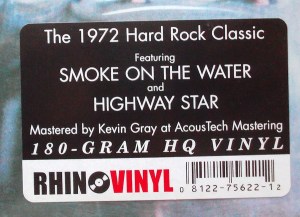
Mastered by Kevin Gray, this record has what we would call ”modern” sound, which is to say it’s clean and tonally correct, but it’s missing the Tubey Magic the British originals are swimming in.

In other words, it sounds like a CD.

I’m guessing that very few people have ever heard this record sound the way our best Hot Stamper pressings can sound.

For one thing, the domestic pressings are made from dubbed tapes, and that’s what most of us Americans would have owned. The original domestic pressings are smeary, veiled and small as a rule

Yes, the average copy may be nothing special, but this one is a boring, lifeless mess, so save your money.

Rhino Records has really made a mockery of the analog medium. Rhino touts their releases as being pressed on “180 gram High Performance Vinyl.” However, if they are using “performance” as a synonym “sound quality,” we have found the performance of their vinyl to be quite low, lower than the average copy one might stumble upon in the used record bins.

Who can be bothered to play a record that has so few of the qualities audiophiles should be looking for on vinyl?

Back in 2007 we put the question this way: why own a turntable if you’re going to play mediocrities like these?


Further Reading

Records are getting awfully expensive these days, and it’s not just our Hot Stampers that seem priced for perfection.

If you are still buying these modern remastered pressings, making the same kind of mistakes that I was making before I knew better, take the advice of some of our customers and stop throwing your money away on Heavy Vinyl and Half-Speed mastered LPs.

(more…)

Letter of the Week – “How the hell did this get released???”

Letters Comparing Hot Stamper Pressings to Their Heavy Vinyl Counterparts

One of our good customers had this to say about a record he played recently:

Hey Tom,   

Not a hot stamper update, but thought to write briefly…

I’ve been experimenting a bit with some of the Analogue Productions stuff, as unlike you I’ve had some mixed success here. However…

OMG. I just opened their pressing of Junior Welles’ Hoodoo Man Blues. It’s, pardon my crudity, not fit to wipe your ass with. The most disgusting perversion of this record imaginable. I’m choking even hearing it. Rank amateurs at the controls it seems… how the hell did this get released??? Are they deaf? Are they even listening to what they’re putting out, or just pressing money? It’s too nauseating to describe, but all your usual terms fit exactly; no ambience, bloated, unreal EQ, compressed and flat and dead, completely f*cking off. I’m just amazed.

The only reason I ventured here is that I have had some good luck with them on various jazz recordings, where the tricks do seem to help (45rpm, master tapes all analogue, etc.). Not so here. Everything you rage about holds true and is possibly the worst case of it I’ve ever come across.

Just sharing with the thought that there is a RANGE of AP stuff; it’s not all this bad. This pressing is escort-it-off-the-property-and-dispose-of-in-someone-else’s-garbage-can-bad.

C

(Meanwhile, latest box of hot stampers arrived today, and are glorious as usual.)

Conrad,

I take issue with any of AP’s records being any good.  None of their “tricks” ever managed to help them produce a record I would want to own. The best one I heard was Fragile, and even that was mediocre. [More recent reviews of AP’s records can be found here. Even though some of them are better than Fragile, I still would not want to have anything they’ve ever pressed in my own collection. In 2007 I swore off mediocrities and feel no need to go back on my word.]

You are mistaken about the “Rank amateurs at the controls it seems…”

The man at the controls was Kevin Gray. He is a professional mastering engineer and has been for a very long time. His records don’t sound very good though, as our reviews make clear for those who care to read them.

Here is a typical review for one of this label’s godawful remasterings:

Vince Guaraldi – a bloated mess at 45 RPM from Acoustech

We flushed good money down the drain in order to suffer through the 45 Analogue Productions cutting of the album. What a mess. Ridiculously overblown bass is its major shortcoming, but dynamic compression and an overall lifeless quality are obvious problems that made us give up on it pretty quickly.

This is the kind of sound that audiophiles want? I find that hard to believe. It’s what they’re stuck with because the good early pressings are just too hard to find and noisy and groove damaged when you do find them.

Most pressings of this album, the OJC and the later reissues especially, are just plain awful, so for the typical audiophile record collector the 45 might actually be a step up over those pressings. Like so much of the heavy vinyl we have played in the last few years, we did not find the sound enjoyable or compelling. I would venture a guess that the DCC gold CD is clearly better overall.

Some audiophiles have complained that we spend too much time bashing Heavy Vinyl, but if ever a record deserved it, it’s that one. It’s a failure as a remastering and an insult to the analog buying audiophile public at large. Searching the web I am glad to see that no one seems to have anything nice to say about it as of this writing. No one should, but that has not deterred the reviewers and forum posters in the past.

Chad was interviewed at the AXPONA show in 2022 by a writer for The Absolute Sound and this is how the conversation went:

“Everything here that I reissued, I wouldn’t have reissued it if I didn’t think it was killer,” Chad said. “At Analogue Productions I’m doing my favorite records, the ones that I think are killer. Otherwise I wouldn’t do it.

“All of those records, you won’t go wrong. If they don’t impress or satisfy you, you might oughta find another hobby.”

Chad also praised the remastered Analogue Productions pressing of Junior Wells’ Hoodoo Man Blues on the Delmark label.

“We’re in Chicago, so if you got a preference for Chicago blues, you need this.”

Our customer is pretty convinced that he “did go wrong.”

Since he was not able to return the record owing to Chad’s “no returns for bad sound” policy, I guess Chad would say that he “might oughta find another hobby.”

Or wise up and stop buying records from someone who apparently doesn’t have faith in his own product.

Chad Has Served Poor Jethro Tull Most Barbarously

Hot Stamper Pressings of the Music of Jethro Tull Available Now

With a nod to our old friend, John Barleycorn.

We were finally able to get our hands on Analogue Productions’ newly remastered Stand Up, an album we know well, having played the British copies from every era by the score. Our notes for the sound can be seen below.

If ever a record deserved a “no” grade, as in “not acceptable,” this new 45 RPM pressing mastered by Kevin Gray deserves such a grade, because it’s just awful. (This link will take you to a great many more records best avoided by audiophiles in search of better sound. Although we’ve only linked to about 75 pressings here on the blog, it should be noted that the world is full of bad sounding records.)

But let’s put that grade in context. The last time a good sounding version of Stand Up was released, as far as we can tell, was 1989, and that version was the Mobile Fidelity Gold CD. I bought mine soon after it came out. I wasn’t even planning on buying a CD player when the Compact Disc was first invented, but then Mobile Fidelity played a dirty trick on me. Instead of releasing Loggins and Messina’s first album on vinyl, they put it out exclusively on CD as part of their Silver MFCD series.

As a die-hard MoFi fan, that sealed the deal: now I had to buy a CD player. I picked up a cheap Magnavox player, the 1040. I think it ran me less than $100, and played my new Sittin’ In CD, which, as I recall, sounded pretty good. (One of my other early CD purchases was Tumbleweed Connection, the regular label release, and it was dreadful.)

I still own Stand Up on Gold CD, and I still find it superb in every way. (Many of the MFSL Gold CDs from this era are excellent and worth seeking out.)

It sounds nothing like this new vinyl release, and that’s a good thing.

On vinyl, Stand Up has rarely been given the care it deserved. The last version of Stand Up to have sound we would want to listen to was pressed in the UK in the early ’70s. That was close to fifty years ago.

We sold some domestic pressings of the album back in the early 2000s, describing them at the time as made from dub tapes with all the shortcomings that entails, but mastered very well from dub tapes. The best domestic pressings are rich, smooth, tonally correct and natural sounding. They’re too dubby to sell as Hot Stampers, but they are not bad records. Some later Chrysalis pressings are big and open, but often they are too thin and bass-shy for the music to work. We’ve never taken them seriously.

It wasn’t long before we’d eliminated everything but the early UK pressings for our shootouts, and we quickly discovered that the earliest of the UK pressings on the older Island label were not good at all. We wrote about the problem with some originals more than ten years ago.

What was surprising about the shootouts we had done in past years was how disappointing most of the early British pressings we played were. They were flat, lacked energy and just didn’t rock the way they should have.

We learned the hard way that most British Pink label pressings aren’t especially rich, that some are small and recessed, and some are just so smeary, thick and opaque that they frustrate the hell out of you as you’re trying to hear what any of the musicians other than Ian Anderson is doing.

So when a reviewer comes along and says something positive about the new pressing compared to some unidentified original, we appreciate the problem that is at the root of his mistaken judgments:

Here’s the deal: if the goal was to duplicate the original pink label Island sound, this reissue misses that, which is good because this new double 45 reissue is far superior to the original in every possible way.

The tape was in great shape, that’s for sure. Clarity, transparency, high frequency extension and especially transient precision are all far superior to the original. Bass is honest, not hyped up and the mastering delivers full dynamics that are somewhat (but only slightly), compressed on the original. Ian Anderson’s vocals are naturally present as if you are on the other side of the microphone. Most importantly, the overall timbral balance sounds honest and correct. But especially great is the transient clarity on top and bottom.

If you’re fortunate to have an original pink label Island, at first you might think the sound is somewhat “laid back”, but that’s only because the mids and upper mids are not hyped up as they are on the original. That adds some excitement, but it clouds the picture and greatly obscures detail.

If you scroll down to our notes, you will see what we thought of the “laid back” sound this reviewer talks about. (Keep in mind that we first read the above review mere moments ago.)

We think “smaller, thick and stuck in the speakers” may be someone’s idea of “laid back,” but, just so there is no misunderstanding, it’s our idea of “awful.”

None of these are good things. Our Hot Stamper pressings are never small, thick or stuck in the speakers. They’re the records with the opposite of that sound. Our records are big, transparent and open. That’s why we can charge so much money for them and have people scooping them up from our Wednesday mailer the moment they become available.

They deliver the big, bold sound that the brilliant engineer for the album, Andy Johns, was known for. Laid back was not in his vocabulary.

Here is more of what we heard on side one.

Jeffrey Goes to Leicester Square

“Transients are sharp but body is dull. Kinda phony.”

Phony sound is the key here. Messing with the EQ in the mastering benefits some aspects of the sound at the expense of others.

Nothing new there. Audiophile pressings with wacky EQ are the norm. I would be surprised if any common Reprise pressing from back in the day wouldn’t sound more “right,” more tonally correct, more seamless. I’ve played quite a few and I don’t recall ever hearing one sound “phony.”

On side two we played the first two tracks.

(more…)

Francis Albert Sinatra & Antonio Carlos Jobim on Bad Rhino Heavy Vinyl

More of the Music of Frank Sinatra

Reviews and Commentaries for the Music of Frank Sinatra

Sonic Grade: C-

The Rhino 180 gram LP mastered by Kevin Gray is passable, but the real thing is the real thing and just can’t be beat by some wannabe reissue.

There is a richness, a sweetness and a relaxed naturalness on the best early pressings that are virtually never found on modern remasterings.

Rhino Records has really made a mockery of the analog medium. Rhino touts their releases as being pressed on “180 gram High Performance Vinyl.” However, if they are using performance to refer to sound quality, we have found the performance of their vinyl to be quite low, lower than the average copy one might stumble upon in the used record bins.

Mastered by Kevin Gray, this record has what we would call ”modern” sound, which is to say it’s clean and tonally correct, but it’s missing the analog qualities the better originals have plenty of, most notably Tubey Magic. [1]

In other words, it sounds like a CD.

Who can be bothered to play a record that has so few of the qualities audiophiles are looking for on vinyl?

Back in 2007 we put the question this way: Why own a turntable if you’re going to play mediocrities like these?


[1] Some records are so completely lacking in Analog Warmth, Richness and Sweetness that they sound like CDs, and bad ones at that. They have so little Tubey Magic that you might as well peg the figure at ZERO.

This is decidedly not our sound. No Hot Stamper pressing could possibly lack Tubey Magic — it’s one of the things that sets our records apart from the modern mediocrity known as the Heavy Vinyl LP.

Who’s Next – An Overview

More of the Music of The Who

The following was written in the early 2000s. Some of the commentary has been added or modified.


Who’s Next has been remastered for audiophiles many, many times, more often than not quite badly in our opinion.

To be fair, we should point out that our opinion has changed quite a few times over the course of the last twenty years.

This then is our story.

MCA MASTERPHILE

Back in the days when I was foolishly in the thrall of half-speed mastered audiophile pressings, I thought that the MCA Masterphile was king. That was probably the mid to late ’80s.

BRITISH TRACK LABEL ORIGINALS

By the early 90s I had discovered how good the Black Label Original British Track pressings could be and started preferring those. A bit murky but Tubey Magical, full and rich, precisely the way a good British Rock recording (Faces, Jethro Tull) should be.

JAPANESE AND GERMAN

Of course by then I had played numerous Japanese and German pressings, none of which sounded right to my ears, then or now. The Japanese did what they like to do to most of the records they master, from whatever dub tapes are sent to them: they brighten up the sound.

When I had much darker, less-revealing system, the Japanese pressing did better than most of the other pressings I played.

But it was wrong, and the better my stereo got the more wrong it sounded. This process comes under the general heading of audio progress 

MCA HEAVY VINYL

In 1995 the MCA Heavy Vinyl version came out, mastered by Kevin Gray. I quite liked it at the time but no longer do; it’s brightened up, opaque, airless and much of the fine detail of the recording is missing, all due to the crude cutting system Kevin employed at the time. It’s also notoriously badly pressed, resulting in stitches in the vinyl that are audible on practically every copy. (more…)

My Aim Is True – More Heavy Vinyl Trash from Rhino

Hot Stamper Pressings of Elvis’s Albums Available Now

I’m embarrassed to say we used to like the Rhino Heavy Vinyl version, and in our defense let me tell you why: it was (for the most part) tonally correct, fairly low distortion, and had tight punchy bass.

Boy, Was We Ever Wrong. 

Now it sounds positively CRUDE and UNPLEASANT next to the real thing — if by “the real thing” you mean an honest to goodness properly-mastered, properly-pressed copy (also known as a Hot Stamper).

Kevin Gray’s transistory, opaque, airless, low-resolution cutting system did this album no favors.

The average copy of this record is aggressive and unpleasant. 

The British pressings are mud.

You either have to work very hard to find a good domestic pressing (which means buying, cleaning and playing lots and lots of them), or you have to luck into a good one by accident.

Or just buy one from us and save yourself all the trouble.

Spirit – Sundazed Heavy Vinyl Mono Reviewed

Sonic Grade: D

Another Sundazed record reviewed and found to be way off the mark.

As usual, the Sundazed only hints at the exceptionally good sound found on the best early pressings. We recommended it back at the day — let’s face it, we had a lot to learn.

In its defense, allow me to point out that it’s tonally correct, so for fifteen bucks you are getting your fifteen bucks worth, and probably not a dime’s more. We just cannot take this kind of sound seriously anymore.

Once you’ve heard the real thing, this pressing just won’t do.

Kevin Gray remastered this title, and we have found that the bulk of the records he’s involved with are rarely better than awful. Here is a good example of a record he mastered that falls far short of any record that would qualify to have the words “audiophile pressing” attached to it.

Look for these obvious signs that you are playing one his recuts:

The sound is opaque. It resists your efforts to hear into the recording. This is to be expected. Modern records in general tend to lack transparency, one of the most important qualities that the better vintage pressings have in abundance.

In addition, Gray’s records consistently lack ambience and air. We discuss that subject in more depth here.

If you are looking for audiophile sound on vinyl, our advice would be to avoid any record he is associated with.

Dave Mason – Alone Together on MCA Heavy Vinyl

More of the Music of Dave Mason

Reviews and Commentaries for the Music of Dave Mason

Sonic Grade: D

I confess I actually used to like and recommend the Heavy Vinyl MCA pressing. Rest assured that is no longer the case. Nowadays it sounds as opaque, ambience-challenged, lifeless and pointless as the rest of its 180 gram brethren.

As for other records we got wrong, you can find plenty more here, under the heading: Live and Learn.

We struggled for years with the bad vinyl and the murky sound of this album. Finally, with dozens of advances in playback quality and dramatically better cleaning techniques, we have now managed to overcome the problems which we assumed were baked into the recording. I haven’t heard the master tape, but I have heard scores of pressings made from it over the years. 

It is a surely a MASTERPIECE that belongs in any Rock Collection worthy of the name. Every track is good, and most are amazingly good. There’s not a scrap of filler here. The recording by Bruce Botnick is hard to fault as well.

1970 was a great time in music. Tea for the Tillerman, Bridge Over Troubled Water, Moondance, Sweet Baby James, Tumbleweed Connection, After the Goldrush, The Yes Album, McCartney, Elton John, His Band And Street Choir, Deja Vu, Workingman’s Dead, Tarkio, Stillness, Let It Be — need I go on?

Even in such illustrious company — I defy anyone to name ten albums of comparable quality to come out in any year — Alone Together ranks as one of the best releases of the year. (more…)

The Not-So-Magnificent Thad Jones – More Dreck on Heavy Vinyl

Hot Stamper Pressings of Blue Note Albums Available Now

After discovering Hot Stampers and the mind-blowing sound they deliver, a new customer generously sent me a few of his favorite Heavy Vinyl pressings to audition, records that he considered the best of the modern reissues that he owns.

He admitted that most of what he has on Heavy Vinyl is not very good, and now that he can clearly hear what he has been missing, having played some of our best Hot Stamper jazz pressings, he is going to be putting them up on Ebay and selling them to anyone foolish enough to throw their money away on this kind of junk vinyl.

We say more power to him.  That money can be used to buy records that actually are good sounding, not just the ones that are supposed to be good sounding, perhaps because they were custom manufactured with the utmost care and marketed at high prices to soi-disant audiophiles.

Audiophile records are a scam. They always have been and always will be.

The three of us who do the critical listening here at Better Records dropped the needle on the first disc in this set and, once the VTA was properly adjusted, gave it a chance to show us just what expert remastering from vintage mono tapes, at 45 RPM, on two slabs of luscious, thick vinyl, could do for the sound of Thad Jones’s trumpet, circa 1956.

The reissue we are playing is the one Music Matters released in 2010. There was a single disc version released by them in 2016, recut by Kevin Gray and Ron Rambach. At the time of this writing, there is one for sale on Discogs for $235.

None of us had ever heard the album on any media, vinyl or otherwise, but we know a good sounding jazz record when we hear one, and we knew pretty early on in the session that this was not a good sounding jazz record.

Two minutes was all it took, but we wasted another ten making sure it was as bad as we thought.

(more…)