Robert Brook runs a blog called The Broken Record, with a subtitle explaining that the aim of his blog is to serve as:
A GUIDE FOR THE DEDICATED ANALOG AUDIOPHILE
Here is a posting Robert wrote many years ago and has recently updated.
Robert Brook runs a blog called The Broken Record, with a subtitle explaining that the aim of his blog is to serve as:
A GUIDE FOR THE DEDICATED ANALOG AUDIOPHILE
Here is a posting Robert wrote many years ago and has recently updated.

On the better copies both the sound and music are absolutely breathtaking. They reproduce clearly what, to our minds, are the three most important elements in the recording — strings, rhythm, and vocal — and, more importantly, the are reproduced properly balanced with one another.
The monos, as you might expect, balance the three elements well enough, but the problem with mono is that the vocals and instruments are jammed together in the center of the soundfield, layered atop one another. Real clarity, the kind that live music has in abundance, is difficult if not impossible under the circumstances. Only the stereo pressings provide the space that each of the elements need in order to be heard.
Naturally, the vocals have to be the main focus on a Billie Holiday record. They should be rich and tubey, yet clear, breathy and transparent. To qualify as a Hot Stamper, the pressings we offer must be highly resolving. You will hear everything, surrounded by the natural space of the legendary Columbia 30th Street Studio in which the recording was made.
Robert Brook runs a blog called The Broken Record, with a subtitle explaining that the aim of his blog is to serve as:
A GUIDE FOR THE DEDICATED ANALOG AUDIOPHILE
Here is Robert’s latest posting.
Robert writes:
A few years ago, Better Records founder Tom Port told me something that I’ve never forgotten. I had just demoed my system for an industry guy, and while relaying the experience to Tom, he asked me what records I had played for him. I mentioned a few, including Charles Mingus‘s Ah Um.
Tom said (paraphrasing here) “Not a good choice. You want to play records that can only sound good one way. Ah Um can sound good a lot of different ways.”
At the time I didn’t fully understand what Tom was getting at. Ah Um, or at least the copy of it I had, always sounded great. Wasn’t it therefore a great record to demo my system with?
Since then I’ve come to understand that this was exactly Tom’s point. If you really want to show someone what your system can do, by all means, play a great sounding record, but also one that requires your turntable and your system as a whole be at their best to reproduce it.
Lately I’ve come to understand something that I feel every audiophile, analog audiophiles in particular, would do well to recognize and come to terms with. When we play a record, each of us is listening for different things, and these things are very often not the things that we should be listening for if we want to determine if our system is sounding its best.
Robert continues:
But a pretty steady diet of Ah Um for a number of years now has taught me that the right copy will sound good, even with the most basic turntable setup, and even on a system that’s not performing its best.
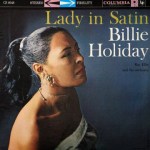
Meanwhile, it would seem that Lady In Satin is a record that only sounds good, great even, one way and one way only. It needs us to attend to all the little details in our system before it will reveal its magic.

Hot Stamper Pressings of the Music of Billie Holiday Available Now
The better copies reproduce clearly the three most important elements in the recording — strings, rhythm, and vocal — and, more importantly, they are properly balanced with one another.
The monos, as you might expect, balance the three elements well enough, but the problem with mono is that the vocals and instruments are jammed together in the center of the soundfield, layered atop one another.
Real clarity, the kind that live music has in abundance, is difficult if not impossible under those circumstances.
Only the stereo pressings provide the space that each of the players needs in order to be heard.
Naturally the vocals have to be the main focus on a Billie Holiday record. They should be rich and tubey, yet clear, breathy and transparent.
To qualify as a Hot Stamper, the pressings we offer must be highly resolving. You will hear everything, all of it surrounded by the natural space of the legendary Columbia 30th Street Studio in which the recording was made. (more…)
Hot Stamper Pressings of the Music of Billie Holiday
Robert Brook has a blog which he calls
A GUIDE FOR THE DEDICATED ANALOG AUDIOPHILE
Below is a link to the review he has written for one of our favorite records, Lady in Satin.
In this review he compares our White Hot Stamper pressing to his two originals, a Six Eye Mono and a Six Eye Stereo. We knew where this review was headed; we’ve been down that road ourselves. For our most recent Hot Stamper reissue, we noted:
There may be amazingly good sounding original pressings, as amazingly good as this one, but we’ve never run into one and we have our doubts about the existence of such a magical LP – where could they all be hiding?
Add Robert’s two originals to the pile of pressings that sound good, but not as good as we might want them to.
Hot Stamper Pressings of the Music of Billie Holiday Available Now
It’s been quite a while since I played the Classic Records pressing that came out in 1998, but I remember it as nothing special, tonally correct but with somewhat low-rez (not breathy) vocals and lacking in both space and warmth.
Records made for audiophiles are rarely any good, so rarely in fact that we are positively shocked when such records are even halfway decent. After playing so many bad audiophile records for so many years it’s practically a truism here at Better Records.
A recording like this is the perfect example of why we pay no attention whatsoever to the bona fides of the disc, but instead make our judgments strictly on the merits of the record spinning on the table. The listener normally does not even know the label of the pressing he is reviewing. It could be a Six Eye original, the 360 reissue, or even a (gasp!) ’70s-era LP.
We don’t care what the label is.
What does that have to do with anything? We’re looking for the best sound. We don’t play labels, we play unique pressings of the album. We assume that every pressing sounds different from every other pressing. Our job is to figure out what each of them is doing, right or wrong.
We mix up all our copies and play them one after another until we come across the best sounding one.
This approach has opened up a world of sound that most audiophiles — at least the ones who buy into the hype associated with the typical audiophile pressing — will never be able to experience.