Geoff Edgers is a writer for the Washington Post. After visiting our studio and seeing our operation in 2022 as part of his investigation into the world of audiophiles, he wrote an award-winning story entitled The Search for the Perfect Sound, which contains a video interview with yours truly.
A video of me doing a shootout was filmed that day. It would have been just the thing to show the public the process we go through with every title we play, and how seemingly identical pressings can sound so different, but unfortunately the video could not be used due to licensing issues.
In the coming months, Geoff expects to be doing more on audio and records, focussed on the obsessions of those who, like me and probably you, are devoted to both.
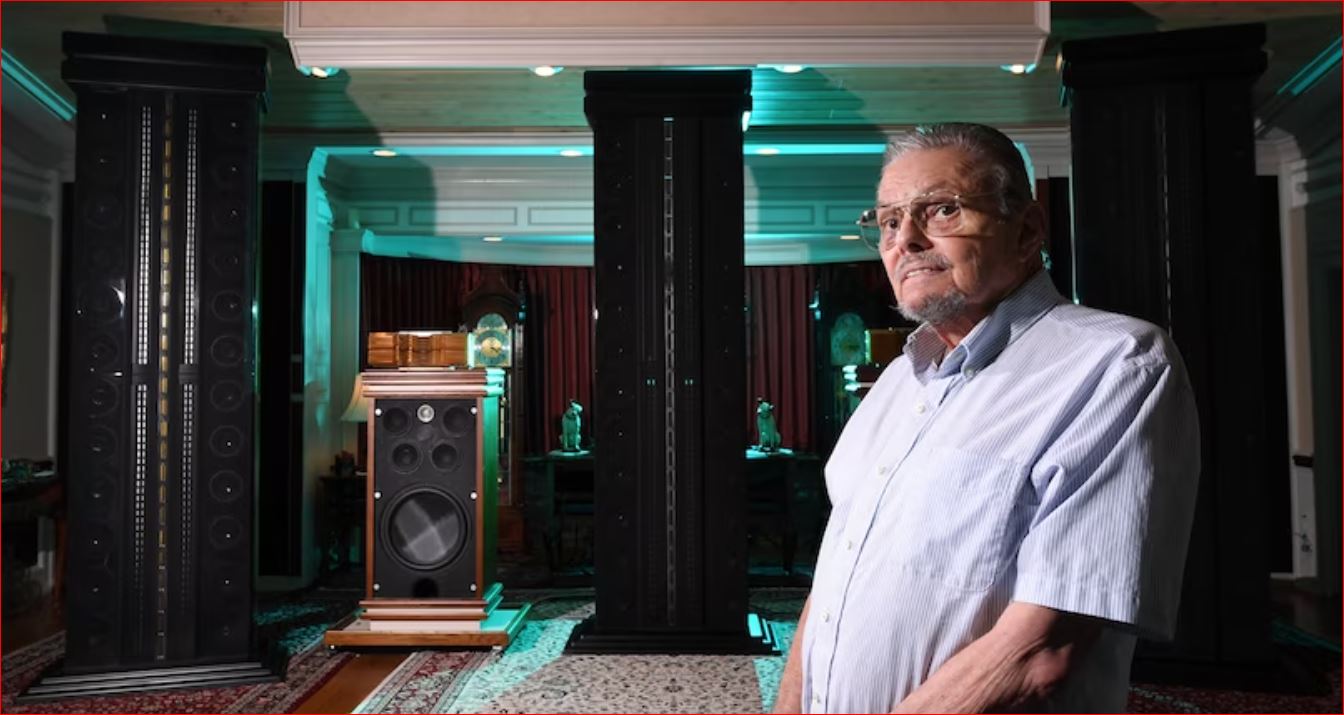
Ken Fritz turned his home into an audiophile’s dream — “the world’s greatest hi-fi”.
What would it mean in the end?
Geoff Edgers has written a highly entertaining story about an extremely misguided audiophile who went “searching for perfect sound” in ways that practically guaranteed he would never find it.
There are a number of lessons to be learned from this fellow’s mistakes.
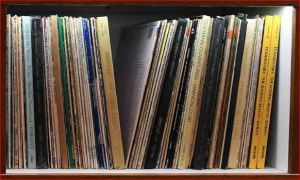
Just to take one obvious example, this picture of some of the records in his collection speaks volumes, at least it does to me.
He built a million dollar stereo to play records like these?
No amount of money spent on equipment can make most of these titles sound good, and failure to appreciate that fact is just one of the many fatal errors the late Mr. Fritz made in his approach to both records and audio.
He mistakenly thought he was at the “I know everything” stage, but that is just the prelude to the stages of knowledge where real understanding and progress begin, not end.
My own stereo history may be of some value in helping to shed light on these issues. Like everyone else, I started at the bottom. Thank god I didn’t have a million dollars to waste back then because I clearly didn’t understand audio any better than the late Mr. Fritz did.
Like him and practically every audiophile I’ve ever come in contact with, I sure thought I did. Having suffered myself from a serious case of pretentious-knowledge syndrome, it’s easy for me to spot the signs in others. (My understanding is that you can’t sign up on the Hoffman Forum without first proving your know-it-all bona fides.)
Why So Uncomfortable?
In a recent letter I received about the Dynavector 17dx cartridge we use, this question was posed:
Why is it that audiophiles are so uncomfortable with the idea that they might be wrong? I mean, you can’t improve if you think you are already right.
I answered as follows:
I was no different back when I started. For about my first ten years in high-end audio, roughly 1975-85, I bought the most expensive equipment that I could afford, as long as it sounded good to me and was well-liked by those whose ears I trusted.
Is the audiophile of today doing anything different?
What would you be doing if you hadn’t stumbled on a guy with some credibility — he sold you some records that sounded amazing, so he must know something — who turned you on to some audio stuff that sounds great and, better yet, didn’t cost that much?
And how did this guy — me — come to find out about all this stuff in the first place? Well, I’ll tell you.
He had a good audio friend who turned him on to Dynavector cartridges twenty years ago (but oddly enough not the really good one they sell. I had to make that leap for myself).
And this audio friend had learned through extensive trial and error that there were certain receivers one could pick up for cheap at thrift stores that offered excellent, audiophile-quality sound. (Trial and error were his forte. This is the same guy that clued me into the concept of Hot Stampers, a life-changing concept if ever there was one.)
As it turned out, even my friend did not know how good the sound of the receiver he sold me could be when fed by a top quality outboard phono stage, something he did not have access to. (The receiver’s phono stage is decent but hopelessly outclassed by the EAR 324p we use.)
I ended up buying four or five different models with mediocre-at-best sound before I realized the one I owned must be a fluke. Then I bought three more of the model I liked and they all sounded different too, although they ranged in sound at most from excellent to crazy good. So I put the best sounding one in my system and kept the other three for backup. Like I said, they were cheap.
When I met my friend George Louis in San Diego back in the 80s, he had a much better system than I did. He was using non-audiophile-approved equipment that drove custom speakers. He showed me that my audiophile electronics and my Fulton so-called state-of-the-art speakers were not nearly as good as I thought they were. What did I know back then? Not as much as I thought I did, that’s for damn sure.
When I moved to Los Angeles in 1987, I met a fellow audiophile named Robert Pincus and we quickly became friends. I was selling vintage classical records to audiophiles (along with lots of other records) and he was supplying me with whatever Shaded Dogs, Mercs, Londons, EMIs and such that he could dig up with top quality sound and surfaces.
He showed me that no two records sound the same, and even that often two sides of the same record don’t sound the same. Once I had a chance to listen to some of the “Hot Stamper” pressings he brought me, I was sold.
One of our good customers had some questions about a commentary we wrote entitled a kinder, gentler approach to record reviewing.
Tom, what about the argument that the engineers had to make the records sound good on the equipment of the day? Now that we have better gear, these guys can make the record sound the way it was originally intended. I think Chad said this about Rudy Van Gelder at some point in the video.
For the benefit of the reader, the video in question can be found on youtube under the title “Michael Fremer, Chad Kassem, Geoff Edgers: A Journey Back to Vinyl.”
Edgers was invited, apparently under pretext as it turns out, to talk about his article, but instead he was pressed into defending me most of the time. Kassem and Fremer — two individuals whose talents, such as they are, could not be more ill-suited to the work they have chosen for themselves — beat up on Edgers for about two hours.
As an aside, Geoff is a good guy and he certainly didn’t deserve this kind of mistreatment. Fremer and Kassem won’t apologize to him — that’s not something they are known to do — so please allow me to apologize to Geoff on their behalf.
I’m sure he has trouble understanding to this day why he was forced into acting as a spokesman for Better Records. Regardless of how he feels about it, we thank him for his service to the cause. (To be clear, he didn’t exactly take my side, which is the right thing for a reporter to do. He wanted to know why our disagreements upset them so much.)
For those of you who like to watch bickering and sniping from a couple of thin-skinned egomaniacs who can’t stand the fact that someone doesn’t think the records they like — or in the case of Chad, produce and sell — are any good, have I got a video for you. If you want to undertand how seriously you should take these two guys, both at the top of their respective mountains, watch the video and make your own judgments.
Our letter writer continues:
Suppose, that the RL cut of Zeppelin 2 had never existed, because Ludwig knew better than to cut it that way, knowing that most stereos couldn’t play it? And then Chad released something that sounded like that. Or, the argument that albums were engineered for listening to on the AM radio.
I think these guys believe they are improving on the mastering, and giving it the sound it should have had all along.
Dear ab_ba,
Yes, you are correct, this is indeed their position. They think these newly remastered pressings are a big improvement over earlier editions, and on quieter vinyl to boot!
Allow me to quote Michael Fremer, a man who apparently cannot get enough of the new records, even though his shelves are stuffed.
Steve Westman invited me to appear again on his youtube channel chat with the Audiophile Roundtable.
At about the 39 minute mark, we discuss my picks for what I would rate as the Five Best Sounding Records I know of.
I wanted to go with more variety, so I picked two rock records, two jazz records and one classical album.
A rough transcription with corrections and additions follows:
Before I did my top five, I wanted to say something along the lines of, if you want to know where somebody’s coming from in audio, you don’t ask them what their stereo is, you don’t ask them what their room is like, and how their electricity is done, and what their history with audio is, because they’re not going to tell you, and they just don’t want to go down that road.
But you can ask them about music, and that will tell you a lot about where they’re coming from, so here are my questions for people if I wanted to know more about their understanding of records (and, by implication, audio):
One: what are the five best sounding records you’ve ever heard?
Two: what are your five favorite records of all time?
Three: what five famous recordings never sounded good to you?
Four: name five recordings that are much better than most of your friends or audiophiles in general think?
In my world, you would have to tell me what pressing you’re listening to. If you said “I love the new Rhino Cars album,” I think we would be done, but if you told me that you love the original, then I would say yes, I love that record too. I bought it in 1978 and I’ve played it about 5000 times. Never tired of hearing it.
At about the 48 minute mark I reveal the best stampers for Ry Cooder’s Jazz album.
At about the 50 minute mark someone asks about my system. This would be my answer:
All that information is on the blog., I actually do a thing about my stereo where I take it all the way from 1976 to the present, which I’m sure bores people to death, but you know, there was a lot to talk about there.
There were a lot of changes that I went through and I even talk about how my old stereo from the 90s, which I had put together after having been an audiophile for 25 years, was dark and unrevealing compared to the one I have now, so all my opinions from 25 years ago are suspect, and rightly so.
I feel the same thing is going on in the world of audiophiles when you have systems that aren’t very revealing and aren’t tonally accurate, yet are very musical and enjoyable the way Geoff would like, but they’re not good for really knowing what your records sound like because your system is doing all sorts of things to the record that you’re playing in order to keep the bad stuff from bothering you.
All the bad stuff just jumps out of the speakers, and that’s why these heavy vinyl records don’t appeal to us anymore, because we hear all the bad stuff and we don’t like it.
At 1:03 I’m asked if I like any modern mastering engineers, and the only one I can think of is Chris Bellman, because he masterered one of the few Heavy Vinyl pressing I know of that sounds any good, Brothers in Arms, released in 2021. I played it when Edgers brought it by the studio when he first visited me in preparation for his article.
My best copy was clearly better in some important ways, but Bellman’s mostly sounds right, and that surprised me because most of these modern records sound funny and weird and rarely do they sound right.
(Geoff brought over three records that day: Brothers in Arms, the remastered Zep II, and a ridiculously bad sounding Craft pressing of Lush Life, which was mastered by Bernie Grundman, and one which I have not had time to review yet. It was my introduction to the Craft series (in this case the small batch, limited to 1000), and let’s just say we got off on the wrong foot. I told Geoff it sounded like a bad CD, and that’s pretty much all I remember of it. The average price for that pressing on Discogs is roughly $210 these days. The CD is cheaper and there is very little doubt in my mind that it would be better sounding to boot.)
At 1:04 I mention the biggest snake oil salesman in the history of vinyl, the man behind The Electric Recording Company.
Patrick mentions an ERC Love record which he likes, but we played one that sounded about as bad as a bad record could sound. That Love record will never get any love from us. He says he’ll never buy another ERC pressing, but that doesn’t sound like the kind of thing someone who really likes a record would say, does it? I suppose you can ask him in the comments section why that would be.
At some point I talk about the studio we play records in, not exactly spouse-friendly but good for hearing what’s really in the grooves of the records we play:
The reason the sound room is the way it is is because you’re not there to be reading magazines and looking at your phone. You’re just in there to sit in a single chair in front of two speakers, not talking. Nobody else is in there. They have no business being in there. It’s just you and the music and that’s the way I like it.
This next section has been fleshed out quite a bit. I took the question posed and ran with it:
In “The search for the perfect sound,” arts reporter Geoff Edgers explores the boom in vinyl record sales and the often contentious world of extreme audiophiles through an immersive mix of video, interactive audio and narrative reporting. This multimedia feature revealed the characters behind this growing subculture, from audio elites hunting down rare pressings to populists sharing their hobby with their community.
Edgers had rocked the audiophile world earlier in the year with his reporting on a record company scandal. Through more than two dozen interviews and over a year of reporting; original photography and video; and interactive audio, this project took both newcomers and experts into the debates and technicalities of this growing market — and captured the artistry that make fans so passionate to begin with.
To open the story, Edgers and video journalist CJ Russo joined the controversial audio entrepreneur Tom Port during one of his “shootouts,” sessions in which Port listens to many pressings of the same record to find the best-sounding version.
How could we re-create this scene for readers? Nothing could match the experience of sitting in front of one of these deluxe sound systems.
With the help of contacts in the music world, the team designed the next best thing. Edgers and audio producer Bishop Sand traveled to Brooklyn with a binaural microphone and a stereo microphone to record the same tracks, the Miles Davis Quintet’s “Oleo” and Neil Young’s “Out on the Weekend,” playing once as a digital file and once on vinyl through Jonathan Weiss’s $363,000 Oswalds Mill Audio speakers. Sand matched the loudness of the recordings postproduction.
The team embedded those tracks as audio quizzes in the story, challenging readers to listen and guess which version was the digital file and which was the vinyl track. After meeting the characters who organize their lives around the search for the perfect sound, readers could get a taste of the difference for themselves.
“She tore up a picture of the pope. Then her life came
apart. These days, she just wants to make music.”
This was true as of 2020, when Geoff Edgers wrote his touching and insightful story about her.
To give you the flavor of the piece, a series of text messages she sent him can be seen below.
I do feel like I was a monster. I feel awful. I do beat the living s- - - out of myself. Am full of grief about it would be a better way of describing it
Was Not my purpose on the planet to have hurt anyone …
But no one ever minded if they hurt me
Is the thing
That’s part of the code also
All artists have one dream that will never come true
If you can figure that out you know them
They teach that in acting school. Key to finding a character is what dream does he or she have that will never come true
One of our good customers had this to say about all the Hot Stampers he has purchased from us over the last year or so (bold added by us):
Dear Tom,
You don’t seem to have too many friends in the vinyl industry. I think it’s a safe bet to say that you have more satisfied customers than industry peers.
I checked my purchase history, and bought my first hot stamper just over a year ago. I can’t believe it’s been that short a time. I have 12 of your records, and I’ve returned 5 to you. Every one of them is a gem in my collection. In my collection of a couple thousand or so, I have other records that sound as good as the ones I bought from you, but not these particular titles, and maybe 5% of my collection sounds to me like a record I might have gotten from you.
I’m appreciative of the records you’ve sold me, and considering a few other things, I am saving money as a customer of yours, compared to my previous buying habits. First of all, the opportunity to return records that I feel are not worth the price I paid (for whatever reason) ensures that my collection of hot stampers itself only includes records that I feel were worth the price I paid. Especially when you consider “spins per dollar,” I’m getting more value out of the hot stampers than the rest of the collection. ($40 on a record I’ll play once or twice, versus $600 on a record I’ll play dozens of times.) But also, it’s the other things I’ve learned from you and your blog. How to listen to records. How good vinyl can sound, when you really do it right. How to clean records.
But, the most important thing I’ve learned from you is how to build a great stereo for vinyl.
I followed your advice to a T, because each new step I took in the direction you recommended yielded clear dividends. I now have an EAR 324 phono stage, a low-powered vintage amp (Sansui 7500, recommended on TheBrokenRecord), and high-sensitivity vintage speakers – Legacy Signature 3’s. I top them off with Townshend SuperTweeters. I get clarity, fullness, soundstage depth, and what was most elusive on my previous setup (McIntosh, B&W), I now get vocals to die for.
One must work up to hot stampers. I get that, but it’s kind of a shame. Ten years ago, when I got back into vinyl, I didn’t think I’d ever buy a $600 record, let alone actively peruse listings of them every Wednesday evening. But, had I started off following your advice on how to build a stereo, and had I started off with your records, I’d have spent less money by now, and built a satisfying stereo and vinyl collection a lot sooner, and for far less expenditure overall.
I’m writing this to you today because I’ve found myself in the really unexpected position of defending you in a few settings where common sense and open-mindedness should not have made those defenses necessary. This was on a YouTube livestream earlier today [linked below for those of you who have a couple of hours to waste], and on a forum thread that’s unfolded over the last couple of weeks [which might actually be worth reading].
Tom, you’ve made yourself into a polarizing figure by stating your views unambiguously. And because people don’t like the way you say things, they won’t even try your records. Everybody can agree on the fundamentals – that not all records sound the same. That older records can often sound better than modern re-presses of them. That it’s worth it to pay more for records that have been play-tested.
And yet, those people swear they won’t buy your records. When you criticize somebody else’s records, I’ll venture a bet you hurt your own business more than theirs. And yet, you keep doing it.
Despite how much people love to complain about you, many of your records are sold before I’ve even made up my mind whether or not I want to buy them. I guess there’s a lot of us who aren’t turned away by your rhetoric, and I know we’re better off for it.
Mr. A
Mr. A,
Thanks for the kind words. Glad to know that, even at our prices, you recognize the value of the records you bought from us. What difference does it make that some people do not like me, or the records we sell, or the prices we charge?
You bought the records, you heard the sound. Are you going to believe your lying ears or the words of the soi-disant audiophiles who have never played one of our records but somehow figure they know more about them than you do. Welcome to the internet!
I think the audiophile community has a lot in common with the LP 45 guy, who, incidentally, has more than thirty three thousand youtube subscribers. To be painfully blunt, this man seems to me to be stoned, lazy, and above all, unserious. I am guessing his followers are too.
Geoff kept trying to find out why he wouldn’t want to try a record if it sounded better.
I think I know why.
Because it’s not about the sound of my records. It’s not about the sound of any records.
It’s about being in the audiophile club and having everybody agree with you about how great it is to be a member of such an awesome audiophile club.
That way of thinking holds no appeal for me and never has.
Music is too important to let these idiots run it into the ground with their awful remastered pressings.
Some people follow their own path and like to speak their mind. Picture a much less smart Elon Musk, accent on the much. You can’t shut him up either. He doesn’t want to join your club. He doesn’t want to play in your sandbox. He makes a product which you are free to accept or reject on the merits. Did anybody ever say “I would never buy a Tesla, that Elon Musk is a jerk.”?
Maybe. But why have respect for people that do not deserve your respect? They certainly haven’t earned it. They are owed the courtesy that we all are, nothing more. I assure you my mail-order bride would back me up on this. (If she didn’t you could ask me if I have stopped beating her.)
Fremer says I say bad things about industry professionals who are doing great work, the Bernie Grundmans and the Kevin Grays of the world. The effrontery of this Tom Port guy and his Hot Peppers!
Geoff was called a liar by Fremer, and Geoff called him out on it. Fremer did not seem to have a good answer. What would a good answer sound like? I cannot imagine. Fremer wanted an apology. Geoff’s editor at The Washington Post said we do not apologize for saying things in our paper that are factually true. No apology will be forthcoming. And who do you think you are anyway?
I am frequently referred to in the video below as a “peripheral character” in the record world. Guilty as charged. What else could I be? Our records are expensive. They are for the few, not the many.
LP 45 guy doesn’t seem to get that playgrading the records is only a small part of the process, representing maybe 1 or 2% of the cost of the finished product. They are expensive for lots of reasons, mostly having to do with the cost of the raw materials – also known as exceptionally clean vintage vinyl LPs – and the cost of the staff it takes to clean them (another 1-2%) and play them and critique them and sell them and ship them.
We spend a lot of money and a lot of our time finding out things out about records. What different pressings sound like. Others can’t be bothered, even — maybe even especially — those with youtube channels.
Aaron, you have returned five records. Some people on the internet say we made, or might make, it hard to get their money back if they were unsatisfied with the sound. Did you have problems? If you did, there are many forums to post on and get the truth out.
Seriously, if someone thinks they would have a hard time getting a refund from a company clearly offering a 100% money back guarantee, that person really needs to call his credit card company and ask them what would happen if we said “no refund, pal.”
He might have to hold the phone while waiting for the laughter to die down. It’s absurd to think we don’t give customers their money back. The credit card companies would not hesitate to take it out of our account and give it back to them without asking us twice. They don’t need us, we need them.
Fremer thinks most folks can’t be bothered to pack up our record and send it back, and that’s why they keep a record that they are not happy with. Can he really believe that? At our prices? This is what passes for an argument against doing business with us in his world? Somebody needs to leave his batcave and get some fresh air.
If you would like to see our two biggest critics make their best case against Hot Pokers, however harebrained and specious their criticisms happen to be (really, it’s something to see, assuming you can get through it), please to enjoy the video below.
And kindly send Geoff Edgers, care of The Washington Post, your condolences. He had to listen to these two gasbags abuse him for two hours. As the adult in the room, he tried his best to understand them and see things from their point of view, which is more than I would have done.
We are not interested in points of view of any kind.
We are only interested in knowing the answer to one question: do your records sound any good?
I am still waiting to play the Analogue Productions pressing that has what I would consider to be good sound. Everyone assumes there must be some, but when folks put forth the names of the actual records they think I would like, some of which can be found here, I have to disagree with them.
And more to the point, I can send you a record that can show you why their record is not as good as you think it is.
If negative opinions about the sound of some of the Heavy Vinyl pressings we’ve reviewed offend you, please go back to your youtube videos and leave those of us who are serious about records to pursue the hobby in peace. We like records. We just don’t like those records.
If you have played one of our records, I am interested in your opinion, pro, con or otherwise. Email me at tom@better-records.com.
If you have not played one of our records, I am not at all interested in your opinion. I can’t be any clearer than that.
Aaron, if you are still reading, thanks very much for your letter and your support.
TP
P.S.
The records Aaron has bought and kept are pictured above. There are many more of course, but man, those are some great albums and I suspect that he would agree with us that the copies we sent him are worth every penny of what he paid.
And when he wasn’t happy, he got his money back because that is our policy. Pace Fremer, I guess he figured out how to get the offending record packed up and on its way back to us. Five times in fact. It’s apparently not as hard as some people think it is.
Geoff Edgers’ Washington Post article “The Search for the Perfect Sound,” in which he talks to lots of audiophiles and music lovers about his personal journey into the world of audiophile equipment and records, is now active on their website.
NEWSFLASH! This is currently the most popular story/video on the WAPO website! Number One with a bullet, baby. [Alas, no longer.]
Don’t miss the video below of yours truly doing a shootout for Tapestry.
It’s actually not a real shootout. For Tapestry we would typically play 8-10 early pressings and grade them for sound. This was more of a test, to see if I could spot the Hot Stamper among the pretenders, more What’s My Line than a shootout.
Part of the attraction of course is that I’m the guy they love to hate. Just check out the comments.
And please add some of your own. You are the only people on the planet qualified to talk about Hot Stampers because you are the only ones who have heard them on your own stereos with your own two ears.
Why should anyone care what somebody else has to say about something that that person has never experienced? The reason we stopped posting on the Hoffman website back in 2002 was simply the fact that I was tired of arguing with people that have strong opinions about the results of experiments they have never run.
Hot Stamper Shootouts are simply our way of doing blinded experiments on various pressings of records. We eschew theories and conjecture. We prefer observations and data. We write about these issues a lot here on the blog for those who would like to learn more about records. If you already know it all, this is probably not a blog you will find of much value.
I will be posting some comments soon, mostly about all the stuff that got left on the cutting room floor. We spent most of the time with some orange label Vertigo pressings of Dire Straits’ first album, finding a White Hot Stamper LP out of the batch we played, then comparing our records to the execrable Mobile Fidelity 45 RPM 2 disc pressings, pressings so bad they defy understanding. But that is another story for another day! (The MoFi was mastered by Krieg Wunderlich, so if you see his name in the credits of a record you may be interested in, don’t waste your money. He is hopelessly incompetent and can be counted on to produce some of the worst sounding audiophile records ever made.)
I had eye surgery on my right earlier on the day of the interview, so hopefully that accounts for some of my squinty appearance.
I have also been invited to participate in a Reddit Q&A sometime next week, discussing the issues raised in the article or video anyone would like to ask about, so stay tuned for that, and I hope you will participate as well.
Our customers have plenty of their own Hot Stamper stories to tell, and I hope to hear from some of you on that Reddit panel.
You are the only audiophiles with real, first-hand knowledge of what a Hot Stamper sounds like. Perhaps you will wish to share with other audiophiles what they don’t know they are missing.
And if you have any questions of any other kind, I hope you will give me a chance to answer them.
Although it’s behind a paywall, you can get a free test drive easily enough.
In September there will be a long-form video of me going about a Hot Stamper shootout and discussing the world of audiophile records, which you do not want to miss, so sign up now and start reading.
Once you are up to date on the basics, check out the video that started it all.
For those of you who can take the abuse, check out the 234 (currently more than 1000!) pages of comments about this video on the Steve Hoffman forum.
I will be adding my two cents worth to this discussion soon, which should equal the value of the 1000 pages of discussion to date if I may be honest about the value of this label and the lost souls who buy their pressings.
I’ve watched about twenty seconds of the video, and read three or four comments on this thread, just enough to get the gist of both, so I am admitting up front that whatever comments I make will be ill-informed regarding the particulars of what has been claimed and what may have been discussed regarding whatever has been said.
I do know something about the subject, however, and my plan is to limit what I say to the broader questions this video raises, in my mind anyway
If you are wondering whether this In Groove guy knows much about records, allow me to refer you to the two commentaries associated with his reviews that we’ve posted to date, which we believe should answer that question.
 He built a million dollar stereo to play records like these?

 Winner: 2023 Excellence in Audio Digital Storytelling, Use of Audio Storytelling
 Sinéad O’Connor is still in one piece


 You bought the records, you heard the sound. Are you going to believe your lying ears or the words of the soi-disant audiophiles who have never played one of our records but somehow figure they know more about them than you do. Welcome to the internet!
 I think I know why.
 Maybe. But why have respect for people that do not deserve your respect? They certainly haven’t earned it. They are owed the courtesy that we all are, nothing more. I assure you my mail-order bride would back me up on this. (If she didn’t you could ask me if I have stopped beating her.)
 I am frequently referred to in the video below as a “peripheral character” in the record world. Guilty as charged. What else could I be? Our records are expensive. They are for the few, not the many.
 Aaron, you have returned five records. Some people on the internet say we made, or might make, it hard to get their money back if they were unsatisfied with the sound. Did you have problems? If you did, there are many forums to post on and get the truth out.
 Fremer thinks most folks can’t be bothered to pack up our record and send it back, and that’s why they keep a record that they are not happy with. Can he really believe that? At our prices? This is what passes for an argument against doing business with us in his world? Somebody needs to leave his batcave and get some fresh air.
 We are not interested in points of view of any kind.
 If negative opinions about the sound of some of the Heavy Vinyl pressings we’ve reviewed offend you, please go back to your youtube videos and leave those of us who are serious about records to pursue the hobby in peace. We like records. We just don’t like those records.
 And please add some of your own. You are the only people on the planet qualified to talk about Hot Stampers because you are the only ones who have heard them on your own stereos with your own two ears.
 For those of you who have not been following this story, here is the best place to start: