10-2022

A Kinder, Gentler Approach to Record Reviewing

Record Collecting for Audiophiles from A to Z

Allow me to respond to a comment left by a fellow named Ian Malone.

It was left in the comments section for the interview Steve Westman did with me.

He wrote:

Quite happy for you to promote your business Tom, but surely you are a better person than doing it in this way. I know that other people in the industry have said unkind things about you but you can rise above these insults.

My response:

I never say that the people making these modern records, as well as those reviewing them, are malicious or evil. I say they make or review bad sounding records and are simply misguided and, more than anything else, incompetent.

Am I being unkind? If Michael Bay makes one bad movie after another, are we unkind to point that out? I don’t know whether or not he is a bad person, but I do know that he is a bad filmmaker, and gets called out regularly for putting out a bad product.

Everyone understands that this is a matter of taste. If you always wished The Beatles albums had more bass, more compression and a smoother tonal balance overall, you can buy the new Heavy Vinyl pressings and get the sound you prefer on every title The Beatles ever released.

However, I hope you know that the sound I have just described does not exist on the master tapes.

I have no way of actually knowing that for a fact, but since no mastering engineer before 2014 had ever put that sound on an actual record, I think we can safely say that the evidence supports the idea that a completely “new sound” was specifically created for The Beatles when their catalog was remastered early in this century. [1]

A New Sound

Call it The New Beatles Sound. I am on record as not liking engineers who create a new sound for records that had perfectly good sound already. Those of us who do not like our Beatles album to have those qualities should not be buying these newly remastered versions.

We offer the consumer an alternative sound, and, since our Beatles Hot Stampers are far and away our best sellers, it seems our customers agree with us that they actually do sound better. Some come back, sure, but not many, and I don’t think anyone has ever said they liked the new pressings better, although I cannot rule out that possibility in the future, audiophiles being who they are.

In some ways we operate like Consumer Reports. Blender X is terrible at making margaritas and blender Y is good at making those delicious drinks. The company that makes bad blenders should be called to account. If there is a name attached to that company, then I guess we can say that the person who runs that company should learn how to make better blenders or find something else to do with his time.


(more…)

A Chat with Yours Truly

The Video That Started It All

Steve Westman graciously invited one of the most controversial members of the Audiophile Community — that would be me — to appear on his youtube channel for a half hour chat. When he couldn’t shut me up, it ended going for an hour.

I want to thank him for putting up with me while I spent the time mostly criticizing all the modern reissues he seems to favor.

Please read the comments and feel free to post your own if you have something you would like to say. I read them all.

Say whatever you like, I can take it!


Unlike the Tom Port of twenty years ago, and some rather famous reviewers still writing today, my skin has grown quite thick since I started causing trouble in the vinyl community with my crackpot ideas and uncontrolled greed. People seem to enjoy  beating up on me and the snake oil they think I am selling, but more than a thousand years ago one of the great Stoic philosophers offered his advice on how to deal with the criticisms of one’s detractors. This is advice that I have tried to heed myself for lo these many years, not always successfully.

Below is an excerpt from an article in The Daily Stoic by Ryan Holiday.

The secret from Marcus Aurelius for when we get flak or insults or judgment from other people? He said we should look inside their soul.

“Get inside him,” Marcus wrote. “Look at what sort of person he is. You’ll find you don’t need to strain to impress him.”

His point was that too often we blindly “accept” what haters throw at us without stopping to actually examine who these haters actually are. You wouldn’t take driving advice from a bad driver, or be guilted about your finances from someone who knows nothing about money.

Nor should you listen to people telling you you’re not good at this or that, that you’re failing here or there, whether you should act in one way or another, if you don’t respect that person and their own choices.

If you want to stop caring what other people think, take a second and actually look at those people for a second. You’ll quickly find that there isn’t much to be harried on about, that you’re doing just fine.

In response to some of my critics, I wrote a commentary entitled a kinder, gentler approach to record reviewing.

Check it out if you have time.

(more…)

What if I like the copy I already own as much (or more!) as the one I bought?

New to the Blog? Start Here

You get your money back, no questions asked.

Seriously, we have been in business since 1987 and there has never been a time when we did not give a customer a full refund on any order he returned. We also refunded records that were abused by customers and no longer saleable. We refunded records that were damaged in transit because of poor packaging.

We refunded all of them, no matter what.

Why? Because that is our policy and we adhere to it one hundred per cent of the time. We make no exceptions to that policy and never have. If anyone says otherwise, that person is not telling the truth.

And if we decided not to provide a refund, for any reason, the credit card companies would simply take the money out of our account and put it back in the customer’s.

We take great pride in our money back guarantee, which, as far as audiophile records go, seems to be unique in the industry.

However, if you’re in the business of selling not very good sounding remastered pressings on Heavy Vinyl, you might have to have a very different return policy from the one we offer. As in, no returns.

What’s a Hot Stamper Worth to You?

Even if you actually like our copy better than yours, but don’t think the difference in sound quality justifies the price, the same policy applies: you get your money back.

If you simply don’t like the music or have issues with the recording itself, you get your money back.

If the record plays noisier for you than you would like, you get your money back.

Part of the fun of having auditioned so many records over the course of so many years is that we’ve run into scores of amazingly well recorded albums, albums that most audiophiles don’t know well or may have never even heard of.

(more…)

Hot Stamper Note Taking – Here Is What You Need to Know

Basic Concepts and Realities Explained 

Finding Hot Stampers is all about doing shootouts for as many different pressings of the same title as you can lay your hands on, the more the merrier.

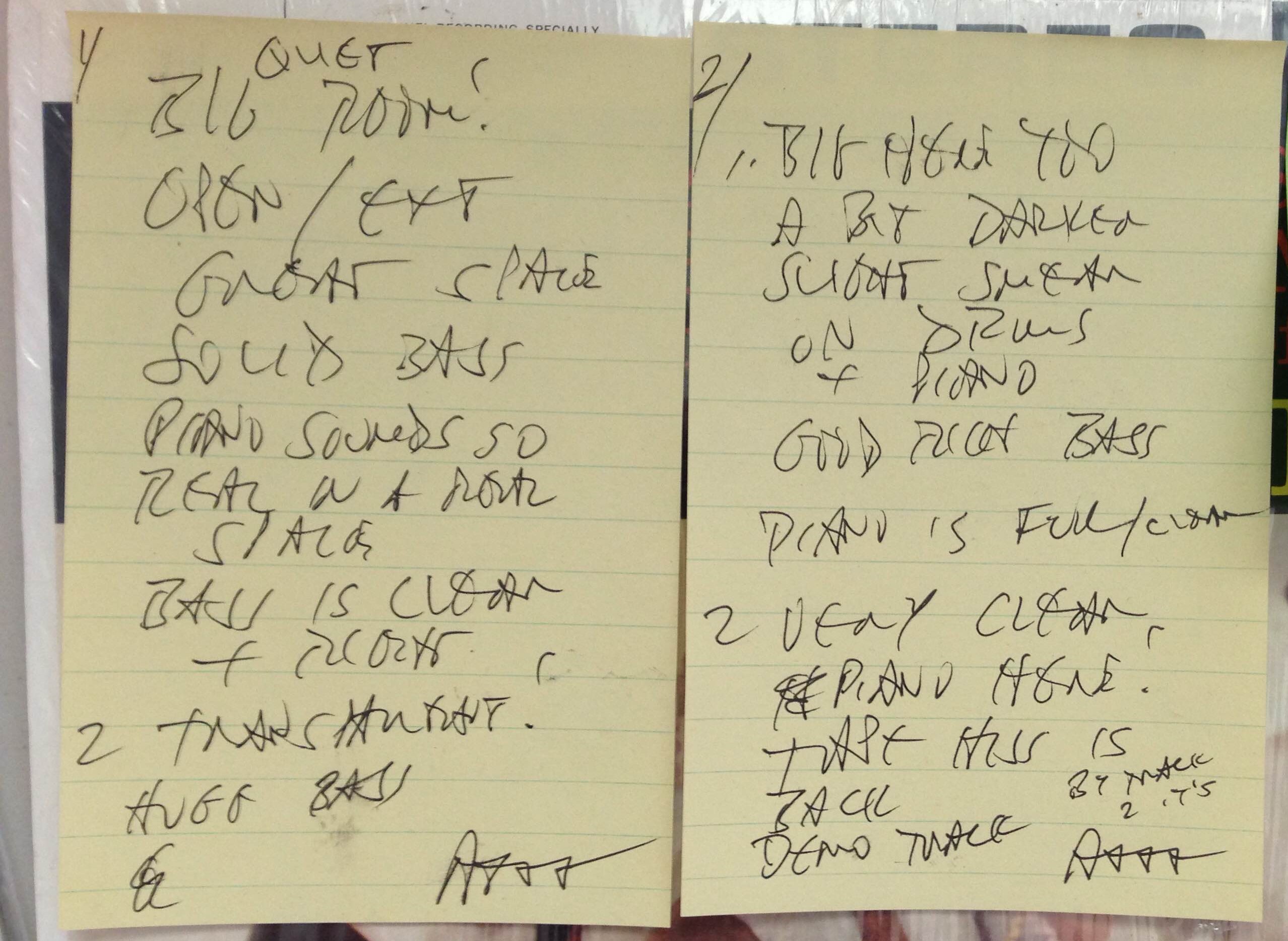
The kind of notes we take can be seen below. 4×6 Post-its work great for this purpose, using one per side.

We go through thousands of them every year.

Without specific notes on your records about exactly what you heard as you played them, you cannot possibly keep track of which pressings have the qualities you were listening for, and to what degree.

Extensive notes like the ones you see below are a must.

Other reviews with post-its can be found here.

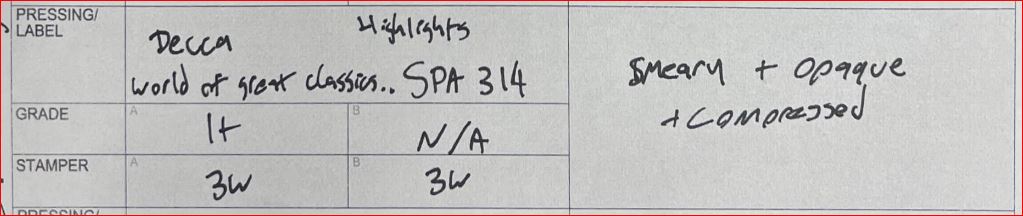
We also make every effort to be very specific about the shortcomings of the audiophile pressings we review, which is why we started to reproduce our notes for their reviews when they are available.


(more…)

What exactly are Hot Stamper pressings?

More Straight Answers to Your Hot Stamper Questions

The easiest and shortest version of the answer would go something like:

Hot Stampers are exceptional pressings that have gone through a shootout and judged to have sound superior to other copies of the album under review.

My good friend Robert Pincus coined the term more thirty years ago. We were both fans of the second Blood, Sweat and Tears album, a record that normally does not sound very good, and when he would find a great sounding copy of an album like B,S&T, he would sell it to me as a Hot Stamper. It was a favorite album and I wanted to hear it sound its best.

Even back then we knew there were a lot of different stampers for that record — it sold millions of copies and was Number One on the charts for 8 weeks in 1969 — but there was one set of stampers we had discovered that seemed to be head and shoulders better than all the others. Side one was 1AA and side two was IAJ. Nothing we played could beat a copy of the record with those stampers.

More Than Just the Right Stampers

After we’d found more and more 1AA/ IAJ copies — check out the picture of more than 40 laid out on the floor — it became obvious that some copies with the right stampers sounded better than other copies with those same stampers.

We realized that a Hot Stamper not only had to have the right numbers in the dead wax, but it had to have been pressed properly on good vinyl.

All of which meant that you actually had to play each copy of the record in order to know how good it sounded.

There were no shortcuts. There were no rules of thumb. Every copy was unique and there was no way around that painfully inconvenient fact.

Thirty Years Roll By

For the next thirty years we were constantly innovating in order to improve our record testing. We went through hundreds of refinements, coming up with better equipment, better tweaks and room treatments, better cleaning technologies and fluids, better testing protocols, better anything and everything that would bring out the best sound in our records.

Our one and only goal was to make the critical evaluation of multiple copies of the same album as accurate as possible.

Whatever system our customer might use to play our record – tubes or transistors, big speakers or small, screens or dynamic drivers — our pressing would be so much better in every way that no matter the system, the Hot Stamper he bought from us would have sound that was dramatically superior to anything he had ever heard.

Technology Played a Big Part in Our Success

It was indeed a slow process, and a frustrating one. Lots of technological advancements were needed in order to make our Hot Stamper shootouts repeatable, practical and scalable, and those advancements took decades to come about.

When I got started in audio in the early- to mid-70s, the following important elements of the modern stereo system did not exist:

  • Stand-alone phono stages.
  • Modern cabling and power cords.
  • Vibration controlling platforms for turntables and equipment.
  • Synchronous Drive Systems for turntable motors.
  • Carbon fiber mats for turntable platters.
  • Highly adjustable tonearms (for VTA, etc.) with extremely delicate adjustments and precision bearings.
  • Modern record cleaning machines and fluids. (Naturally, the best fluids we know of are the ones we sell.)
  • And there wasn’t much in the way of innovative room treatments like the Hallographs we use.

A lot of things had to change in order for us to reproduce records at the level we needed to in order to carry out our record testing, and be confident about our findings, and we pursued every one of them as far as time and money allowed.

(more…)

Coppelia and Sylvia / London Vs. Decca – Updated 2025

Hot Stamper Pressings of Music Conducted by Ernest Ansermet Available Now

Once again, the right Decca reissue blows the doors off the original London we played. This has lately become a pattern, but keep in mind it’s a pattern that’s reliable less than half the time, if memory is any guide. Many of the Decca reissues we’ve played over the last few years have failed badly in a head to head with their earlier-mastered and -pressed counterparts.

But the ones that beat all comers are the ones that stick in our minds and show up on our site.


UPDATE 2025

A copy of one of the SPA reissues we used to like shown above made it to our latest shootout and did not do nearly as well as a copy did years ago.

We don’t have those copies anymore and cannot say whether they actually did sound as good as we thought they did.

Our advice would be to assume that this is not the best way to buy this album. But neither is the original, as you will read below.


Clearly a case of confirmation bias, but at least we know something about our own biases, and that puts us well ahead of the audiophile pack.

Record collectors and record collecting audiophiles will tell you it shouldn’t happen, but fools like us, who refuse to accept the prognostications of those supposedly “in the know,” have done the work and come up with the experimental data that’s proven them wrong again and again.

Sort of. We had one, and only one, pressing of the original London (CS 6185), and boy was it a mess — crude as crude can be.

It sounded like an “old London record,” not the Decca engineered and mastered vintage collectible we know it to be.

We’ve played them by the hundreds, so we know that sound fairly well by now.

Are there copies that sound better? Surely there are, but how are you going to find them? Are you going to shell out the going rate of $25-50 on ebay for one (or more) clean copies, only to find that it/they sound every bit as bad as the one we auditioned? The question answers itself.

If, however, you are one of the lucky few who has a nice London or Decca original of this recording, please let us send you this copy so that you can do the shootout for yourself. You may be shocked at how good this music can sound on the right pressing. And if your copy sounds better than ours we will be very shocked indeed. [This offer was only good while we had the record, and it is long gone at this point. We still remember the sound though!]

Production and Engineering

James Walker was the producer, Roy Wallace the engineer for these sessions from April of 1959 in Geneva’s glorious Victoria Hall. It’s yet another remarkable disc from the Golden Age of Vacuum Tube Recording.

The hall the Suisse Romande recorded in was possibly the best recording venue of its day, possibly of all time. More amazing sounding recordings were made there than in any other hall we know of. There is a solidity and richness to the sound beyond all others, yet clarity and transparency are not sacrificed in the least.

It’s as wide, deep and three-dimensional as any, which is of course all to the good, but what makes the sound of these recordings so special is the weight and power of the brass, combined with unerring timbral accuracy of the instruments in every section of the orchestra.

(more…)