Glyn Johns, Engineer – Reviews and Commentaries

How Do the The Mastering Lab Pressings of Sticky Fingers Sound?

Hot Stamper Pressing of the Music of The Rolling Stones Available Now

A listing for an early domestic Hot Stamper pressing for Sticky Fingers will typically be introduced like this:

If you have never heard one of our Hot Stamper pressings of the album, you (probably) cannot begin to appreciate just how amazing the sound is.

A landmark Glyn Johns / Andy Johns recording, our favorite by the Stones, a Top 100 Title (of course) and 5 stars on Allmusic (ditto).

After hearing so much buzz about it, we finally broke down and ordered a German TML pressing about a year ago. Having played scores of phenomenally good sounding copies of the album over the past fifteen or so years, we were very skeptical that anyone could cut the record better than the mastering engineers who inscribed Rolling Stones Records into the dead wax on the early pressings. (I could find no mastering engineers credited.)

Well, the results were not good. As we suspected would be the case, we were not impressed in the least with what The Mastering Lab — one of the greatest independent cutting houses of all time, mind you — had wrought.

Their version is not really even good enough to charge money for. It might have earned a grade of One Plus, just under the threshold for a Hot Stamper that we would put on the site these days. Decent, but not much more than that.

Wait, There’s More

We subsequently learned that it is the British TML pressings that are supposed to be the best.

So we got one of those in, an A3/B4 copy.

Better, but good enough? Barely.

Here are the notes for the copy we played. For those who have trouble reading our writing, I have transcribed the notes as follows:

Side One

Track one:

Weighty, a bit veiled or smeary. Backing vox kinda lost.

Track three:

Very full, rockin’ but not the sparkle/space.

Kinda compressed.

Not as huge.

Side Two

Track two:

Not as rich, clear.

A bit pushy/dry vox.

No real space.

Thick drums

Track one:

This works better.

A bit hard, but full and lively.

This Sound?

Is this the sound audiophiles are raving about?

(more…)

Your Shootout Questions Answered – Part One

Hot Stamper Pressing of the Music of The Rolling Stones Available Now

Robert Brook wrote to me recently with some questions.

Hi Tom,

I read your recent post about Sticky Fingers and the European TML reissues you included in shootouts.

It raised a question for me that I’ve been wanting to ask you for a while now.

The fact that the UK TML earned an A+ to A++ grade and that, with just a one copy sample, you wouldn’t consider that pressing to have shootout winning potential, suggests to me that the US pressings you favor will grade at A++ or higher.

In other words, if you put a shootout together of [redacted stamper] pressings and whatever else you like, does every copy in the shootout grade at least A++ / A++? Are the right stampers that reliable?

I guess I’ve always assumed that even if you put together a shootout with this or any other title, and even if you only include pressings that have won or placed high in the past, at least a couple of them would end up graded no higher than A+ or A+ to A++.

And if that is correct, wouldn’t it be worth buying more UK TML’s to see if any emerge that could win a shootout?

With Revolver, for instance, why not just do shootouts with [redacted numbers] if those are the ones that win the shootouts? Why even bother with [later pressings]?

Robert,

All good questions! I could go on for days with this kind of inside baseball stuff. I’ve been living it full time for more than twenty years, and it obviously interests you because you are actually trying to hone your shootout skills and figure out how many of what pressings you need to get one going, etc., etc.

Not many others are doing what you are doing in a serious way, so how helpful anyone will find this information is hard to know. Under the circumstances, I should have kept my answers shorter rather than longer but I could not resist going into more detail than might have been advisable. Feel free to skim if you like.

Why not put more TML pressings into shootouts?

If they had pressed plenty of them and they’d ended up sitting in record bins all over town for twenty bucks a pop, we could get a bunch in and see if we could figure which stampers, if any, are able to reach the Super Hot stamper level.

(more…)

What Track Here Would Be Right at Home on David Crosby’s First Album?

Hot Stamper Pressings of the Music of Graham Nash Available Now

Our last shootout for this album took place in 2021. I wish we could keep the record in stock but finding the right stampers these days is not easy.

Still, as a favorite album of mine, I listen to the album regularly, just not on vinyl. Both the standard CD and the cassette I have sound right to me, sounding very much like the original record.

Recently I was playing the album and heard a song that sounded an awful lot like it might have been produced by the same team that recorded David Crosby’s first album, If Only I Could Remember My Name.

If you’re up for it, listen to the Crosby, then play the Nash and see if you can spot it. Feel free to leave your impressions in the comments section below.

Digging Deeper

Songs for Beginners is one of those albums that made me want to dig deeper into audio. After every improvement I managed to make to the system, Songs for Beginners would be one of the records that I would play (at very high volume) to see what changes I had brought about.

All the best changes — the ones I kept — always made the album sound better than I had last heard it. Over the course of decades the sound became amazingly good, a true Demo Disc that belonged in the company of Tea for the Tillerman or Dark Side of the Moon.

Back in the 70s and the 80s, not so much later as I had found plenty of other tough test discs by then, it helped me dramatically improve the playback quality of my system, which, to be honest, had a very long way to go, although I sure didn’t know that at the time. I thought it sounded great.

Early on in the history of our track by track breakdowns, written in order to aid listeners in testing their stereos and the other copies of the record they might own, we did a breakdown for the album which you can read here.

If you can’t find a nice original, whatever you do, don’t buy the awful Classic Records pressing of the album. They ruined it.

(more…)

The Who By Numbers – How Did We Know Side Two Was Slightly Veiled?

Hot Stamper Pressings of the Music of The Who Available Now

Here is how we might typically describe one of our Shootout Winning copies:

Who By Numbers returns to the site for only the second time in over three years, here with KILLER Shootout Winning Triple Plus (A+++) sound or close to it on both sides of this vintage Polydor import pressing – fairly quiet vinyl too.

Glyn Johns‘s magic is on display here, with open mics in a big studio space creating the 3D soundscapes we love.

Features two of their most iconic songs, “Slip Kid” and “Squeezebox,” and both sound incredible on this copy.

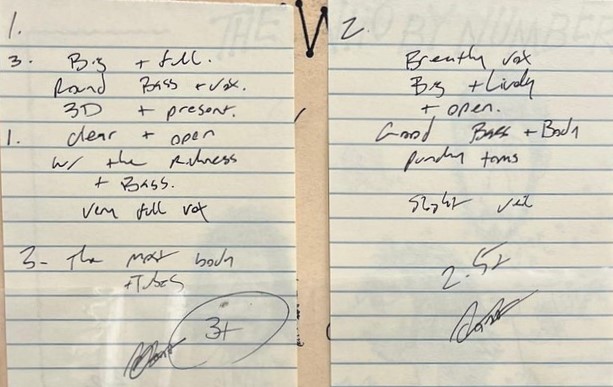
To back it all up, here are the notes for that very copy.

We started playing track three on side one, Squeeze Box, and returned to that track when we had two top copies to play against each other in the final round. Which one won? The one with “the most body and tubes.”

Note that side two of this copy was slightly veiled compared to the side two of the best copy we played, the one that would go on to earn 3+.

We don’t like veiled records — records where there is a curtain, no matter how transparent, in front of the musicians. Heavy Vinyl pressings are typically quite veiled and recessed in the midrange compared to their vintage vinyl counterparts, and that sound is simply not going to cut it with us. (Other folks may prefer a different sound it seems.)

Midrange presence is one of the most important qualities of any rock or pop recording we evaluate. You want Roger Daltry to be front and center, neither recessed nor behind a veil.

(more…)

How Good Are the UK Original Unboxed Deccas of Satanic Majesties?

Hot Stamper Pressings of the Music of The Rolling Stones Available Now

How good are the original Unboxed Deccas on Satanic Majesties?

They can be very good.

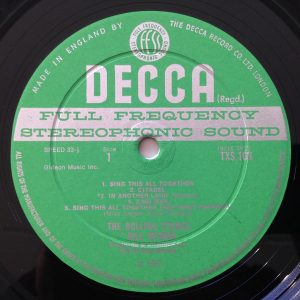
But they are never as good as the right later pressings with the Decca in a box label, the ones produced from about 1970 on.

The Unboxed Decca pressing earned a Super Hot Stamper grade (A++). The later pressing, with the right stamper, showed us just how good the album can sound.

Since the originals are pricey and hard to find, and, as a rule, noisier than the later pressings, we don’t pick them up unless we find them for cheap, which rarely happens. They have not won any shootouts, and that is very unlikely to change.

There is one set of stampers for this album that always wins, and those stampers are not found on the early label.

(more…)

Most Domestic Pressings of On The Border Suck, and We Know Why

Hot Stamper Pressings of the Music of The Eagles Available Now

This is one of the pressings we’ve discovered with reversed polarity on some songs.

The domestic copies of On The Border have many tracks in reversed absolute phase, including and especially Midnight Flyer, a lifelong favorite of mine. The front and center banjo will positively tear your head off; it’s bright, sour, shrill, aggressive and full of distortion. Don’t look at me — that’s what reverse polarity sounds like!

I’ve known for some time that domestic pressings of On The Border have their phase reversed — just hadn’t gotten around to discussing the issue because I wasn’t ready to list the record and describe the phenomenon.

A while back [January 2005, time flies] I happened to play a copy of One Of These Nights and was appalled by the dismal quality of the sound. Last night I put two and two together. I pulled out both Eagles records and listened to them with the phase reversed. Voila! (On The Border is a favorite record of mine, dismissed by everyone else, but loved by yours truly.)

[I don’t think One of These Nights has its polarity reversed anymore, although some copies may.]

I’m of the opinion that only a very small percentage of records have their absolute phase reversed. Once you’ve learned to recognize the kind of distortion reversed polarity causes, you will hear recordings that may make you suspicious, and the only way to know for sure is to switch the positive and negative, wherever you choose to do so. 

With the help of our EAR 324 Phono Stage, the phase is reversible with the mere touch of a button, a wonderful convenience that we have grown to love, along with the amazingly transparent sound of course. (Hard to imagine living without either at this point.)

(more…)

Harry Moss Cut These UK Stampers for Hey Jude – How Did He Go So Wrong?

Hot Stamper Pressings of the Music of The Beatles Available Now

Now with a couple of shootouts for both Hey Jude and the 1967-1970 compilation album under our belts, our main listening guy thinks the versions of the overlapping songs on Hey Jude are a little more fun.

He said that, all things being equal, the best pressings of Hey Jude might be a little more exciting while the best pressings of The Blue Album are a little more polite.

Here is how we described a recent shootout winning copy:

An amazing 10-song compilation from 1970 of some of the band’s biggest and best hits – “Can’t Buy Me Love,” “Paperback Writer,” “Lady Madonna,” and the iconic title track among them.

Longtime customers know that we had never been able to offer this title up until 2022 – it took us twenty years to figure out what the right pressings are, and believe me, we had to go through a lot of crap to find them.

If you know the album at all, you know how bad it sounds on the average copy, and my guess is you just gave up on the idea of finding good sound for these songs, which is more or less the way we felt too, but we finally found what we were looking for, and here it is.

However, some stampers are disappointing as you can see from this section of the stamper sheet we compiled for the shootout.

Harry T. Moss, the man with the initials HTM you see above, is the Parlophone/Apple engineer who cut many of the greatest sounding Beatles albums ever made (and plenty of not-so-great sounding ones, which is why you either need to do your own shootouts or have us do them for you).

Seems at though at least some of the work he did for the Hey Jude album is not his best. We awarded both sides a sub-Hot Stamper grade of 1+, which means the sound is passable at best, even after a good cleaning. (Without a good cleaning it would probably not even earn that one plus.)

We do not sell records with 1+ grades; you can find those on your own. The world is full of them.

Our notes for this pressing read:

  • Too midrangey and compressed
  • Heavy tape or tube saturation, side two especially

Your only other option for hearing some of this music with top quality sound is on the 1967-1970 compilation album, the Hot Stamper pressings of which have only recently been discovered.

(more…)

Are All the Original Asylum Pressings of Desperado Demo Discs?

Hot Stamper Pressings of the Music of The Eagles Available Now

No, and this should come as not much of a surprise to anyone that’s bought records from us or spent much time reading this blog.

As you can see from the notes below for this particular pressing of Desperado, both sides are passable, earning a minimal Hot Stamper grade of 1.5+.

It’s a decent sounding copy I suppose, but a long, long, long way from the best.

1.5+ is four grades down from the top copy. That’s a steep dropoff as far as we’re concerned. 1.5+ only hints at how good a recording Desperado can be on the best vintage pressings.

To see more records that earned the 1.5+ grade, please click here.

Incidentally, some of them are even on Heavy Vinyl. The better modern pressings have sometimes, if rarely, been known to earn Hot Stamper grades, and one shocked the hell out of us by actually winning a shootout. Wouldn’t you like to know which one!

For those who might be interested, there’s more on our grading scale here.


Desperado Is a True Super Disc 

Of course, the best sound on an Eagles record is found on the first album. For whatever reason, that record was left off the TAS super disc list, even though we feel that both musically and sonically it beats this one by a bit.

On the TAS Super Disc list. Harry Pearson recommends the British SYL pressings for this album. SYL pressings can sound very good; in fact, one of the top copies from a recent (2024) shootout was SYL. A bit of a surprise since our champion for both sides during the previous shootout was domestic.

Does that mean the best domestics will always beat the best SYL pressings? Not at all. Only critical listening can separate the superb pressings from the typical ones. After playing more than a dozen copies of this album this week, we can definitively tell you that there are far more mediocre copies of this record — both domestic and import — than truly exceptional ones. The typical pressing of this album, whether the domestic or SYL, falls far short of belonging on a Super disc list.

There are killer domestic copies and killer SYL imports out there, and the only way to know which ones sound good is to collect ’em, clean ’em, and play ’em.

Remember: TAS list doesn’t guarantee great sound, but Better Records does — if you don’t think a record sounds as good as we’ve stated, we’ll always happily take that record back and refund your money. Good luck getting ol’ Harry to send you a check when the TAS-approved pressings you pick up don’t deliver.

(more…)

Robert Brook Revisits a White Hot Stamper Pressing of The Eagles

Robert Brook runs a blog called The Broken Record, with a subtitle explaining that the aim of his blog is to serve as:

A GUIDE FOR THE DEDICATED ANALOG AUDIOPHILE

Here is a posting Robert wrote many years ago and has recently updated.

EAGLES: WHITE HOT and SOARING HIGHER!

A quote I rather liked:

You can throw a Hot Stamper onto your rig and hear that it sounds better than your crappy “audiophile” 180g reissue, but when you compare it to your high res digital file, you’re not quite sure which one you like better.

The digital vs. analog debate, perhaps the most enduring in all of audio, persists because only a handful of audiophiles have truly realized the full potential of analog in their systems.

You may be reading this thinking “hey whad’ya mean! My analog system sounds great!.” And it very well may sound great, but I thought and still think that my copy of Eagles sounds great, and let me tell you, the White Hot Stamper is a WHOLE new platter of wax!

The tubey jangle of the guitars, the room filling weight of the drums and bass, the airy, spacious, luscious vocal harmonies, and every last sumptuous element of the mix, unmoored, liberated from obscuration so completely that the music, freed from every conceivable resolution constraint, SOARS to life in the listening room.

That’s what this White Hot Stamper of Eagles sounds like, and that’s what analog is ALL ABOUT!

This record, The Dude be damned, is one of my all time favorites. It’s a delicious recording on even a decent copy. My current copy, which bested several others, was competitive on side 1, but laid to waste by the White Hot on side 2. And that was the side I thought mine had nailed!

Eagles lives and dies by the vocal harmonies, and when the backing vocals are as clear and present and alive as the lead vocal is on most other records then you know you’re hearing a very special copy.

Here is our description of a recent copy that is up on the site at this time.

Super Hot and $699 — affordable maybe for some, certainly not cheap, but as Robert makes clear in his review, one of the most amazing sounding recordings in the history of popular music on the right pressing, and the right pressings are the only ones we offer.

The notes for our Shootout Winning copy from 2024 can be seen at the very end of this post. Side two was a “strong 3+, ” which we would have called 4+, Beyond White Hot, way back when, but we stopped doing that many years ago.

Side two was HTF — Hard To Fault. This may have been the side two that Robert is raving about in his review.

My current copy, which bested several others, was competitive on side 1, but laid to waste by the White Hot on side 2. And that was the side I thought mine had nailed!

Eagles lives and dies by the vocal harmonies, and when the backing vocals are as clear and present and alive as the lead vocal is on most other records then you know you’re hearing a very special copy.

Can’t argue with any of that! That’s what we heard too.

(more…)

The True Test for Side Two (and How Wrong We Were about Domestic Pressings) of Backless

Hot Stamper Pressings of the Music of Eric Clapton Available Now

During our shootout we discovered that the true test for side two was the second track, the old blues song Early In The Morning.

It’s by far the best sounding track on the album, with huge space, rich bass, a fat snare and Tubey Magic to die for. This is the kind of sound that the likes of Glyn Johns gets down on tape, live in the studio no doubt, and it made it easy to do the shootout for side two.

The bigger, the richer, the tubier, the more transparent the better. It’s THE track to demo with. 

Both sides have rich, smooth, clear sound. Listen for the guitars on the first track on side one; the grungier the better. Punchy bass too.

Turn It Up and Let It Rock

The typical pressing of Backless, much like the typical pressing of Slowhand, is just too thick, dull, compressed and veiled to be much fun.

At the very least you need to turn this album up good and loud to get it to do anything.

The copies that are solid and weighty love getting loud; the copies that are thin and bright only get worse as the level goes up, a sign that they leave a lot to be desired. This is a rock album after all.

We Was Wrong

We used to note the following regarding the country that produced the best sounding pressings:

We had top quality copies on both domestic and British vinyl. Both were cut here in L.A.. It makes sense that either can be good.

This should have been corrected a long time ago, as far back as 2017, perhaps earlier. The domestic copies, thought cut at The Mastering Lab, are not competitive with the British LPs also cut there and then sent to England for pressing.

Live and learn is our motto, and progress in audio is a feature, not a bug, of record collecting at the most advanced levels.

We may have liked the domestic pressings a long time ago, but with changes to the system and many shootouts under our belts, the sonic superiority of the Brits cannot be denied.

(more…)