*Side to Side Differences

These are just a small fraction of the records we’ve found to be good for recognizing side to side differences.

Which Side of this Pressing Lacked Space, and How on Earth Did You Spot It?

Hot Stamper Pressings of the Music of Thelonious Monk Available Now

Our notes for a recent shootout winning copy read:

Monk’s Dream returns to the site for only the second time in over two years, here with INCREDIBLE Shootout Winning Triple Plus (A+++) grades or close to them throughout this black print Stereo 360 pressing.

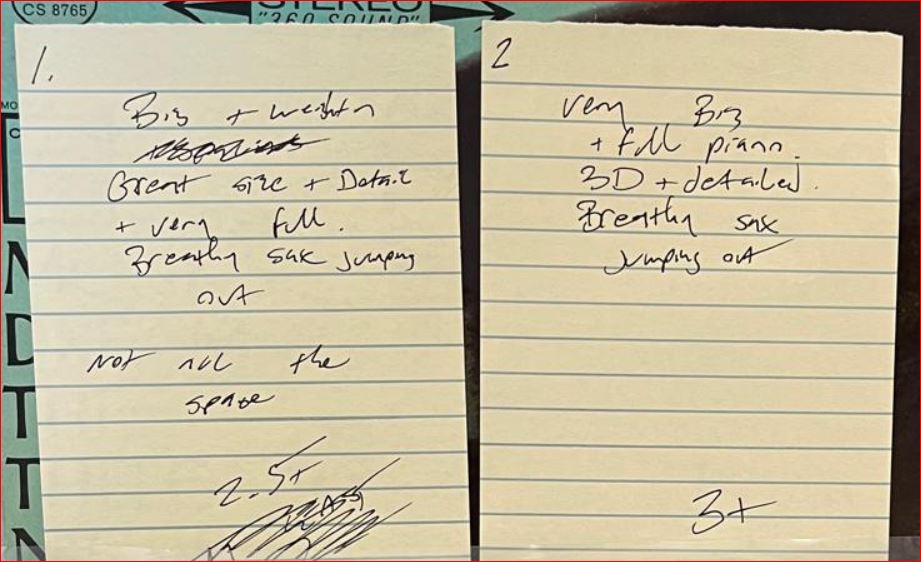
These are just a few of the things we had to say about this killer copy in our notes: “big and weighty”…”great size and detail and very full”…”breathy sax jumping out of the speakers”…”very big and full piano”

In our notes you can see that side one fell short in one area, space, but how would anyone know that who hadn’t played a copy with even more space than this one? That’s why we do shootouts and you must do them too.

Both of these sides are rich, spacious, big and Tubey Magical, with less smear on the piano, a problem that holds many copies back. The sound found on these early Columbia 360 Label Stereo pressings is absolutely the right one for Monk’s music.

As you can see from the notes we took for this copy, we are not making any of this up!
This is why we do shootouts. If you really want to be able to recognize subtle (and sometimes not so subtle!) differences between pressings, you must learn to do them too.

And make sure to take notes about what you are hearing, good and bad.

One side falling short of the full Three Pluses happens all the time.

One out of five records that has one shootout winning side will have a matching shootout-winning other side.

(more…)

On Our Top Copy of Face Value, How Did We Know that One Side Lacked Weight?

Hot Stamper Pressings of the Music of Phil Collins Available Now

We described our most recent shootout-winning pressing this way:

An early UK copy of Phil Collins’s killer solo debut with STUNNING Shootout Winning Triple Plus (A+++) side two mated to a nearly as good side one.

The recording of this album is still analog and the quality is excellent, thanks to hugely talented engineer and producer Hugh Padgham (Peter Gabriel, Genesis, The Police, Yes, Emerson, Lake & Palmer, etc.).

Song after song, Collins’s songwriting and musicianship shine with this breakout record, the first and clearly the best of all his solo albums. The sound on the better copies is vibrant, with superb extension on the top, punchy bass, and excellent texture on the drums and percussion, as well as spacious strings and vocals.

Side two was killer in every way, and the way we know that is we played a bunch of copies and nothing could beat it. This side two took top honors for having exactly the sound we described above.

For Those About to Rock

Of special interest to those of you who would like to do your own shootouts for the album are some of the specific notes we took:

The third track is “much less pinched,” with the most warmth and the least hardness.

Those are the areas that set this killer side two apart — it wasn’t as pinched and hard as most copies, and it had more warmth. Listen for those three things on the third track of the second side and you might just find it’s a lot easier to pick a winner.

Side one was doing great in many areas. Track three (again) was punchy, rich and relaxed, with no hardness.

It had most, but not all of the weight.

Same story as side two. Listen for all those qualities, especially hardness and how much weight you can hear on the first side. You will need big speakers to do this shootout, and don’t be afraid to turn them up.

(more…)

An Extraordinary Recording of the Carmen Fantasie – This Is Why You Must Do Shootouts

It has been years since a Whiteback pressing on the later label won a shootout. Some reissue copies of CS 6165 have earned Nearly White Hot Stamper grades, but we would be very surprised if one of the Blueback originals we play in the next shootout does not come out on top. They are just too good.


This London Whiteback LP has DEMO DISC sound like you will not believe, especially on side two, which earned our coveted A Triple Plus rating. The sound is warm, sweet and transparent; in short, absolutely GORGEOUS. We call it AGAIG — As Good As It Gets!

As this is one of the Greatest Violin Showpiece Albums of All Time, it is certainly a record that belongs in every right-thinking audiophle’s collection. (If you’re on our site and taking the time to read this, that probably means you.) Ruggiero Ricci is superb throughout.

And side one was just a step below the second side in terms of sound quality, with very solid A++ sound. To find two sides of this caliber, on quiet vinyl no less, is no mean feat. You could easily go through ten copies without finding one as consistently good sounding as this one.

A True Demo Disc, Or Was It?

Ricci’s playing of the Bizet-Sarasate Carmen Fantasie is OUT OF THIS WORLD. There is no greater perforrmance on record in my opinion, and few works that have as much Audiophile Appeal.

Which is why I’ve had a copy of this record in my own collection for about fifteen years marked “My Demo Disc.” But this copy KILLED it. How could that be?

It just goes to show: No matter how good a particular copy of a record may sound to you, when you clean and play enough of them you will almost always find one that’s better, and often surprisingly better.

Shootouts are the only way to find these kinds of records. That’s why you must do them.

Nothing else works. If you’re not doing shootouts (or buying the winners of shootouts from us) you simply don’t have top quality copies in your collection, except in the rare instances where you just got lucky. In the world of records luck can only take you so far. The rest of the journey requires effort.

(more…)

This Is the Kind of Thing You Notice When You Play Scores of Copies of the Same Album

Hot Stamper Pressings of the Music of Hall and Oates Available Now
If you have a copy or two laying around, there is a very good chance that side two will be noticeably thinner and brighter than side one. That has been our experience anyway, and we’ve been playing batches of this album for well over a decade. To find a copy with a rich side two is rare indeed.

Most copies lack the top end extension that makes the sound sweet, opens it up and puts air around every instrument. It makes the hi-hat silky, not spitty or gritty. It lets you hear all the harmonics of the guitars and mandolins that feature so prominently in the mixes.

If you’re looking for a big production pop record that jumps out of your speakers, is full of TUBEY MAGIC, and has consistently good music, look no further.

Until I picked up one of these nice originals, I had no clue just how amazing the record could sound. For an early 70s multi-track pop recording it’s about as good as it gets.

It’s rich, sweet, open, natural, smooth most of the time — in short, it’s got all the stuff audiophiles like you and me LOVE.

Side One

On the better copies practically every track on this side will have killer sound.

When the Morning Comes
Had I Known You Better Then
Las Vegas Turnaround (The Stewardess Song)
She’s Gone
I’m Just a Kid (Don’t Make Me Feel Like a Man)

Side Two

Abandoned Luncheonette

In our experience, only the best copies (and the best stereos) can make sense of this track.

Lady Rain

Wall to wall, floor to ceiling multi-track ANALOG MAGIC.

Laughing Boy

Everytime I Look at You

The FUNKIEST Hall and Oates track ever. Bernard Purdie on the drums! And who’s that funky rhythm guitarist with the Motown Sound? None other than John Oates hisself. If you hear echoes of Motown throughout this record, you’re hearing what we’re hearing. Who doesn’t love that sound? (If we could only find real Motown records that sound like this one…)
(more…)

On Our Top Copy of Moondance, How Did We Recognize that One Side Was Not as Tubey?

Hot Stamper Pressings of the Music of Van Morrison Available Now

We described our most recent shootout winning pressing this way:

A Moondance like you’ve never heard, with Shootout Winning Triple Plus (A+++) grades or close to them on both sides of this early Green Label pressing.

Here are just a few of the things we had to say about this killer copy in our notes: “silky and 3D and present”…”sweet and breathy vox”…”spacious and rich”…”huge and lively”…”jumping out of the speakers.”

Drop the needle anywhere on the album for a taste of early-70s Tubey Magical analog, not to mention the kind of blue-eyed soul that will remind some of you just how good music on vinyl used to be.

Side one was killer in every way, and the way we know that is we played a bunch of copies and nothing could beat it. This side one took top honors for having exactly the sound we described above.

Side two is another matter. We came across a side two that was slightly better than the side two you see here.

When we played the two best copies back to back, side one of this copy came out on top, earning a grade of 3+. However, the side two of another pressing showed us there was even more Tubey Magic in the recording than we’d noticed the first time around.

With another copy earning a better grade for having even more Tubey Magic, the full 3 pluses, we felt the right grade for this side two was 2.5+.

Helpful Advice

To aid you in doing your own evaluations, here is a list of records that we’ve found to be good for testing Tubey Magic.

This is exactly why we do shootouts. If you really want to be able to recognize subtle (and not so subtle!) differences between pressings, you must learn to do them too.

And make sure to take notes about what you are hearing, good and bad.

One more thing: stick with the Green Label early pressings, they are the only way to fly on Moondance.

Mistakes Were Made

If you made the mistake of buying the Rhino pressing of Moondance, I hope you heard what we heard: a complete lack of Tubey Magic! This on one of the most Tubey Magical analog recordings we’ve ever played. You can thank Kevin Gray for helping you flush your record money down the drain. When we first reviewed the remaster in 2014, we wrote:

Where is the Tubey Magic of the originals? The sweetness? The richness? And why is there so little ambience or transparency? You just can’t “see” into the studio on this pressing the way you can on the good originals, but that’s fairly consistently been the knock on these remastered Heavy Vinyl records. We noted as much when we reviewed Blue all the way back in early 2007, so no surprise there.

We also complained that the Heavy Vinyl reissue gets the voice wrong.  When the voice is wrong on a Van Morrison record, you have yourself a completely worthless piece of vinyl. 180 grams or 120 grams or any other number of grams, vinyl with sound this bad should hold no appeal to the audiophile. The record collector, maybe, but collecting for the sake of collecting has never been our thing and we hope it’s never been yours.

(more…)

Are All MoFis Created Equal? A Pair of Pink Floyd LPs Proved They Aren’t

Hot Stamper Pressings of the Music of Pink Floyd Available Now

[This commentary was written about twenty years ago.]

Many audiophiles are operating under the misapprehension that Mobile Fidelity managed to eliminate pressing variations of the kind we discuss endlessly on the site.

That is simply not the case, and it’s child’s play to demonstrate how misguided this way of thinking is, assuming you have the following four things: good cleaning fluids and a machine, multiple copies of the same record, a reasonably revealing stereo, and two working ears.

With all four the reality of pressing variations for ALL pressings is both obvious and incontrovertible.

The discussion below of a Hot Stamper pair of Dark Sides from long ago may shed light on some of the issues involved.

Remember Classic Records Comparison Packages?

This is our first Hot Stamper Comparison Package.

For those who remember the 45 RPM/ 33 RPM Classic Records comparison packages, this is somewhat in the same vein. Of course, we don’t know that they kept the EQ the same for the 45 versions compared to the 33s of the albums included in the package, so the comparison is suspect at best.

You’re not really comparing apples to apples unless you keep the EQ exactly the same. I rather doubt they did, because on Simon and Garfunkel the sound was noticeably worse at 45 than it was at 33. This is the main reason we don’t carry the 45 versions of Classic’s records: they are a lot more money, and who knows if they’re even any better?

[This one sure wasn’t better. This guy liked it, but he is rarely right about any of this record and equipment stuff, as I hope everyone knows by now.]

(more…)

Debussy & Ravel – A Tale of Two Top Copies

Hot Stamper Pressings of the Music of Claude Debussy Available Now

Hot Stamper Pressings of the Music of Maurice Ravel Available Now

In 2024 we did a shootout for this recording of quartets, LSC 2413, our first in 19 years.

For the shootout winning pressing, we wrote the following:

Juilliard String Quartet’s performance of these wonderful classical works appears on the site for only the second time ever, here with INSANELY GOOD Shootout Winning Triple Plus (A+++) grades on both sides of this original Shaded Dog pressing.

Having just played some killer copies of Death and the Maiden, we’re tempted to say that this Debussy record has the potential for even better sound — it’s richer and sweeter, but every bit as real and immediate as any chamber recording we know of.

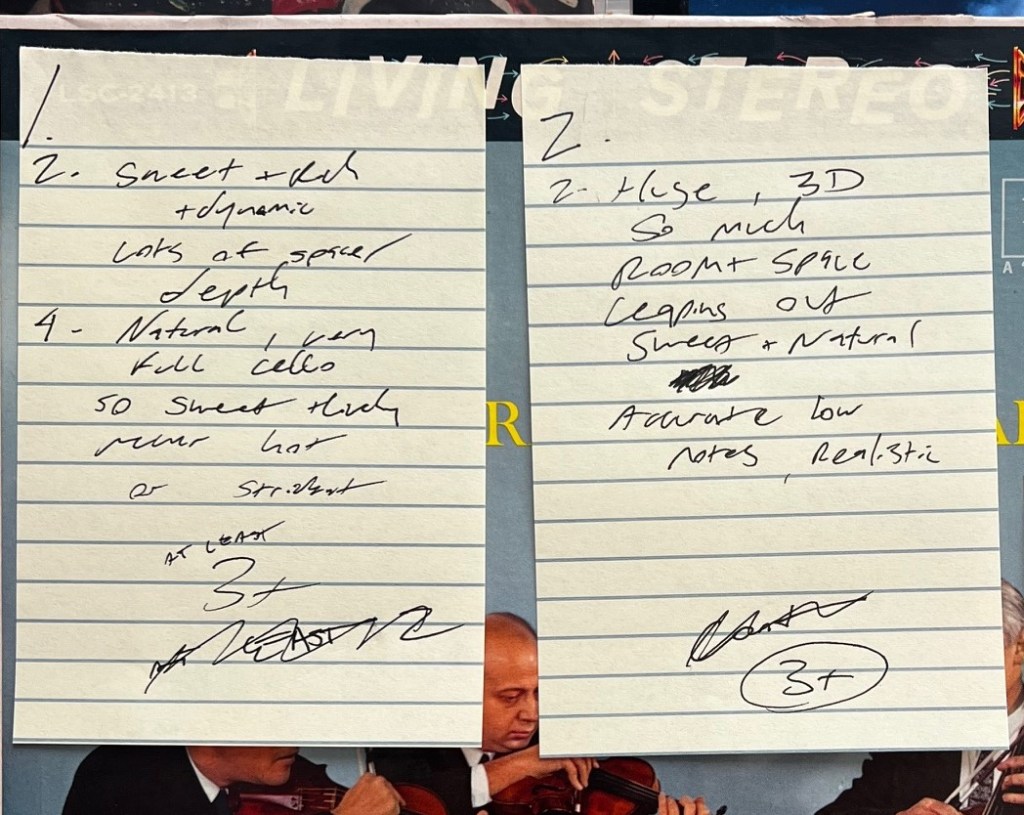
Here are the notes for the actual record we played. Side one really blew our minds, earning a grade of at least 3+.

The second place finisher may not have been quite as good on side one, but it was still so good that it had no problem earning the full three pluses. It had the same stampers as the copy above by the way.

Side two however lacked the space of the very best pressings we played, and we marked it down one half plus for that shortcoming. Although it was “so tubey and 3-D” it did not have “all the space but not hot at all and natural and sweet.”

It’s very unlikely that the person who bought this copy would feel there was any problem with side two. We had two killer side two’s to play against each other back to back, and that’s about the only way these kinds of very subtle differences can be recognized, assuming you have a system that can resolve the space of the recording at an extremely high level to begin with.

The big rooms with high ceilings that systems like those require are not usually found in listening rooms that have not been custom built.

More on this wonderful record:

The Living Stereo sound here is Tubey Magical, lively and clear, with the kind of transparency that puts living, breathing musicians right in your listening room in the way that only the best vintage vinyl pressings can.

Lewis Layton engineered this recording (along with Ed Begley) and he nailed it, perfectly capturing the rich, textured sheen on the strings, the hallmark of Living Stereo sound in the 50s and 60s.

He recorded both the Schubert (LSC 2378) mentioned above and this wonderful Debussy/Ravel record for RCA in 1960 — it would be quite the understatement to say he had a gift for recordings of this kind.


Another superb recording from the 60s, brought to you by your vinyl-loving friends at Better Records.

It’s an exceptional Living Stereo all analog recording from 1960 – nothing else sounds like it.

When you’ve played as many Living Stereo titles as we have (250+ and counting), you’re bound to run into this kind of Demo Disc sound from time to time – it’s what makes record collecting fun.

It’s an amazing find, the kind of record we live for here at Better Records.

(more…)

Blonde On Blonde and Some Bad Side Fours

Hot Stamper Pressings of the Music of Bob Dylan Available Now

Here’s a little something that you may have come across on your own, but since we’ve never seen it mentioned anywhere else, perhaps this will come as news to you the way it came as news to us about ten years ago.

There is a stamper used on some Blonde on Blonde side fours that is so ridiculously bad, you might as well be listening to a cassette playing underwater.

To be sure, we pick up plenty of mediocre copies all the time, but these side fours are so beyond terrible it’s clear someone was asleep at the wheel.

They’re fascinating to hear in their own way, because it’s simply shocking that a good recording could sound that bad. Like the best pressings of our favorites (but in a very different way), words don’t do it justice.

Its awfulness has to be heard to be believed.

If you’ve been reading this blog much, you may have noticed that we’ve been saying that more and more lately.

(more…)

Our Amazingly Good Shootout Winning Copy Fell Short in One Area

Hot Stamper Pressings of Bossa Nova Albums Available Now

With INCREDIBLE Shootout Winning Triple Plus (A+++) live jazz sound or close to it throughout, this copy is guaranteed to blow the doors off any other Getz – Gilberto #2 you’ve heard.

Rich, tubey and musical, the sound is wonderful for these live performances of the two very different groups – one side featuring Getz, the other Gilberto.

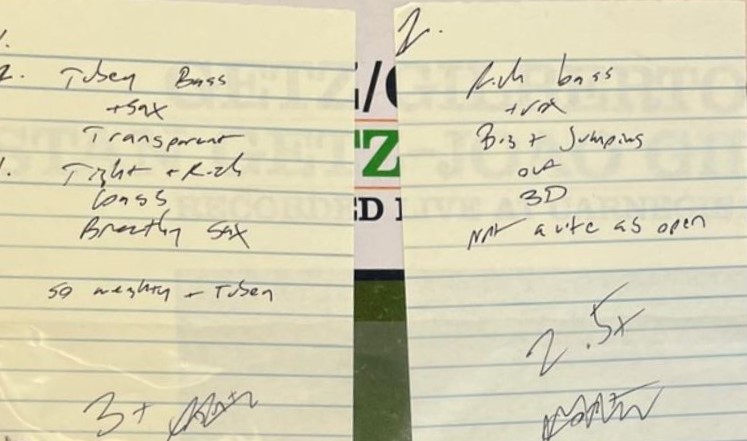
As you can see from the notes, side one of our most recent White Hot stamper Shootout Winner was doing everything right.

However, we had a side two that was slightly better than the side two you see here.

The Second Round

When we played the two best copies back to back, side one of this copy came out on top, earning a grade of 3+, but the side two of another pressing showed us the sound could be even more open than we thought the first time around.

As a consequence, we dropped side two’s grade a half plus, from 3 to 2.5+.

This is exactly why we do shootouts. If you really want to be able to recognize subtle (and sometimes not so subtle!) differences between pressings, you must learn to do them too.

And make sure to take notes about what you are hearing, good and bad.

One side falling short of the full Three Pluses happens more often than not. One out of five records that has one shootout winning side will have a matching shootout winning other side.

The math works like this. 3+/3+ records go in this section, which currently holds 29 titles as of 4/2025. Records with at least one 3+ side go in this section, and there are 145 of those as of the same date, about five times as many.

Getz Is the Man

Stan Getz is a truly great tenor saxophonist, the cool school’s most popular player. Over the years we have invested an insane amount of time and money in our search for Hot Stamper copies of this and other Getz albums.

We rarely have much to show for our efforts — certainly not in terms of quantity, as years can go by without a single record of his on the site.

(more…)

This Mystery Mercury May Have the Same Stampers on Both Sides, But the Sound Is Very, Very Different

Hot Stamper Pressings of Mercury Classical Recordings Available Now
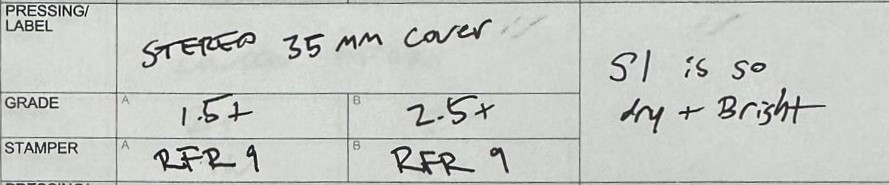

For Mercury classical and orchestral recordings, the original FR pressings (when there are such pressings), in stereo, on the original plum label are the best way to go, right? 

In many cases, yes. We talk about how much better the FR pressings for The Firebird are compared to the much more common, and still quite good, M2 reissue pressings here. (Both beat the pants off the awful Classic Records pressing.

But sometimes the RFR pressings — which, as I am sure you know, can be the earliest stampers for some titles — are nothing special on one side or the other. That is exactly the case here.

Keep in mind that the stamper numbers you see above belong to a different album.

We’ve lately been giving out much more stamper information than we used to, but for now we are keeping the identify of this title close to the vest.

We are not able to predict what stampers will win a shootout before we actually sit down to play all our copies.

It turns out that the FR pressings did not sound as good as some of other pressings. The RFR stampers came in somewhere in the middle of the pack, an average of 2+, but a hard record to sell with such very different sounding sides.

This is why we do shootouts, and why you must do them too, if owning the highest quality pressings is important to you.

Fortunately for readers of this blog, our methods are explained in detail, free of charge.

We’ve also written quite a few commentaries to help audiophiles improve the way they think about records.

I implore everyone who wants to make progress in this hobby to learn from the mistakes we’ve made. There are 146 “we were wrong” listings on the site as of this writing, and we learned something from every damn one of them, painful and costly as those experiences may have been.

(more…)