MFSL (UHQR)

Labels With Shortcomings – Mobile Fidelity (UHQR)

Classic Records Had an Epiphany in 2007 – UHQRs Actually DO Sound Good

More Records Perfectly Suited to the Stone Age Stereos of the Past

Don’t believe your ears!

Listen to Mike Hobson. After all, he’s the expert, right?

This commentary was written in 2007 and we admit it may be a bit long in the tooth for the brave new world of Heavy Vinyl we currently find ourselves in. Classic Records has been gone for a while now and when that blessed day came we were finally able to say good riddance to their bad records.


Mike Hobson thinks he knows why his pressings often don’t sound good and/or are noisy. We’ll let him explain it. If you want the whole story (which goes on for days) you can find it on the Classic Records website, assuming it’s still active. While you’re there, remember the sound.

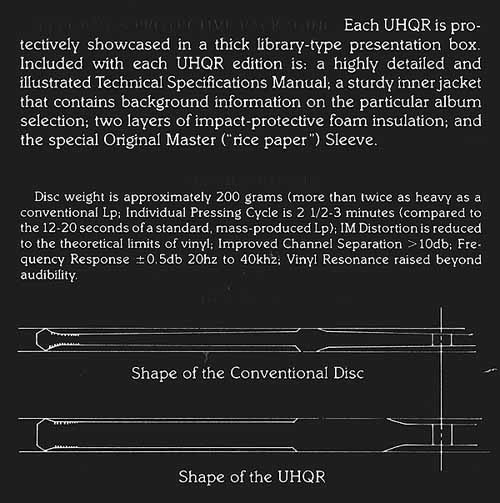
One day, while out for a run, I had an epiphany and rushed home to dig out a JVC pressing from the 1980’s pressed for Herb Belkin’s Mobile Fidelity. The Mobile Fidelity UHQR pressings were always revered as sounding better than the standard weight pressings from JVC [citation needed, big time] – but why I thought? To find out, I cut a UHQR pressing in half and guess what I found? First, it weighed 195 grams and IT WAS A FLAT PROFILE! I cut a 120g JVC pressing in half and found that it had the conventional profile that, with small variations, seems to be a record industry standard and is convex in it’s [sic] profile – NOT FLAT.

So, that is why the UHQR JVC pressings sounded better than their standard profile pressings and further confirmation of why our Flat Profile pressings sound better than 180g conversional pressings! [italics added]

This is a classic (no pun intended) case of begging the question, asserting the very thing that Mr. Hobson is trying to prove.

There was no need to saw up a record. Mofi actually explained in the booklet for every UHQR how its shape differed from a conventional disc.

(more…)

Can the Brightness Problem on the UHQR of Tea for the Tillerman Be Fixed?

Hot Stamper Pressings of the Music of Cat Stevens Available Now

Can adjusting the VTA for the heavier weight vinyl of the UHQR fix its tonality problems?

[This subject also came up in a discussion of the remastered pressings of Scheherzade.]

Probably not. VTA is all about balance.

Adjusting for all the elements in a recording involve tradeoffs. When all the elements sound close to their best, and none of them are “wrong,” the VTA is mostly right.

Try as you might, you cannot fix bad mastering by changing your VTA.

Tea for the Tillerman on UHQR

When I first got into the audiophile record business back in the 80s, I had a customer tell me how much he liked the UHQR of Tea for the Tillerman.

This was a record I was selling sealed for $25. And you could buy as many as you liked at that price!

I was paying $9 for them and could order them by the hundreds if I’d wanted to. Yes, I admit I had no shame.

I replied to this fellow that “the MoFi is awfully bright, don’t you think?” (My old Fulton system may have been darker than ideal, but no serious audio system can play a UHQR as bright as this one without someone noticing the paint has started to peel.)

His reply: “Oh no, you just adjust your VTA until the sound is tonally correct.”

(more…)

The Alan Parsons Project – A MoFi Disaster

Hot Stamper Pressings of Albums Engineered by Alan Parsons Available Now

MoFi Regular LP: F / UHQR:

Two — count ’em, two — hall of shame pressings and two more MoFi Half-Speed Mastered Audiophile LPs reviewed and found wanting.

The MoFi is a textbook example of their ridiculous affinity for boosting the top end, not to mention the extra kick they like to put in the kick drum, great for mid-fi (sometimes known around these parts as stone age audio systems) but a serious distraction on a high end stereo with good low end reproduction.

If you like the album –and that’s a big if, I myself have never been able to take it seriously — try the Simply Vinyl or the Classic LP.

Even the UHQR sucks. Don’t kid yourself. They’re still mastered by Stan Ricker, and he likes plenty of top end.

Like the old saying goes, if it’s worth doing it’s worth overdoing.

(more…)

Sgt. Pepper’s and Mistaken Audiophile Thinking (Hint: the UHQR Is Wrong)

Hot Stamper Pressings of Sgt. Peppers Available Now

This commentary was probably written between 2005 when we did our first shootout for the album and 2008, by which time it would have been a regular feature on the site. 

We charge hundreds of dollars for a Hot Stamper Sgt. Pepper, which is a lot to pay for a record. But consider this: the UHQR typically sells for a great deal more than the price we charge and doesn’t sound remotely as good. 

Of course the people that buy UHQRs would never find themselves in a position to recognize how much better one of our Hot Stampers sounds in a head to head shootout with their precious and oh-so-collectible UHQR.

They assume that they’ve already purchased the Ultimate Pressing and see no reason to try another.

I was guilty of the same mistaken audiophile thinking myself in 1982. I remember buying the UHQR of Sgt. Pepper and thinking how amazing it sounded and how lucky I was to have the world’s best version of Sgt. Pepper.

If I were to play that record now it most likely would be positively painful. All I would hear would be the famous MoFi 10K Boost on the top end (the one that MoFi lovers never seem to notice), and the flabby Half-Speed mastered bass (ditto).

Having heard really good copies of Sgt. Pepper, like the wonderful Hot Stampers we put on the site from time to time, now the MoFi UHQR sounds so phony to me that I wouldn’t be able to sit through it with a gun to my head.


UPDATE 2025

If you are still buying these remastered pressings, making the same mistakes that I was making before I knew better, take the advice of some of our customers and stop throwing your money away on Heavy Vinyl and Half-Speed mastered LPs.

At the very least let us send you a Hot Stamper pressing — of any album you choose — that can show you what is lacking on your copy of the album.

And if for some reason you disagree with us that our record sounds better than yours, we will happily give you all your money back and wish you the very best.

To learn more about records that sound dramatically better than any Half-Speed mastered title ever made (with one exception, John Klemmer’s Touch), please go to our Half-Speed mastering main page .

(more…)

“Ultra High Quality Records” or “Lipstick on a Pig”?

Hot Stamper Pressings of Audiophile Recordings Available Now

Today’s vinyl-loving audiophile seems to be making the same mistakes I was making more than forty years ago. Heavy Vinyl, the 45 RPM 2 LP pressing, the Half-Speed Limited Edition — aren’t these all just audiophile fads, each with a track record of underperformance that seems to worsen with each passing year? Would you really want to defend this piece of junk in 2023?

In my formative years in audio, starting in the mid-70s, it would never have occurred to me to buy more than one copy of a record. I didn’t need to do a head-to-head comparison in order to find out which one sounded better. I approached the subject Platonically, not scientifically: the record that should sound better, would sound better.

uhqrb

Later on in the decade, a label by the name of Mobile Fidelity would come along claiming to actually make better sounding pressings than the ones the major labels put out, and cluelessly I bought into that nonsense too. (To be fair, sometimes they did — Waiting for Columbus and American Beauty come to mind if you don’t have properly-pressed, properly-mastered originals, but my god, Katy Lied, Year of the Cat and Sundown have to be three of the worst sounding records I’ve ever played in my life.)

And isn’t it every bit as true today as it was in the past that the audiophiles who buy these “special” pressings, like the ones I bought back in the 70s and 80s, rarely seem to notice that many of them don’t actually sound good? (Some of the worst can be found here, the worst of the worst here.)

CofAEasy Answers and Quick Fixes

Turns out there are no easy answers. There are no quick fixes. In audio there’s only hard work and more hard work. That’s what gives the learning curve its curvature — the more you do it, the better you can do it.

And if doing all that work is also your idea of fun, you just might get really good at it.

If you actually enjoy playing five or ten or even fifteen copies of the same album to find the few that really sound good, and the one that sounds amazing — because hearing your favorite music the way it was meant to be heard is a positive thrill — then you just might end up with one helluva record collection, worlds better than one filled with audiophile pressings from any era, most especially the present.


Further Reading

The Planets – MoFi and UHQR Reviewed

Reviews and Commentaries for The Planets

Sonic Grade: Regular MoFi LP: F / UHQR: D

Years ago we auditioned an excellent sounding Decca Purple Label British import LP, the same performance, the same recording that Mobile Fidelity remastered (#510), but, thankfully, it sounded a whole lot better.

I just listened to both and a catalog of the faults of the MFSL pressing would be quite lengthy. I won’t waste your time listing them.

Although the recording is far from perfect, the Decca pressing shows it in its proper light. It finds the right balance between the multi-miked sound of the super disc List Mehta and a vintage recording from the Golden Age such as the famous Boult.

The sound is very dynamic and the brass has tremendous weight.

Not the MoFi. It’s thin and bright.

Their UHQR is somewhat better, not quite as thin and phony up top, but not really very good either.

Avoid them both.

Our Recommendation

Our favorite performance of The Planets can be found here.

Many of Solti’s recordings from the Seventies are not to our liking, for reasons we lay out here.


Our Pledge of Service to You, the Discriminating Audiophile 

We play mediocre-to-bad sounding pressings so that you don’t have to, a free service from your record-loving friends at Better Records.

(more…)

Back to the Stone Age with The Pines of Rome on Mobile Fidelity

Click Here to See Our Favorite Pines of Rome

An audiophile hall of shame pressing and another MoFi LP reviewed and found wanting.

MoFi’s version of this The Pines of Rome (#1-507) is one of the worst sounding classical records they ever made, and that’s saying something, because most of their classical catalog is awful.

Thin, bright, with sloppy bass and completely unnatural string tone — the MoFi makes the typical Classic Record sound good.

And that’s REALLY saying something.

The UHQR is somewhat better, especially in the lower octaves, but it’s maybe a D+ or C-, not a Better Record by any means.

How dull and opaque does a stereo have to be to make this record listenable?

The answer is VERY dull and VERY opaque.

Stone Age audio systems are the only ones that can play junk like this and get away with it.       

(more…)

Tea For The Tillerman – MoFi Reviewed (UHQR too)

Hot Stamper Pressings of the Music of Cat Stevens Available Now

Sonic Grade: MoFi LP: D / Sonic Grade: MoFi UHQR:

Tea for the Tillerman is, I hope it goes without saying, one of the greatest folk rock records of all time, music that belongs in any collection.

I’ve been playing this album for more than 30 years [now more than 50] and I can honestly say I’ve never once tired of hearing it.

I do get tired of hearing bad copies. I become absolutely incensed when I play the Mobile Fidelity version of this album, because what they did to this record is a travesty. If you want to know what the guitars on this album are NOT supposed to sound like, play the MOFI.

And if you want to hear an even worse version, play the UHQR.

(more…)