Hot Stamper Pressings of Living Stereo Recordings Available Now
Subtitle: it’s also hard to imagine that space and time are two aspects of the same reality, spacetime, but that’s why we employ rigorous scientific methods to test our theories and — in some cases — prove ourselves wrong.
We here at Better Records like testing records. We want to know if the predictions we make about the titles we play are accurate, which is simply to say, do they match the data derived from our blinded shootouts?
In the case of the stampers for this mystery title, it turns out that our whatever intuitions we may have had going in would have been no help at all. Who could possibly predict that, for sound quality on side one, 13s would substantially beat 12s, 12s would beat 15s, and that 15s would beat 11s. Side two was even wackier: 10s badly beat 12s, 12s beat 11s, and 11s beat 20s.
I can detect practically no pattern in these numbers, on either side. They seem pretty random.
But we don’t have a problem with random numbers because the person sitting at the table playing the record and the person in the listening chair grading the sound of that record never know what the stampers are for any of the records they are playing. This should be standard practice, but it seems nobody in the audiophile world practices it but us and Robert Brook.
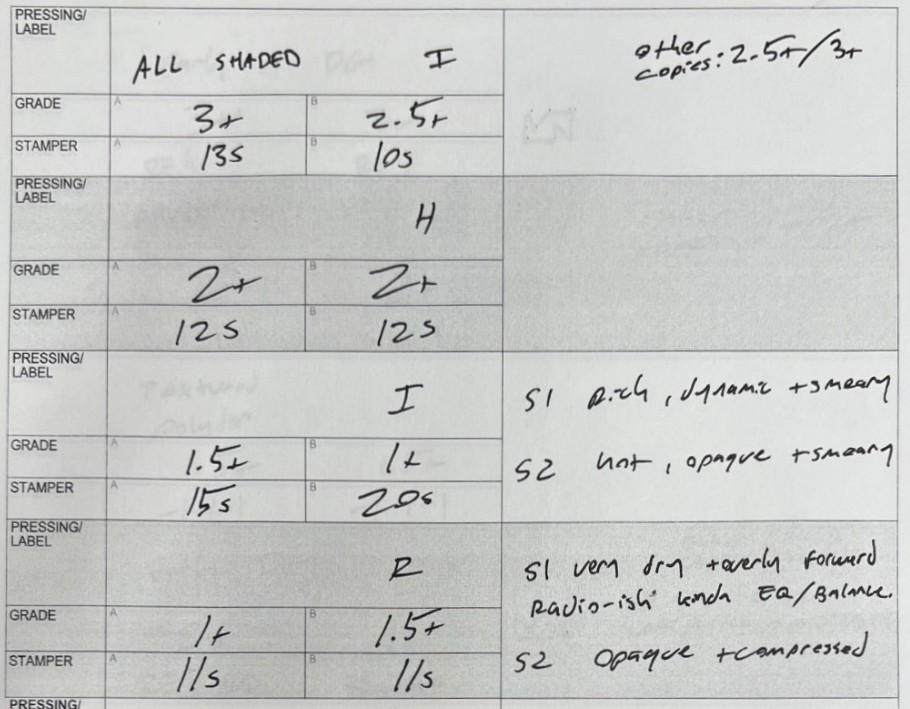
What you see above is the complete stamper sheet for a shootout we did recently. Note that the album you see pictured at the top is not the record we did the shootout for.
We are not revealing what record had these stampers and earned these grades for the simple reason that we rarely if ever give out the specific information that identifies the best sounding pressing of any album. (Rarely, but rarely doesn’t mean never.)
As I’m sure you can understand, we want you to buy the copy with the Hottest Stampers from us, not find one on your own! We’re happy to be moderately helpful, but naturally we find it necessary to draw the line somewhere, and giving out “the shootout winning stampers” are where we choose to draw it.
One set of stampers for the mystery RCA pressings we played in our shootout were clearly superior to all the others, 13s/10s. They were the two best copies we played, and no other copy earned a grade that was not a noticeable step down in sound quality. (They were all Shaded Dogs by the way — forget the White Dog and later reissues, they are hopeless.)
One set of stampers sounded consistently subpar, 11s/11s. They were the lowest stampers from the shootout, and pressed in Indianapolis, the plant that produced the two best copies. What happened?
Don’t ask us. We sure don’t know. And one thing we’ve learned over the years is not to pretend to.
These are record mysteries, and they are mysteries that will remain mysteries if for no other reason than the number of production variables hopelessly intertwined at the moment of a pressing’s creation can never be teased apart no matter how hard one tries.
As we never tire of saying, trying to predict which pressings will sound the best — by country, label, stamper numbers, pressing plants, or anyting else — is of little use with regard to finding the best sounding records.
Not surprisingly, we discovered something long ago that the rest of the audiophile community has yet to recognize, and it’s simply this: Cleaning and playing a big pile of pressings works quite well.
Those two things work well because nothing else works at all.
But they’re expensive and hard to do, so too many audiophiles end up cutting too many corners and end up just fooling themselves. If you’re serious about improving the quality of your record collection, we would love to help you get on the right road and headed in the right direction.
We’ve made practically every mistake that can be made, so please consider taking our advice. Why repeat our errors?
Shady Dogs
Some audiophiles may be impressed by the average Shaded Dog pressing, but I assure you that we here at Better Records are decidedly not of that persuasion.
Something in the range of five to ten per cent of the major label Golden Age recordings we play will eventually make it to the site. The vast majority just don’t sound all that good to us. (Many have second- and third-rate performances and those get tossed without ever making it to a shootout.)