More of the Music of Journey
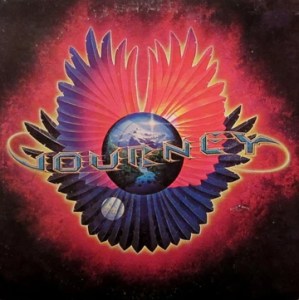
- Both sides of this vintage Columbia pressing have excellent sound for the band’s 1978 release, earning solid Double Plus (A++) grades – fairly quiet vinyl too
- This copy was bigger and bolder than most others we played, with huge choruses that really come alive – just the way we like our Journey albums to sound
- Spaciousness, richness and freedom from grit and grain are key to the better pressings, and here you will find all three
- 4 stars: “Released in January of 1978, Infinity easily proved to be the band’s most cohesive work to date. Dead and buried were the jazz fusion overtones of previous offerings, and with the new songwriting combo of Perry/Neal Schon leading the march, the band set out to completely redefine their sound. Traditional pop arrangements were now adopted, cutting out the unnecessary musical fat, and allowing each bandmember to play to his strength: Perry’s soaring, whale of a voice, Schon’s scorching fret work, and Gregg Rolie’s subtle keyboard arrangements.”
This vintage Columbia pressing has the kind of Tubey Magical Midrange that modern records can barely BEGIN to reproduce. Folks, that sound is gone and it sure isn’t showing signs of coming back. If you love hearing INTO a recording, actually being able to “see” the performers, and feeling as if you are sitting in the studio with the band, this is the record for you. It’s what vintage all analog recordings are known for — this sound.
If you exclusively play modern repressings of vintage recordings, I can say without fear of contradiction that you have never heard this kind of sound on vinyl. Old records have it — not often, and certainly not always — but maybe one out of a hundred new records do, and those are some pretty long odds.
What The Best Sides Of Infinity Have To Offer Is Not Hard To Hear
- The biggest, most immediate staging in the largest acoustic space
- The most Tubey Magic, without which you have almost nothing. CDs give you clean and clear. Only the best vintage vinyl pressings offer the kind of Tubey Magic that was on the tapes in 1978
- Tight, note-like, rich, full-bodied bass, with the correct amount of weight down low
- Natural tonality in the midrange — with all the instruments having the correct timbre
- Transparency and resolution, critical to hearing into the three-dimensional studio space
No doubt there’s more but we hope that should do for now. Playing the record is the only way to hear all of the qualities we discuss above, and playing the best pressings against a pile of other copies under rigorously controlled conditions is the only way to find a pressing that sounds as good as this one does.
Pop and Rock Shootouts
What are the sonic qualities by which a Pop or Rock record — any Pop or Rock record — should be judged?
Pretty much the ones we discuss in most of our Hot Stamper listings: energy, vocal presence, frequency extension (on both ends), transparency, spaciousness, harmonic textures (freedom from smear is key), rhythmic drive, tonal correctness, fullness, richness, three-dimensionality, and on and on down the list.
When we can get a number of these qualities to come together on the side we’re playing, we provisionally give it a ballpark Hot Stamper grade, a grade that is often revised during the shootout as we hear what the other copies are doing, both good and bad.
Once we’ve been through all the side ones, we play the best of the best against each other and arrive at a winner for that side. Other copies from earlier in the shootout will frequently have their grades raised or lowered based on how they sounded compared to the eventual shootout winner. If we’re not sure about any pressing, perhaps because we played it early on in the shootout before we had learned what to listen for, we take the time to play it again.
Repeat the process for side two and the shootout is officially over. All that’s left is to see how the sides of each pressing match up.
It may not be rocket science, but it’s a science of a kind, one with strict protocols that we’ve developed over the course of many years to insure that the results we arrive at are as accurate as we can make them.
The result of all our work speaks for itself, on this very record in fact. We guarantee you have never heard this music sound better than it does on our Hot Stamper pressing — or your money back.
What We’re Listening For On Infinity
- Energy for starters. What could be more important than the life of the music?
- Then: presence and immediacy. The vocals aren’t “back there” somewhere, lost in the mix. They’re front and center where any recording engineer worth his salt would put them.
- The Big Sound comes next — wall to wall, lots of depth, huge space, three-dimensionality, all that sort of thing.
- Then transient information — fast, clear, sharp attacks, not the smear and thickness so common to these LPs.
- Tight punchy bass — which ties in with good transient information, also the issue of frequency extension further down.
- Next: transparency — the quality that allows you to hear deep into the soundfield, showing you the space and air around all the instruments.
- Extend the top and bottom and voila, you have The Real Thing — an honest to goodness Hot Stamper.
Side One
Lights
Feeling That Way
Anytime
La Do Da
Patiently
Side Two
Wheel In The Sky
Somethin’ To Hide
Winds Of March
Can Do
Opened The Door
AMG 4 Star Review
By 1977 Journey had reached a creative crossroads, with three underwhelming studio albums under their belt and little to show in the way of commercial success. At the prodding of manager Herbie Herbert, who felt a major shakeup was needed in order to reignite their spark, the band was convinced to audition and eventually recruit the services of former Alien Project vocalist Steve Perry. Sure enough, adding him to the band just prior to the sessions for Infinity proved to be a stroke of genius, and a move that undeniably altered the course of history for the fledging Bay Area act.
Released in January of 1978, Infinity easily proved to be the band’s most cohesive work to date. Dead and buried were the jazz fusion overtones of previous offerings, and with the new songwriting combo of Perry/Neal Schon leading the march, the band set out to completely redefine their sound. Traditional pop arrangements were now adopted, cutting out the unnecessary musical fat, and allowing each bandmember to play to his strength: Perry’s soaring, whale of a voice, Schon’s scorching fret work, and Gregg Rolie’s subtle keyboard arrangements. Enlisting eccentric producer Roy Thomas Baker (already famous for guiding the likes of Queen and Nazareth to giant commercial triumphs of their own) also proved to be a rewarding move for the boys.
With newfound confidence, Journey crafted a record that could finally land them on the radio. Loaded with future FM staples like “Wheel in the Sky” (which hit the Top 50 in April of 1978), “Lights” (which quietly peaked at number 68 that August), and “Anytime” (pretty much a flop, crawling to number 83 in July), Infinity introduced Journey to an entirely new audience. Even non-singles like “Patiently (the first tune Perry ever wrote with Schon) and “Somethin’ to Hide” were leaps and bounds beyond the band’s previous accomplishments.
And, ultimately, though Infinity merely introduced the band to mainstream radio (it was the never-ending tour on which the band embarked on to support it that drove the disc past the platinum plateau), it effectively cemented their rep as one of America’s most beloved (and sometimes hated) commercial rock/pop bands. With over 170 shows under their belts, Journey had just begin to hit their stride.