More of the music of Ludwig van Beethoven (1770-1827)
More of the music of Johannes Brahms (1833-1897)
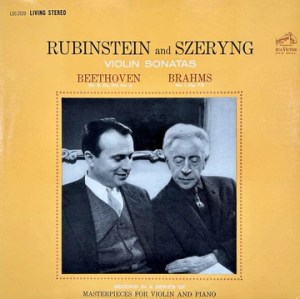
- Szeryng and Rubinstein’s performance of these wonderful violin-piano duos appears on the site for only the second time ever, here with with STUNNING Shootout Winning Triple Plus (A+++) Living Stereo sound or close to it throughout this original Shaded Dog pressing
- These are just a few of the things we had to say about this incredible copy in our notes: “big and rich and 3D violin”…”sweet and lively and roomy”…”very rich and present”…”great size and energy”
- Both of these sides are Tubey Magical, lively and clear, with richness and warmth that only the best vintage vinyl pressings offer
- Here you will find exceptionally three-dimensional sound, expanding the space of your listening room from wall to wall and floor to ceiling
- This copy also showed us the balance of clarity and sweetness we were looking for in the violin – not many recordings from this era can do that, and not even most RCA’s, to be honest
This vintage Shaded Dog pressing has the kind of Tubey Magical Midrange that modern records can barely BEGIN to reproduce. Folks, that sound is gone and it sure isn’t showing signs of coming back. If you love hearing INTO a recording, actually being able to “see” the performers, and feeling as if you are sitting in the studio with the band, this is the record for you. It’s what vintage all analog recordings are known for — this sound.
If you exclusively play modern repressings of vintage recordings, I can say without fear of contradiction that you have never heard this kind of sound on vinyl. Old records have it — not often, and certainly not always — but maybe one out of a hundred new records do, and those are some pretty long odds.
What The Best Sides Of Beethoven and Brahms’s Violin Sonatas Have To Offer Is Not Hard To Hear
- The biggest, most immediate staging in the largest acoustic space
- The most Tubey Magic, without which you have almost nothing. CDs give you clean and clear. Only the best vintage vinyl pressings offer the kind of Tubey Magic that was on the tapes in 1962
- Tight, note-like, rich, full-bodied bass, with the correct amount of weight down low
- Natural tonality in the midrange — with all the instruments having the correct timbre
- Transparency and resolution, critical to hearing into the three-dimensional studio space
No doubt there’s more but we hope that should do for now. Playing the record is the only way to hear all of the qualities we discuss above, and playing the best pressings against a pile of other copies under rigorously controlled conditions is the only way to find a pressing that sounds as good as this one does.
Copies with rich lower mids and nice extension up top did the best in our shootout, assuming they weren’t veiled or smeary of course. So many things can go wrong on a record. We know, we’ve heard them all.
Top end extension is critical to the sound of the best copies. Lots of old records (and new ones) have no real top end; consequently, the studio or stage will be missing much of its natural air and space, and instruments will lack their full complement of harmonic information.
Tube smear is common to most vintage pressings. The copies that tend to do the best in a shootout will have the least (or none), yet are full-bodied, tubey and rich.
What We’re Listening For On Violin Sonatas
- Energy for starters. What could be more important than the life of the music?
- The Big Sound comes next — wall to wall, lots of depth, huge space, three-dimensionality, all that sort of thing.
- Then transient information — fast, clear, sharp attacks, not the smear and thickness so common to these LPs.
- Next: transparency — the quality that allows you to hear deep into the soundfield, showing you the space and air around all the instruments.
- Extend the top and bottom and voila, you have The Real Thing — an honest to goodness Hot Stamper.
Hi-Fidelity
What do we love about these Living Stereo Hot Stamper pressings? The timbre of every instrument is Hi-Fi in the best sense of the word. The instruments here are reproduced with remarkable fidelity. Now that’s what we at Better Records mean by “Hi-Fi,” not the kind of audiophile phony BS sound that passes for Hi-Fidelity these days.
There’s no boosted top, there’s no bloated bottom, there’s no sucked-out midrange.
There’s no added digital reverb (Patricia Barber, Diana Krall, et al.). The microphones are not fifty feet away from the musicians (Water Lily) nor are they inches away (Three Blind Mice).
This is Hi-Fidelity for those who recognize the real thing when they hear it. I’m pretty sure our customers do, and whoever picks up this Hot Stamper pressing is guaranteed to have a powerful musical experience while playing it or his money will be returned, no questions asked.
Side One
Sonata No. 8 In G Major, Op. 30, No. 3 – Beethoven
Allegro Assai
Temp Di Minuetto Ma Molto Moderato E Grazioso
Allegro Vivace
Side Two
Sonata No. 1 In G Major, Op. 78 – Brahms
Vivace Ma Non Troppo
Adagio
Allegro Molto Moderato
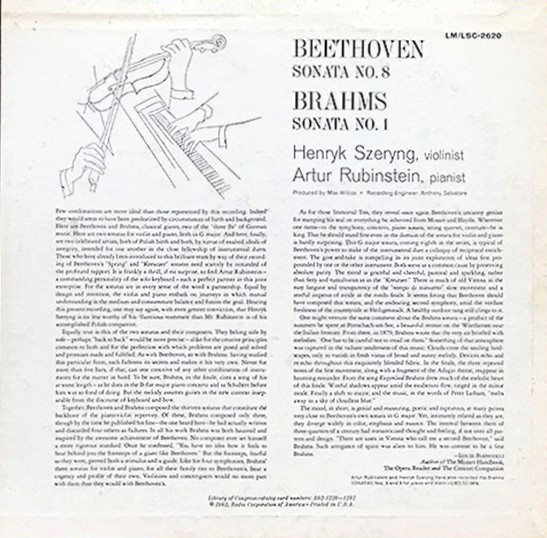
Sonata for Violin and Piano No. 8 in G major, Op. 30 (Beethoven)
Beethoven’s eighth piano-violin duo is the last of a trio of sonatas designated Op. 30, composed in 1802. Following as it did the C-minor storminess of the central Op. 30 Sonata, No. 3 relaxes from the fist-clenched dramatics of its slightly older sibling and revels in sprightly good humor and in vigorous athleticism.
The first movement is a prime example of the 32-year-old Beethoven’s facility for exercising compositional legerdemain, inasmuch as the slender materials consist of the most basic kinds of scale figures and chordal patterns. Instrumental equity is attempted, but the violin is no match for the bravura that is often unleashed by the keyboard in this virtually monothematic movement.
For his middle movement, Beethoven indicates a Tempo di Menuetto for music that has everything to do with graceful lyricism and almost nothing to do with dance. The composer lingers over, and frequently repeats, the main, E-flat-major materials, providing contrast to them through recourse to minor-mode inflection and rhythmic variation.
The rustic Beethoven comes to the fore in a final movement that flaunts a stubborn ground bass, decidedly rakish melodic contours, and all manner of ensemble gymnastics in which both instruments operate with full virtuoso power.
-LAPhil.com
Violin Sonata No. 1 (Brahms)
The Violin Sonata No. 1 in G major, Op. 78, Regensonate, for violin and piano was composed by Johannes Brahms during the summers of 1878 and 1879.
Each of the three movements of this sonata shares common motivic ideas or thematic materials from the principal motif of Brahms’s two songs “Regenlied” and “Nachklang,” Op. 59, and this is why this sonata is also called the “Rain Sonata” (Regensonate).
The first movement, Vivace ma non troppo is written in sonata form in G major; the second movement, Adagio – Più andante – Adagio, is an expanded ternary form in E♭ major, and the third movement, Allegro molto moderato is a rondo in G minor with coda in G major. The dotted rhythm motif from the two songs is not only directly quoted as a leading theme in the third movement of this sonata but also constantly appearing as fragmented rhythmic motif throughout the all three movements of the sonata so that the entire sonata has a certain coherency. The rhythm of the rain motif appearing in the middle section of the second movement is adapted to a funeral march. The two disruptive appearances of the main theme of the Adagio in the third movement also represent cyclic form used in this sonata.
-Wikipedia
Further Reading
- More Hot Stamper pressings featuring the violin available now
- More Hot Stamper pressings of Living Stereo titles available now
- Letters, reviews and commentaries for Living Stereo records by the hundreds