More Jazz Recordings of Interest
More Recordings Engineered by Tom Dowd
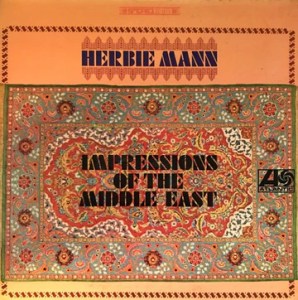
- Impressions of the Middle East debuts on the site on this early Green and Blue Stereo Atlantic pressing – fairly quiet vinyl too
- Exceptionally spacious, tubey and three-dimensional, as well as relaxed and full-bodied — this is the sound of vintage jazz
- Phil Iehle and Tom Dowd made up the engineering team for these sessions, which explains why the better copies of the album sound so damn good
- If you’re looking for a little something different, with outstanding vintage 60s jazz sound, this is guaranteed to be worth your while, and if not, just send it back and we’ll let someone else give it a try
- It’s yet another recording we’ve discovered with (potentially) excellent sound
This vintage Atlantic stereo pressing has the kind of Tubey Magical Midrange that modern records can barely BEGIN to reproduce. Folks, that sound is gone and it sure isn’t showing signs of coming back. If you love hearing INTO a recording, actually being able to “see” the performers, and feeling as if you are sitting in the studio with the band, this is the record for you. It’s what vintage all analog recordings are known for — this sound.
If you exclusively play modern repressings of vintage recordings, I can say without fear of contradiction that you have never heard this kind of sound on vinyl. Old records have it — not often, and certainly not always — but maybe one out of a hundred new records do, and those are some pretty long odds.
What The Best Sides Of Impressions of the Middle East Have To Offer Is Not Hard To Hear
- The biggest, most immediate staging in the largest acoustic space
- The most Tubey Magic, without which you have almost nothing. CDs give you clean and clear. Only the best vintage vinyl pressings offer the kind of Tubey Magic that was on the tapes in 1967
- Tight, note-like, rich, full-bodied bass, with the correct amount of weight down low
- Natural tonality in the midrange — with all the instruments having the correct timbre
- Transparency and resolution, critical to hearing into the three-dimensional studio space
No doubt there’s more but we hope that should do for now. Playing the record is the only way to hear all of the qualities we discuss above, and playing the best pressings against a pile of other copies under rigorously controlled conditions is the only way to find a pressing that sounds as good as this one does.
Copies with rich lower mids and nice extension up top did the best in our shootout, assuming they weren’t veiled or smeary of course. So many things can go wrong on a record! We know, we’ve heard them all.
Top end extension is critical to the sound of the best copies. Lots of old records (and new ones) have no real top end; consequently, the studio or stage will be missing much of its natural air and space, and instruments will lack their full complement of harmonic information.
Tube smear is common to most vintage pressings. The copies that tend to do the best in a shootout will have the least (or none), yet are full-bodied, tubey and rich.
Learning the Record
For our shootout for Impressions of the Middle East, we had at our disposal a variety of pressings that had the potential for Hot Stamper sound. We cleaned them carefully, then unplugged everything in the house we could, warmed up the system, Talisman’d it, found the right VTA for our Triplanar arm (by ear of course) and proceeded to spend the next hour or so playing copy after copy on side one, after which we repeated the process for side two.
If you have five or more copies of a record and play them over and over against each other, the process itself teaches you what’s right and what’s wrong with the sound of the album. Once your ears are completely tuned to what the best pressings do well that the other pressings do not do as well, using a few carefully chosen passages of music, it quickly becomes obvious how well a given copy can reproduce those passages. You’ll hear what’s better and worse — right and wrong would be another way of putting it — about the sound.
This approach is simplicity itself. First, you go deep into the sound. There you find a critically important passage in the music, one which most copies struggle — or fail — to reproduce as well as the best. Now, with the hard-won knowledge of precisely what to listen for, you are perfectly positioned to critique any and all pressings that come your way.
It may be a lot of work but it sure ain’t rocket science, and we’ve never pretended otherwise. Just the opposite: from day one we’ve explained step by step precisely how to go about finding the Hot Stampers in your own collection. Not the good sounding pressings you happen to own — those may or may not have Hot Stampers — but the records you actually cleaned, shot out, and declared victorious.
What We’re Listening For On Impressions of the Middle East
- Energy for starters. What could be more important than the life of the music?
- The Big Sound comes next — wall to wall, lots of depth, huge space, three-dimensionality, all that sort of thing.
- Then transient information — fast, clear, sharp attacks, not the smear and thickness so common to these LPs.
- Tight, full-bodied bass — which ties in with good transient information, also the issue of frequency extension further down.
- Next: transparency — the quality that allows you to hear deep into the soundfield, showing you the space and air around all the instruments.
- Extend the top and bottom and voila, you have The Real Thing — an honest to goodness Hot Stamper.
Side One
Turkish Coffee
Incense
Odalisque
Do Wah Diddy Diddy
Side Two
Uskudar
The Oud And The Pussycat
Yavuz
Dance Of The Semites
Eli Eli
Herbie Mann
Herbert Jay Solomon (April 16, 1930 – July 1, 2003), known by his stage name Herbie Mann, was an American jazz flute player and important early practitioner of world music. Early in his career, he also played tenor saxophone and clarinet (including bass clarinet), but Mann was among the first jazz musicians to specialize on the flute. His most popular single was “Hi-Jack”, which was a Billboard No. 1 dance hit for three weeks in 1975.
Mann emphasized the groove approach in his music. Mann felt that from his repertoire, the “epitome of a groove record” was Memphis Underground or Push Push, because the “rhythm section locked all in one perception.”
Mann was an early pioneer of the fusion of jazz and world music. In 1959, following a US State Department-sponsored tour of Africa, he recorded Flautista!, an album of Afro-Cuban jazz. In 1961, Mann toured Brazil, returning to the US to record with Brazilian musicians, including Antonio Carlos Jobim and guitarist Baden Powell. These albums helped popularize bossa nova in the US and Europe. He often worked with Brazilian themes.
Following the 1969 hit album Memphis Underground, a number of smooth jazz records influenced by Southern soul, blues rock, reggae, funk and disco elicited criticism from jazz purists but allowed Mann to remain active during a period of declining interest in jazz. According to a 1998 interview Mann had made at least 25 albums that were on the Billboard 200 pop charts, success denied most of his jazz peers.”
-Wikipedia