More Classical and Orchestral Recordings
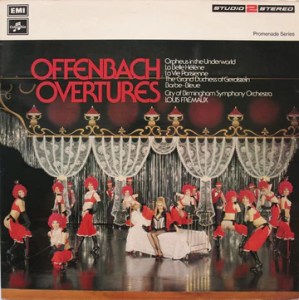
- Overtures appears on the site for only the second time ever, here with INCREDIBLE Shootout Winning Triple Plus (A+++) grades or close to them on both sides of this original British EMI pressing
- Both of these sides are exceptionally big, clear and dynamic with an abundance of Tubey Magical richness to rival the best recordings you may have heard
- The notes for side one of our best copy, with sound similar to this side two, read: breathy and rich flutes / fully extending up high / very weighty and powerful and tubey / so fun / spacious
- If that sounds like the kind of record you might want to hear for yourself in your very own listening room, this one is currently available for just that purpose
- This shootout has been many years in the making – we’ve been trying to do these wonderful overtures for about five years, which just goes to show how hard it is to find these kinds of records in audiophile playing condition nowadays
- We also just debuted a recording with Ansermet at the helm for Decca which features two of the pieces found here that’s every bit as good
- Which one is better is probably a matter of taste as they are both head and shoulders better than any other recordings we have come across in the last five or more years
This vintage UK import pressing has the kind of Tubey Magical Midrange that modern records can barely BEGIN to reproduce. Folks, that sound is gone and it sure isn’t showing signs of coming back. If you love hearing INTO a recording, actually being able to “see” the performers, and feeling as if you are sitting in the studio with the band, this is the record for you. It’s what vintage all analog recordings are known for — this sound.
If you exclusively play modern repressings of vintage recordings, I can say without fear of contradiction that you have never heard this kind of sound on vinyl. Old records have it — not often, and certainly not always — but maybe one out of a hundred new records do, and those are some pretty long odds.
What The Best Sides Of Overtures Have To Offer Is Not Hard To Hear
- The biggest, most immediate staging in the largest acoustic space
- The most Tubey Magic, without which you have almost nothing. CDs give you clean and clear. Only the best vintage vinyl pressings offer the kind of Tubey Magic that was on the tapes in 1972
- Tight, note-like, rich, full-bodied bass, with the correct amount of weight down low
- Natural tonality in the midrange — with all the instruments having the correct timbre
- Transparency and resolution, critical to hearing into the three-dimensional studio space
No doubt there’s more but we hope that should do for now. Playing the record is the only way to hear all of the qualities we discuss above, and playing the best pressings against a pile of other copies under rigorously controlled conditions is the only way to find a pressing that sounds as good as this one does.
Copies with rich lower mids and nice extension up top did the best in our shootout, assuming they weren’t veiled or smeary of course. So many things can go wrong on a record! We know, we’ve heard them all.
Top end extension is critical to the sound of the best copies. Lots of old records (and new ones) have no real top end; consequently, the studio or stage will be missing much of its natural air and space, and instruments will lack their full complement of harmonic information.
Tube smear is common to most vintage pressings. The copies that tend to do the best in a shootout will have the least (or none), yet are full-bodied, tubey and rich.
Size and Space
One of the qualities that we don’t talk about on the site nearly enough is the SIZE of the record’s presentation. Some copies of the album just sound small — they don’t extend all the way to the outside edges of the speakers, and they don’t seem to take up all the space from the floor to the ceiling. In addition, the sound can often be recessed, with a lack of presence and immediacy in the center.
Other copies — my notes for these copies often read “BIG and BOLD” — create a huge soundfield, with the music positively jumping out of the speakers. They’re not brighter, they’re not more aggressive, they’re not hyped-up in any way, they’re just bigger and clearer.
And most of the time those very special pressings are just plain more involving. When you hear a copy that does all that — a copy like this one — it’s an entirely different listening experience.
What We’re Listening For On Overtures
- Energy for starters. What could be more important than the life of the music?
- The Big Sound comes next — wall to wall, lots of depth, huge space, three-dimensionality, all that sort of thing.
- Then transient information — fast, clear, sharp attacks, not the smear and thickness so common to these LPs.
- Powerful bass — which ties in with good transient information, also the issue of frequency extension further down.
- Next: transparency — the quality that allows you to hear deep into the soundfield, showing you the space and air around all the instruments.
- Extend the top and bottom and voila, you have The Real Thing — an honest to goodness Hot Stamper.
Side One
Orpheus In The Underworld
The Grand Duchess Of Gerolstein
Side Two
La Belle Helene
Barbe-Bleue
La Vie Parisienne
Orpheus in the Underworld
Orpheus in the Underworld and Orpheus in Hell are English names for Orphée aux enfers, a comic opera with music by Jacques Offenbach and words by Hector Crémieux and Ludovic Halévy. It was first performed as a two-act “opéra bouffon” at the Théâtre des Bouffes-Parisiens, Paris, on 21 October 1858, and was extensively revised and expanded in a four-act “opéra féerie” version, presented at the Théâtre de la Gaîté, Paris, on 7 February 1874.
The opera is a lampoon of the ancient legend of Orpheus and Eurydice. In this version Orpheus is not the son of Apollo but a rustic violin teacher. He is glad to be rid of his wife, Eurydice, when she is abducted by the god of the underworld, Pluto. Orpheus has to be bullied by Public Opinion into trying to rescue Eurydice. The reprehensible conduct of the gods of Olympus in the opera was widely seen as a veiled satire of the court and government of Napoleon III, Emperor of the French. Some critics expressed outrage at the librettists’ disrespect for classic mythology and the composer’s parody of Gluck’s opera Orfeo ed Euridice; others praised the piece highly. Orphée aux enfers was Offenbach’s first full-length opera. The original 1858 production became a box-office success, and ran well into the following year, rescuing Offenbach and his Bouffes company from financial difficulty. The 1874 revival broke records at the Gaîté’s box-office. The work was frequently staged in France and internationally during the composer’s lifetime and throughout the 20th century. It is one of his most often performed operas, and continues to be revived in the 21st century.
The Grand Duchess of Gerolstein (La Grande-Duchesse de Gérolstein)
La Grande-Duchesse de Gérolstein is an opéra bouffe (a form of operetta), in three acts and four tableaux by Jacques Offenbach to an original French libretto by Henri Meilhac and Ludovic Halévy. The story is a satirical critique of unthinking militarism and concerns a spoiled and tyrannical young Grand Duchess who learns that she cannot always get her way.
La Belle Hélène
La belle Hélène (The Beautiful Helen) is an opéra bouffe in three acts, with music by Jacques Offenbach and words by Henri Meilhac and Ludovic Halévy. The piece parodies the story of Helen’s elopement with Paris, which set off the Trojan War.
Barbe-Bleue
Barbe-bleue (Bluebeard) is an opéra bouffe, or operetta, in three acts (four scenes) by Jacques Offenbach to a French libretto by Henri Meilhac and Ludovic Halévy based on Charles Perrault’s 1697 story.
The work was composed while Offenbach was travelling during 1865, in Vienna, Brussels and Cologne, conducting his works in those cities. It was first performed at the Théâtre des Variétés, Paris on 5 February 1866, playing for five months. Following the great success of the creators’ Belle Hélène, the roles were close relations of the composer’s antique operetta: Dupuis (Paris) another seducer, in Barbe-Bleue, Kopp (Ménélas) another old vain, cuckolded monarch in Bobèche, Grenier (Calchas) once more the mediocre confidant of a king – Count Oscar and Schneider (Hélène) again a woman seeking all of her desires – Boulotte. Contemporary critics judged the libretto to be one of the best constructed the composer set.
La Vie Parisienne
La vie parisienne (Parisian life) is an opéra bouffe, or operetta, composed by Jacques Offenbach, with a libretto by Henri Meilhac and Ludovic Halévy.
This work was Offenbach’s first full-length piece to portray contemporary Parisian life, unlike his earlier period pieces and mythological subjects. It became one of Offenbach’s most popular operettas.
– Wikipedia
