More Black Sabbath
More Rock Classics
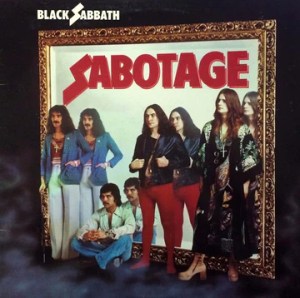
- Sabotage debuts on the site with solid Double Plus (A++) grades or BETTER on both sides of this original Palm Tree pressing
- The sound is lively, punchy, and powerful – with all due respect, it should murder whatever copies you may have
- If you want to hear this music explode out of the speakers and come to life the way the band wanted you to hear it, this record will do the trick
- 4 1/2 stars: “…the real revelation on Sabotage is Ozzy Osbourne, who turns in his finest vocal performance as a member of Black Sabbath. Really for the first time, this is the Ozzy we all know, displaying enough range, power, and confidence to foreshadow his hugely successful solo career.”
This vintage Warner Bros. pressing has the kind of Tubey Magical Midrange that modern records can barely BEGIN to reproduce. Folks, that sound is gone and it sure isn’t showing signs of coming back. If you love hearing INTO a recording, actually being able to “see” the performers, and feeling as if you are sitting in the studio with the band, this is the record for you. It’s what vintage all analog recordings are known for — this sound.
If you exclusively play modern repressings of vintage recordings, I can say without fear of contradiction that you have never heard this kind of sound on vinyl. Old records have it — not often, and certainly not always — but maybe one out of a hundred new records do, and those are some pretty long odds.
What The Best Sides Of Sabotage Have To Offer Is Not Hard To Hear
- The biggest, most immediate staging in the largest acoustic space
- The most Tubey Magic, without which you have almost nothing. CDs give you clean and clear. Only the best vintage vinyl pressings offer the kind of Tubey Magic that was on the tapes in 1975
- Tight, note-like, rich, full-bodied bass, with the correct amount of weight down low
- Natural tonality in the midrange — with all the instruments having the correct timbre
- Transparency and resolution, critical to hearing into the three-dimensional studio space
No doubt there’s more but we hope that should do for now. Playing the record is the only way to hear all of the qualities we discuss above, and playing the best pressings against a pile of other copies under rigorously controlled conditions is the only way to find a pressing that sounds as good as this one does.
Shootout Criteria
What are sonic qualities by which a record — any record — should be judged? Pretty much the ones we discuss in most of our Hot Stamper listings: energy, vocal presence, frequency extension (on both ends), transparency, spaciousness, harmonic textures (freedom from smear is key), rhythmic drive, tonal correctness, fullness, richness, three-dimensionality, and on and on down the list.
When we can get a number of these qualities to come together on the side we’re playing, we provisionally give it a ballpark Hot Stamper grade, a grade that is often revised during the shootout as we hear what the other copies are doing, both good and bad.
Once we’ve been through all the side ones, we play the best of the best against each other and arrive at a winner for that side. Other copies from earlier in the shootout will frequently have their grades raised or lowered based on how they sounded compared to the eventual shootout winner. If we’re not sure about any pressing, perhaps because we played it early on in the shootout before we had learned what to listen for, we take the time to play it again.
Repeat the process for side two and the shootout is officially over. All that’s left is to see how the sides of each pressing match up.
It may not be rocket science, but it’s a science of a kind, one with strict protocols that we’ve developed over the course of many years to insure that the results we arrive at are as accurate as we can make them.
The result of all our work speaks for itself, on this very record in fact. We guarantee you have never heard this music sound better than it does on our Hot Stamper pressing — or your money back.
What We’re Listening For On Sabotage
- Energy for starters. What could be more important than the life of the music?
- Then: presence and immediacy. The vocals aren’t “back there” somewhere, lost in the mix. They’re front and center where any recording engineer worth his salt –– Robin Black in this case — would put them.
- The Big Sound comes next — wall to wall, lots of depth, huge space, three-dimensionality, all that sort of thing.
- Then transient information — fast, clear, sharp attacks, not the smear and thickness so common to these LPs.
- Tight punchy bass — which ties in with good transient information, also the issue of frequency extension further down.
- Next: transparency — the quality that allows you to hear deep into the soundfield, showing you the space and air around all the instruments.
- Extend the top and bottom and voila, you have The Real Thing — an honest to goodness Hot Stamper.
Side One
Hole In The Sky
Don’t Start (Too Late)
Symptom Of The Universe
Megalomania
Side Two
The Thrill Of It All
Supertzar
Am I Going Insane (Radio)
The Writ
AMG 4 1/2 Star Review
Sabotage is the final release of Black Sabbath’s legendary First Six, and it’s also the least celebrated of the bunch, though most die-hard fans would consider it criminally underrated. Sabotage came at a time when Sabbath was turning in one platinum record after the next, and critics were finally starting to appreciate the band as much as their fans. It also came during a lengthy and bitter legal battle between the band and their former management, which no doubt informed lyrical themes of betrayal and paranoia as well as the pervasive overall feeling of life itself unraveling.
Musically, the band continues further down the proto-prog metal road of Sabbath Bloody Sabbath, and this time around, the synthesizers feel more organically integrated into the arrangements. What’s more, the song structures generally feel less conventional and more challenging. There’s one significant exception in the blatant pop tune “Am I Going Insane (Radio),” which rivals “Changes” as the most fan-loathed song of the glory years, thanks to its synth-driven arrangement (there isn’t even a guitar riff) and oft-repeated one-line chorus. But other than that song and the terrific album-opener “Hole in the Sky,” the band largely eschews the standard verse-chorus format, sticking to one or two melody lines per riffed section and changing up the feel before things get too repetitive.
The prevalence of this writing approach means that Sabotage rivals Vol. 4 as the least accessible record of Sabbath’s early material. However, given time, the compositional logic reveals itself, and most of the record will burn itself into the listener’s brain just fine. The faster than usual “Symptom of the Universe” is a stone-cold classic, its sinister main riff sounding like the first seed from which the New Wave of British Heavy Metal would sprout (not to mention an obvious blueprint for Diamond Head’s “Am I Evil?”). Like several songs on the record, “Symptom” features unexpected acoustic breaks and softer dynamics, yet never loses its drive or focus, and always feels like Sabbath. Less immediate but still rewarding are “Thrill of It All,” with its triumphant final section, and the murky, sullen “Megalomania,” which never feels as long as its nearly nine-and-a-half minutes.
But more than the compositions, the real revelation on Sabotage is Ozzy Osbourne, who turns in his finest vocal performance as a member of Black Sabbath. Really for the first time, this is the Ozzy we all know, displaying enough range, power, and confidence to foreshadow his hugely successful solo career. He saves the best for last with album-closer “The Writ,” one of the few Sabbath songs where his vocal lines are more memorable than Tony Iommi’s guitar parts; running through several moods over the course of the song’s eight minutes, it’s one of the best performances of his career bar none. Unfortunately, after Sabotage, the wheels of confusion came off entirely. Technically, there were two more albums released, but for most fans, the story of Osbourne-era Sabbath effectively ends here.
Want to find your own killer copy?
Consider taking our moderately helpful advice for how to find your own shootout winners.
As of 2024, shootouts for this album should be carried out:
How else can you hear this record right?
Based on what were the winners of our most recent shootout, Paranoid should sound its best:
Further Reading