More Classical and Orchestral Music
More Albums Engineered by Kenneth Wilkinson

- We guarantee you’ve never heard this powerful orchestral masterpiece sound remotely as good as it does here
- One of the truly great All Tube Wilkinson “Decca Tree” recordings in Kingsway Hall, captured faithfully in all its beauty on this very disc
- The 1950s master tape has been transferred brilliantly using “modern” cutting equipment (from 1976, not the low-rez junk they’re forced to make do with these days), giving you, the listener, sound that only the best of both worlds can offer
- Don’t expect to see an original on this site – the two we auditioned were crude, flat, full of harmonic distortion, and had clearly restricted frequency extremes, aka “boxy sound“
- If you’re a fan of large symphonic works from the Romantic period, this is a Must Own Recording from 1958 that belongs in your collection
- There are roughly 100 orchestral recordings we think offer the discriminating audiophile the best combination of Superior Performances with Top Quality Sound. This record has earned a place on that list.
Krips’ 1958 recording for Decca is brought to life on a fairly quiet and certainly quite wonderful World of the Great Classics pressing from 1976. This copy was clearly the best we played, showing us a huge hall, with layered depth that was only hinted at on most pressings, regardless of age.
The strings are remarkably rich and sweet. This pressing is yet another wonderful example of what the much-lauded Decca recording engineers of the day were able to capture on analog tape all those years ago.
That Vintage Decca Sound
This vintage Decca pressing has the kind of Tubey Magical Midrange that modern records can barely BEGIN to reproduce. Folks, that sound is gone and it sure isn’t showing signs of coming back. If you love hearing INTO a recording, actually being able to “see” the performers, and feeling as if you are sitting in the studio with the band, this is the record for you. It’s what vintage all analog recordings are known for — this sound.
If you exclusively play modern repressings of vintage recordings, I can say without fear of contradiction that you have never heard this kind of sound on vinyl. Old records have it — not often, and certainly not always — but maybe one out of a hundred new records do, and those are some pretty long odds.
What The Best Sides Of Schubert’s Symphony No. 9 Have To Offer Is Not Hard To Hear
- The biggest, most immediate staging in the largest acoustic space
- The most Tubey Magic, without which you have almost nothing. CDs give you clean and clear. Only the best vintage vinyl pressings offer the kind of Tubey Magic that was on the tapes in 1958
- Tight, note-like, rich, full-bodied bass, with the correct amount of weight down low
- Natural tonality in the midrange — with all the instruments having the correct timbre
- Transparency and resolution, critical to hearing into the three-dimensional studio space
No doubt there’s more but we hope that should do for now. Playing the record is the only way to hear all of the qualities we discuss above, and playing the best pressings against a pile of other copies under rigorously controlled conditions is the only way to find a pressing that sounds as good as this one does.
Copies with rich lower mids and nice extension up top did the best in our shootout, assuming they weren’t veiled or smeary of course. So many things can go wrong on a record! We know, we’ve heard them all.
Top end extension is critical to the sound of the best copies. Lots of old records (and new ones) have no real top end; consequently, the studio or stage will be missing much of its natural air and space, and instruments will lack their full complement of harmonic information.
Tube smear is common to most vintage pressings and this is no exception. The copies that tend to do the best in a shootout will have the least (or none), yet are full-bodied, tubey and rich.
Original Is Better?
What was most striking about this shootout, our first for the Krips / LSO performance of the work, was how poorly the original London Bluebacks fared when going head to head with the best vintage reissues. In fact, they were so obviously inferior I doubt we would have even needed another pressing to know that they could not possibly be competitive.
The two we had were crude, flat, full of harmonic distortion, and both had clearly restricted frequency extremes. I remember liking the Blueback pressings I played ten or twenty years ago. Did I have better copies, or was my system not capable of showing me the shortcomings I so clearly heard this time around? Since this is a question that cannot be answered with any certainty, we’ll have to leave it there.
What We’re Listening For On Schubert’s Symphony No. 9
- Energy for starters. What could be more important than the life of the music?
- The Big Sound comes next — wall to wall, lots of depth, huge space, three-dimensionality, all that sort of thing.
- Then transient information — fast, clear, sharp attacks, not the smear and thickness so common to these LPs.
- Tight punchy bass — which ties in with good transient information, also the issue of frequency extension further down.
- Next: transparency — the quality that allows you to hear deep into the soundfield, showing you the space and air around all the instruments.
- Extend the top and bottom and voila, you have The Real Thing — an honest to goodness Hot Stamper.
Hi-Fidelity
What do we love about these vintage pressings? The timbre of every instrument is Hi-Fi in the best sense of the word. The unique sound of every instrument is reproduced with remarkable fidelity. That’s what we at Better Records mean by “Hi-Fi,” not the kind of Audiophile Phony BS Sound that passes for Hi-Fidelity these days. There’s no boosted top, there’s no bloated bottom, there’s no sucked-out midrange.
This is Hi-Fidelity for those who recognize The Real Thing when they hear it. I’m pretty sure our customers do, and whoever picks this record up is guaranteed to get a real kick out of it.
Numbering Issues
There continues to be some controversy over the numbering of this symphony, with German-speaking scholars sometimes numbering it as symphony No. 7, the most recent version of the Deutsch catalog (the standard catalogue of Schubert’s works, compiled by Otto Erich Deutsch) listing it as No. 8, and English-speaking scholars often listing it as No. 9. – Wikipedia
Vinyl Condition
Mint Minus Minus and maybe a bit better is about as quiet as any vintage pressing will play, and since only the right vintage pressings have any hope of sounding good on this album, that will most often be the playing condition of the copies we sell. (The copies that are even a bit noisier get listed on the site are seriously reduced prices or traded back in to the local record stores we shop at.)
Those of you looking for quiet vinyl will have to settle for the sound of other pressings and Heavy Vinyl reissues, purchased elsewhere of course as we have no interest in selling records that don’t have the vintage analog magic of these wonderful recordings.
If you want to make the trade-off between bad sound and quiet surfaces with whatever Heavy Vinyl pressing might be available, well, that’s certainly your prerogative, but we can’t imagine losing what’s good about this music — the size, the energy, the presence, the clarity, the weight — just to hear it with less background noise.
Wilkie and the Decca Tree
Decca was an early adopter of the LP album, which put it ahead of its direct competitor EMI. The company was also an early exponent of stereophonic recording. Wilkinson would make the move to stereo recordings for Decca in April 1958, but until then he remained the engineer with the monaural recording team (for a time there were parallel recording teams) because mono was considered the more important release. In the early 1950s, together with Roy Wallace (1927–2007) and Haddy, he developed the Decca tree spaced microphone array used for stereo orchestral recordings. Decca began to use this for recordings in May 1954 [the month and year I was born!] at Victoria Hall in Geneva, a venue Wilkinson did not record in. He preferred recording in London and Paris although he also recorded in Amsterdam, Bayreuth, Chicago, Copenhagen, Rome, and Vienna.
Wilkinson discussed the use of the Decca tree in an interview with Michael H. Gray in 1987.
You set up the Tree just slightly in front of the orchestra. The two outriggers, again, one in front of the first violins, that’s facing the whole orchestra, and one over the cellos. We used to have two mikes on the woodwind section – they were directional mikes, 56’s in the early days. You’d see a mike on the tympani, just to give it that little bit of clarity, and one behind the horns. If we had a harp, we’d have a mike trained on the harp. Basically, we never used too many microphones. I think they’re using too many these days.
Wilkinson’s method of selecting recording venues was recounted in an article on concert hall orchestral sound written by the conductor Denis Vaughan in 1981:
I have recorded in many halls throughout Europe and America and have found that halls built mainly of brick, wood and soft plaster, which are usually older halls, always produce a good natural warm sound. Halls built with concrete and hard plaster seem to produce a thin hard sound and always a lack of warmth and bass. Consequently when looking for halls to record in I always avoid modern concrete structures.
Wilkinson went on to engineer at hundreds of recording sessions. He was said to have worked with more than 150 conductors. He was the engineer most responsible for Richard Itter’s Lyrita recordings (which Decca produced). Itter always requested Wilkinson as engineer, calling him “a wizard with mikes.”
Wilkinson’s stereo recordings with the conductor Charles Gerhardt (including a series of Reader’s Digest recordings and the RCA Classic Film Scores series) and the producer John Culshaw made his name and reputation known to record reviewers and audiophiles. His legacy was extended by the fact that he trained every Decca engineer from 1937 onwards.
Wilkinson, always called “Wilkie” in the music business, was known as a straight-talking man, interested only in the quality of the work. The Decca producer Ray Minshull (1934–2007) recalled Wilkinson’s methods in an interview with Jonathan Valin in March 1993:
Everyone loved and respected Wilkie, but during a session he could be exacting when it came to small details. He would prowl the recording stage with a cigarette – half-ash – between his lips, making minute adjustments in the mike set-up and in the orchestral seating. Seating arrangement was really one of the keys to Wilkie’s approach and he would spend a great deal of time making sure that everyone was located just where he wanted them to be, in order for the mikes to reflect the proper balances.
Of course, most musicians had a natural tendency to bend toward the conductor as they played. If such movement became excessive, Wilkie would shoot out onto the stage and chew the erring musician out before reseating him properly. He wanted the musicians to stay exactly where he had put them. He was the steadiest of engineers, the most painstaking and the most imaginative. In all of his sessions, he never did the same thing twice, making small adjustments in mike placement and balances to accord with his sense of the sonic requirements of the piece being played.
His recordings were characterised by the producer Tam Henderson in an appreciation: “The most remarkable sonic aspect of a Wilkinson orchestral recording is its rich balance, which gives full measure to the bottom octaves, and a palpable sense of the superior acoustics of the venues he favored, among them London’s Walthamstow Assembly Hall and The Kingsway Hall of revered memory”.
On retiring, Wilkinson received a special gold disc produced by Decca with extracts of his recordings. He received three Grammys for engineering: 1973, 1975, and 1978. He also received an audio award from Hi-Fi magazine in 1981 and the Walter Legge Award in 2003 “…for extraordinary contribution to the field of recording classical music.”
Wikipedia Background on The Symphony No. 9
The Symphony No. 9 in C major, D. 944, known as the Great (published in 1840 as “Symphony No. 7 in C Major”, is the final symphony completed by Franz Schubert. Originally called The Great C major to distinguish it from his Symphony No. 6, the Little C major, the subtitle is now usually taken as a reference to the symphony’s majesty. A typical performance takes around 55 minutes, though it can be played in 45 at a faster tempo.
Often considered Schubert’s finest piece for orchestra, this symphony is also one of the composer’s most innovative pieces. Thematic development in the style of Beethoven is still present in the work, but Schubert puts far more emphasis on melody, which one might expect from the composer of some six hundred lieder. In fact, this new style prompted Schumann to pursue his own symphonic ambitions.
The symphony is scored for 2 flutes, 2 oboes, 2 clarinets in A and C, 2 bassoons, 2 horns in C, 2 trumpets in A and C, 3 trombones, timpani, and strings.
In 1838, ten years after Schubert’s death, Robert Schumann visited Vienna and was shown the manuscript of the symphony at the Gesellschaft der Musikfreunde by Ferdinand Schubert. He took a copy that Ferdinand had given him back to Leipzig, where the entire work was performed publicly for the first time by Felix Mendelssohn at the Leipzig Gewandhaus on 21 March 1839. Schumann celebrated the event in the Neue Zeitschrift für Musik with an ecstatic article in which, in a phrase destined to become famous, he hailed the symphony for its ‘heavenly length’. Legend claims that, during a rehearsal of the first movement, one musician was reported as asking another if he had managed to hear a tune yet. On the other hand, having heard its first performance, Schumann is reported to have said he thought it the greatest instrumental work since the death of Beethoven.
Beethoven had always used the trombone as an effect, and therefore very sparingly, or, in the case of Beethoven’s Ninth Symphony, also to double the alto, tenor, and bass parts of the chorus as was common in sacred music and opera at the time. However, in both Schubert’s Unfinished Symphony and the Ninth Symphony, trombones are liberated from these roles and have far more substantial parts.
ThinkQuest Entry
Melody: The one element of Schubert’s style which is totally, completely distinctive and unique, is his gift for spontaneous, lyrical, charming melodic invention. His melodies include some of the most famous in all Western music, and often express tremendous joy, but can also convey dark mood swings and deep despair.
Harmony: In terms of harmonic originality, Schubert is equal, maybe even superior, to Beethoven. He often explores wildly unusual key relationships, and has a penchant for modulations into distant harmonic territory.
Form: Schubert stretched Classical sonata form to its absolute limits. His expositions usually feature a bewildering array of thematic material, presented in highly imaginative key relationships. Many works, particularly the String Quintet and the last piano sonata, anticipate Bruckner in their luxurious spaciousness of form.
Heavy Vinyl and Transparency Loss
We used to like the Speakers Corner pressing of this recording, but it has been close to ten years since we’ve played one, and I rather doubt I would feel the same way about it now. So often when we revisit the remastered records we used to like we come away dumbfounded — what on earth were we thinking? These are not the droids sounds we are looking for. Perhaps our minds were clouded at the time.
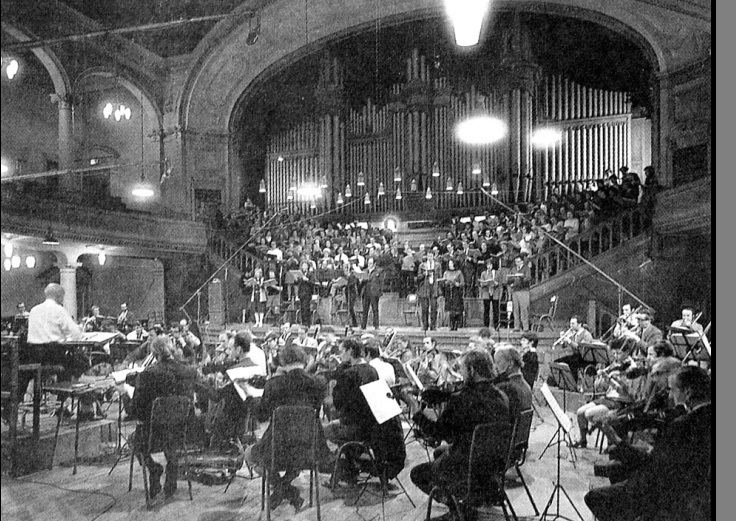
Not sure what performance this is, but it’s definitely not the Schubert 9th.
Dear Sirs,
where can I buy this vinyl ?
Best regards.
Alberto
Alberto,
We haven’t done a shootout for the album in quite a while, so we have no stock at this time.
You can find them on Discogs easily enough though.
Best, TP