 Hot Stamper Pressings of the Music of Claude Debussy Available Now
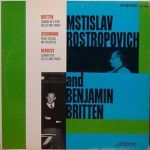
Both sides of this promo London Blueback pressing (CS 6237) of piano and cello music have SUPERB sound. If you’re a fan of the cello, the piano, or chamber works in general, you will have a hard time finding a better sounding recording than this.
Notice especially that there is practically no smear on the piano — the notes are clear, with their transients fully intact, something one rarely hears anywhere but in a live setting. The tonality of the piano is also correct from top to bottom.
Lately we have been writing quite a bit about how pianos are good for testing your system, room, tweaks, electricity and all the rest, not to mention turntable setup and adjustment.
- We like our pianos to sound natural (however one chooses to define the term).
- We like them to be solidly weighted.
- We like them to be free of smear, a quality that is rarely mentioned in the audiophile record reviews we read.
This is an Older Classical/Orchestral Review
Most of the older reviews you see are for records that did not go through the shootout process, the revolutionary approach to finding better sounding pressings we started developing in the early 2000s and have since turned into a veritable science.
We found the records you see in these older listings by cleaning and playing a pressing or two of the album, which we then described and priced based on how good the sound and surfaces were. (For out Hot Stamper listings, the Sonic Grades and Vinyl Playgrades are listed separately.)
We were often wrong back in those days, something we have no reason to hide. Audio equipment and record cleaning technologies have come a long way since those darker days, a subject we discuss here.
Currently, 99% (or more!) of the records we sell are cleaned, then auditioned under rigorously controlled conditions, up against a number of other pressings. We award them sonic grades, and then condition check them for surface noise.
As you may imagine, this approach requires a great deal of time, effort and skill, which is why we currently have a highly trained staff of about ten. No individual or business without the aid of such a committed group could possibly dig as deep into the sound of records as we have, and it is unlikely that anyone besides us could ever come along to do the kind of work we do.
The term “Hot Stampers” gets thrown around a lot these days, but to us it means only one thing: a record that has been through the shootout process and found to be of exceptionally high quality.
The result of our labor is the hundreds of titles seen here, every one of which is unique and guaranteed to be the best sounding copy of the album you have ever heard or you get your money back.
Side One
Britten – Sonata in C for Cello and Piano
Schumann – Funf Stucke Im Volkston
Side Two
Schumann – Funf Stucke Im Volkston
Debussy – Sonata for Cello and Piano
Benjamin Britten
Britten was an accomplished pianist, frequently performing chamber music and accompanying lieder and song recitals. However, apart from the Holiday Diary (1934), Piano Concerto (1938), Young Apollo (1939), Diversions (written for Paul Wittgenstein in 1940), Scottish Ballad (1941), he wrote relatively little music that puts the piano in the spotlight, and in a 1963 interview for the BBC said that he thought of it as “a background instrument”.
One of Britten’s best known works is The Young Person’s Guide to the Orchestra (1946), which was composed to accompany Instruments of the Orchestra, an educational film produced by the British government, narrated and conducted by Malcolm Sargent. Its subtitle is Variations and Fugue on a Theme of Purcell, the theme is a melody from Henry Purcell’s Abdelazar. Britten gives individual variations to each of the sections of the orchestra, starting with the woodwind, then the string instruments, the brass instruments and finally the percussion. Britten then brings the whole orchestra together again in a fugue before restating the theme to close the work. The original film’s spoken commentary is often omitted in concert performances and recordings.
Britten’s church music is also considerable: it contains frequently performed ‘classics’ such as Rejoice in the Lamb, composed for St Matthew’s Northampton (where the Vicar was Revd Walter Hussey), as well as A Hymn to the Virgin, and Missa Brevis for boys’ voices and organ.
As a conductor, Britten performed the music of many composers, as well as his own. Among his celebrated recordings are versions of Mozart’s 40th Symphony and Elgar’s The Dream of Gerontius (with Pears as Gerontius), and an album of works by Grainger in which Britten features as pianist as well as conductor.
Early in his career, Britten made a conscious effort to set himself apart from the English musical mainstream, which he regarded as complacent, insular and amateurish. Many contemporary critics distrusted his facility, cosmopolitanism and admiration for composers such as Mahler, Berg, and Stravinsky, not at the time considered appropriate models for a young English musician.
Britten’s status as one of the greatest composers of the 20th century is now secure among professional critics.
Wikipedia


