strong-weak

Here we detail the strengths and weaknesses of various pressings we’ve played in shootouts.

Playing multiple pressings of the same recording against each other under controlled conditions is the only practical way to identify the important differences discussed in these listings.

On Our Top Copy of Moondance, How Did We Recognize that One Side Was Not as Tubey?

Hot Stamper Pressings of the Music of Van Morrison Available Now

We described our most recent shootout winning pressing this way:

A Moondance like you’ve never heard, with Shootout Winning Triple Plus (A+++) grades or close to them on both sides of this early Green Label pressing.

Here are just a few of the things we had to say about this killer copy in our notes: “silky and 3D and present”…”sweet and breathy vox”…”spacious and rich”…”huge and lively”…”jumping out of the speakers.”

Drop the needle anywhere on the album for a taste of early-70s Tubey Magical analog, not to mention the kind of blue-eyed soul that will remind some of you just how good music on vinyl used to be.

Side one was killer in every way, and the way we know that is we played a bunch of copies and nothing could beat it. This side one took top honors for having exactly the sound we described above.

Side two is another matter. We came across a side two that was slightly better than the side two you see here.

When we played the two best copies back to back, side one of this copy came out on top, earning a grade of 3+. However, the side two of another pressing showed us there was even more Tubey Magic in the recording than we’d noticed the first time around.

With another copy earning a better grade for having even more Tubey Magic, the full 3 pluses, we felt the right grade for this side two was 2.5+.

Helpful Advice

To aid you in doing your own evaluations, here is a list of records that we’ve found to be good for testing Tubey Magic.

This is exactly why we do shootouts. If you really want to be able to recognize subtle (and not so subtle!) differences between pressings, you must learn to do them too.

And make sure to take notes about what you are hearing, good and bad.

One more thing: stick with the Green Label early pressings, they are the only way to fly on Moondance.

Mistakes Were Made

If you made the mistake of buying the Rhino pressing of Moondance, I hope you heard what we heard: a complete lack of Tubey Magic! This on one of the most Tubey Magical analog recordings we’ve ever played. You can thank Kevin Gray for helping you flush your record money down the drain. When we first reviewed the remaster in 2014, we wrote:

Where is the Tubey Magic of the originals? The sweetness? The richness? And why is there so little ambience or transparency? You just can’t “see” into the studio on this pressing the way you can on the good originals, but that’s fairly consistently been the knock on these remastered Heavy Vinyl records. We noted as much when we reviewed Blue all the way back in early 2007, so no surprise there.

We also complained that the Heavy Vinyl reissue gets the voice wrong.  When the voice is wrong on a Van Morrison record, you have yourself a completely worthless piece of vinyl. 180 grams or 120 grams or any other number of grams, vinyl with sound this bad should hold no appeal to the audiophile. The record collector, maybe, but collecting for the sake of collecting has never been our thing and we hope it’s never been yours.

(more…)

Debussy & Ravel – A Tale of Two Top Copies

Hot Stamper Pressings of the Music of Claude Debussy Available Now

Hot Stamper Pressings of the Music of Maurice Ravel Available Now

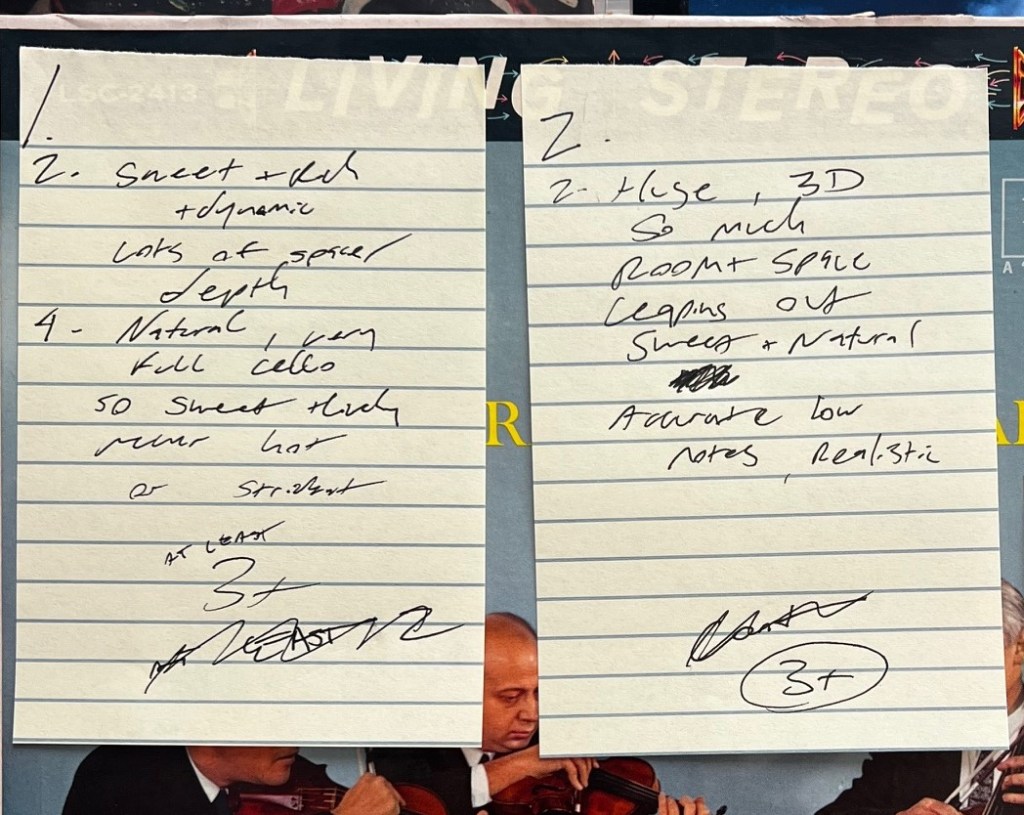
In 2024 we did a shootout for this recording of quartets, LSC 2413, our first in 19 years.

For the shootout winning pressing, we wrote the following:

Juilliard String Quartet’s performance of these wonderful classical works appears on the site for only the second time ever, here with INSANELY GOOD Shootout Winning Triple Plus (A+++) grades on both sides of this original Shaded Dog pressing.

Having just played some killer copies of Death and the Maiden, we’re tempted to say that this Debussy record has the potential for even better sound — it’s richer and sweeter, but every bit as real and immediate as any chamber recording we know of.

Here are the notes for the actual record we played. Side one really blew our minds, earning a grade of at least 3+.

The second place finisher may not have been quite as good on side one, but it was still so good that it had no problem earning the full three pluses. It had the same stampers as the copy above by the way.

Side two however lacked the space of the very best pressings we played, and we marked it down one half plus for that shortcoming. Although it was “so tubey and 3-D” it did not have “all the space but not hot at all and natural and sweet.”

It’s very unlikely that the person who bought this copy would feel there was any problem with side two. We had two killer side two’s to play against each other back to back, and that’s about the only way these kinds of very subtle differences can be recognized, assuming you have a system that can resolve the space of the recording at an extremely high level to begin with.

The big rooms with high ceilings that systems like those require are not usually found in listening rooms that have not been custom built.

More on this wonderful record:

The Living Stereo sound here is Tubey Magical, lively and clear, with the kind of transparency that puts living, breathing musicians right in your listening room in the way that only the best vintage vinyl pressings can.

Lewis Layton engineered this recording (along with Ed Begley) and he nailed it, perfectly capturing the rich, textured sheen on the strings, the hallmark of Living Stereo sound in the 50s and 60s.

He recorded both the Schubert (LSC 2378) mentioned above and this wonderful Debussy/Ravel record for RCA in 1960 — it would be quite the understatement to say he had a gift for recordings of this kind.


Another superb recording from the 60s, brought to you by your vinyl-loving friends at Better Records.

It’s an exceptional Living Stereo all analog recording from 1960 – nothing else sounds like it.

When you’ve played as many Living Stereo titles as we have (250+ and counting), you’re bound to run into this kind of Demo Disc sound from time to time – it’s what makes record collecting fun.

It’s an amazing find, the kind of record we live for here at Better Records.

(more…)

Our Amazingly Good Shootout Winning Copy Fell Short in One Area

Hot Stamper Pressings of Bossa Nova Albums Available Now

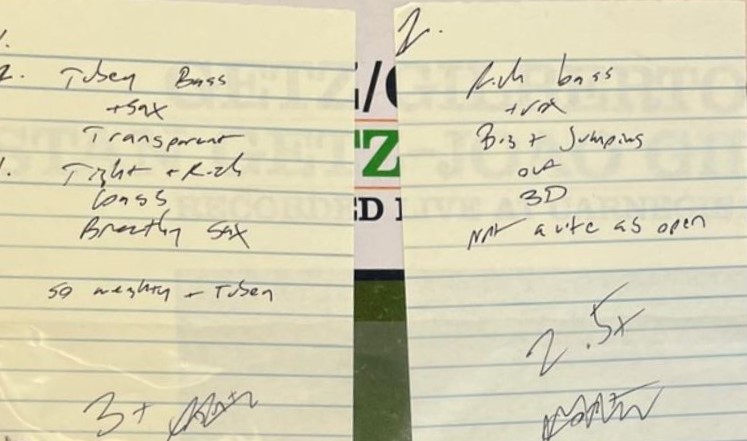
With INCREDIBLE Shootout Winning Triple Plus (A+++) live jazz sound or close to it throughout, this copy is guaranteed to blow the doors off any other Getz – Gilberto #2 you’ve heard.

Rich, tubey and musical, the sound is wonderful for these live performances of the two very different groups – one side featuring Getz, the other Gilberto.

As you can see from the notes, side one of our most recent White Hot stamper Shootout Winner was doing everything right.

However, we had a side two that was slightly better than the side two you see here.

The Second Round

When we played the two best copies back to back, side one of this copy came out on top, earning a grade of 3+, but the side two of another pressing showed us the sound could be even more open than we thought the first time around.

As a consequence, we dropped side two’s grade a half plus, from 3 to 2.5+.

This is exactly why we do shootouts. If you really want to be able to recognize subtle (and sometimes not so subtle!) differences between pressings, you must learn to do them too.

And make sure to take notes about what you are hearing, good and bad.

One side falling short of the full Three Pluses happens more often than not. One out of five records that has one shootout winning side will have a matching shootout winning other side.

The math works like this. 3+/3+ records go in this section, which currently holds 29 titles as of 4/2025. Records with at least one 3+ side go in this section, and there are 145 of those as of the same date, about five times as many.

Getz Is the Man

Stan Getz is a truly great tenor saxophonist, the cool school’s most popular player. Over the years we have invested an insane amount of time and money in our search for Hot Stamper copies of this and other Getz albums.

We rarely have much to show for our efforts — certainly not in terms of quantity, as years can go by without a single record of his on the site.

(more…)

Which Side Lacked Space, and How Did You Figure That Out?

Hot Stamper Pressings of the Music of Linda Ronstadt Available Now

Big, rich, smooth, and sweet, how did George Massenburg pull off this kind of analog sound in 1987?

We don’t know, but we do know good sound when we hear it, and we heard remarkably good sound on this copy.

The first track on side one was big and rich, with vocals that were breathy and present, just the way we like ’em.

The third track was every bit as good, with sound that was rich and weighty. The vocals wer so present and open, sweet and silky. This is exactly what you want on this album.

And the way we know that is we played a bunch of copies and nothing could beat it. This side one took top honors for having sound we described above.

Side two is another matter. We came across a side two that was slightly better than the side one you see here.

How did that kind of thing happen, you ask?

Well, when we played the two best copies back to back, side one of this copy came out on top, earning a grade of 3+, but the side two of another pressing showed us there was even more space in the recording than we noticed the first time around.

We knew side two was “at least 2+,” the crossed-out text you see in the notes.

With another copy earning a better grade, 3 pluses, we felt the right grade for this side two was 2.5+.

(more…)

What We’ve Learned About Peer Gynt Over the Last 20 Years

Hot Stamper Pressings of the Music of Edvard Grieg Available Now

The commentary reproduced down below is from 2005. It is unlikely that the pressing we liked at the time, a Stereo Treasury LP of the famous Fjeldstad performance, would come anywhere close to winning a shootout these days. We simply don’t buy them anymore. We stick to the pressings that have done well for us over the last twenty years in shootout after shootout.

Peer Gynt is a Masterpiece that deserves a place at the heart of any classical collection of the greatest recordings of all time.

If you want to improve the quality of pressings in your collection, by far the best way to go about it is to start doing your own shootouts. A great deal of this blog is dedicated to helping you learn how to do that.

Oddly enough, there actually are budget reissues that win shootouts. They just happen to be Ace of Diamonds pressings and not Stereo Treasurys. (You can see a picture of the pressing we like at the bottom of this post.)

The Wonderful Peer Gynt

Our favorite recording of Peer Gynt is the one by Otto Gruner-hegge and the Oslo Philharmonic from 1959.

The only other reading of the work with top quality sonics is the one that won our proto-shootout twenty years ago, the one with Fjeldstad and the London Symphony Orchestra.

Speaking of budget reissues, we are on record as having been fans of a great many budget classical LPs stretching back decades. My catalogs from the 90s were full of reissues with exceptionally good sound.

Doing things as we do them now, by following rigorous testing protocols, has made it possible for us to discover some budget pressings that are so well-mastered they have the potential — accent on the word potential — to win shootouts.

(more…)

An Amazingly Good Nashville Skyline, But Side Two Fell Short in One Area

Hot Stamper Pressings of the Music of Bob Dylan Available Now

You just can’t beat a well-produced, well-engineered Columbia from this era. There’s a richness and a naturalness to the sound that’s almost completely disappeared from the modern world of music, and by “modern world” we mean both modern recordings and modern remasterings of vintage recordings.

Practically none of them ever have the qualities of this wonderful record from 1969.

You really do have to go back to these old originals to find it. And then you have to find just the right old originals for it to be there. Here are the notes for one we played not long ago.

As you can see from the notes, side one of our most recent White Hot stamper shootout winning copy was doing everything right. We marvelled at these specific qualities in the sound:

Track three

  • Big and spacious and lively
  • The vocals and guitars are big and weighty and jumping

Track one

  • Spacious and great size and detail
  • Vocals jump out
  • Realistic acoustics

However, we had a side two that was slightly better than the side two you see here.

When we played the two best copies back to back, side one of this copy came out on top, earning a grade of 3+, but the side two of another copy showed us there was potentially even more presence to Dylan’s vocals in the recording than we had assumed. As a consequence, we felt it best to drop side two’s grade a half plus to 2.5+.

Track one

  • Tubey bass
  • Weighty
  • Very full vocals
  • A bit veiled but better than most

Track one on side two was doing practically everything right, but it slightly lacked presence, and for that we dropped the grade one half plus to 2.5+.

Midrange presence is one of the most important qualities of any rock or pop recording we might evaluate, and for a Bob Dylan album it is absolutely essential.

You want Dylan to be front and center, neither recessed nor behind a veil.

To aid you in doing your own evaluations, here is a list of records that we’ve found to be good for testing midrange presence.

(more…)

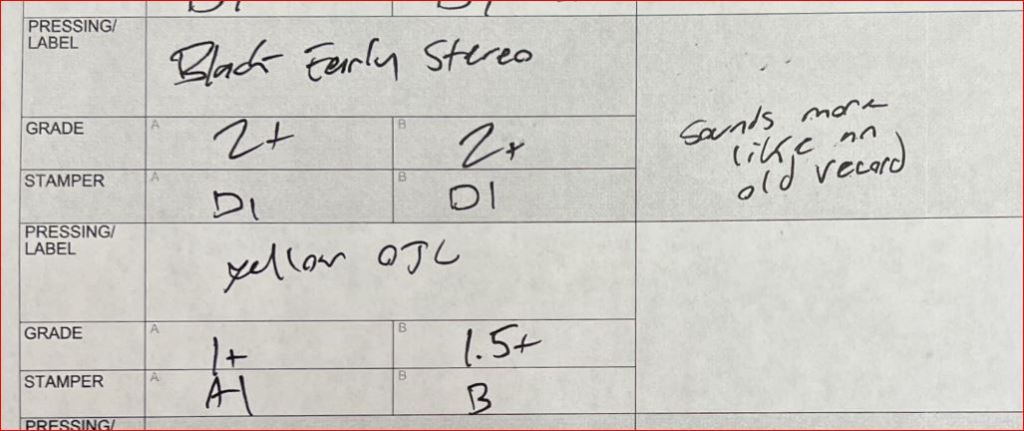
How Does the D1/D1 Jazz Giant Black Label Pressing Sound?

Hot Stamper Pressings of Contemporary Jazz Albums Available Now

Even though the Black label original of Jazz Gianot we played in our shootout held its own well enough, it did suffer from a slight case of “old record” sound.

Head to head with the best vintage reissues, it was a bit crude, didn’t extend fully on the top end, and wasn’t as resolving in the midrange.

The fact that it earned a Super Hot (A++) sonic grade means that it could not have sounded too much like an old record. It was still doing most everything right.

It just had a few sonic shortcomings we recognized were holding it back.

The reissues that beat it in the shootout showed us just how good the album could sound, maybe not night and day better, but definitely better, a full grade better.

The Black Label original we played would still beat the pants off the godawful Analogue Productions Heavy Vinyl pressing that came out in the 90s, the one mastered by the formerly-brilliant Doug Sax.

For those who may not have been collecting back then, we describe in great detail the bad sound of the Heavy Vinyl pressing that AP produced for their version of Way Out West in 1992.

Mobile Fidelity got into the reissue act in 1994, making murky-sounding records on 200 gram vinyl and calling them Anadisqs.

Classic Records started producing their bright, screechy reissues of Living Stereo titles that year as well.

It seems a lot of bad sounding records were being made back then!

Is it any different now? (If it is, please contact me at tom@better-records.com and tell me what you think the differences are. I am at a loss after playing these six Heavy Vinyl titles in 2024 and finding that all of them fell well short of the mark. What mark is that, you ask? Why, the mark set by their vintage counterparts.)

(more…)

Lincoln Mayorga Volume 1 and Obvious Pressing Variations

Hot Stamper Pressings of Direct-to-Disc Recordings Available Now

After doing our first shootout many years ago for the record that single-handedly introduced the audiophile community to Direct to Disc recording, Lincoln Mayorga and Distinguished Colleagues, Volume One, I have to confess I was taken aback by the significant pressing variations we heard among the copies we played, 

These LPs are all over the map sonically.

Some Sheffield pressings are aggressive, many of them are dull and lack the spark of live music, some of them have wonky bass or are lacking in the lowest octave — they are prey to every fault that befalls other pressings, direct to disc and otherwise.

Which should not be too surprising. Records are records. Pressing variations exist for every album ever made. If you haven’t noticed that yet, start playing multiple copies of the same album while listening carefully and critically. If your stereo is any good at all, it should not take you long to notice how different one record sounds from another in practically every case.

Biggest problems on S9?

I would have to say smear is Number One.

When the brass loses its bite and the bells don’t have the percussive quality of metal being struck, this is not a good thing. The band also seems to lose energy when the pressing suffers from smear.

Number Two would be a lack of top end extension.

The harmonics of the sax and trumpet are muted on some copies, and the harpsichord really suffers when the top end isn’t all there. This lack of extension is most noticeable on all the lovely bells and percussion instruments that pepper the soundstage, but you can actually hear it on practically every instrument once you recognize the problem. It’s there on guitar harmonics, cymbals and snares, and on down the list.

Linked here are other records that are good for testing these same shortcomings:

(more…)

This Sibelius Violin Concerto Was Big and Lush but…

Hot Stamper Pressings Featuring the Violin Available Now
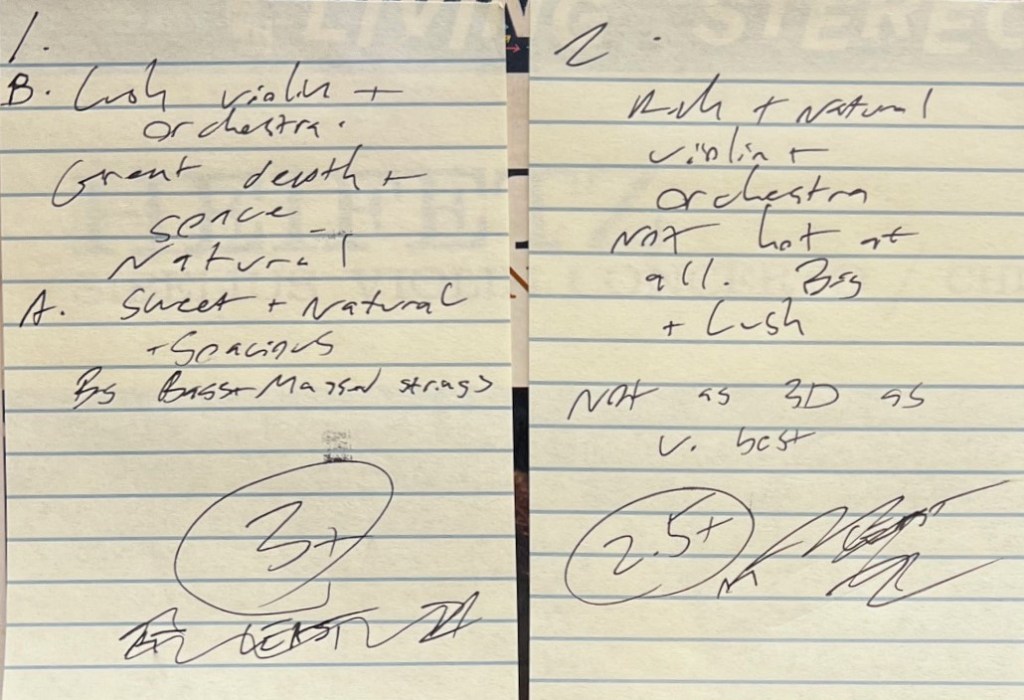
We love the way RCA recorded Heifetz back in the day, the day in this case being 1960. We usually have a good supply of vintage Heifetz titles on the site at all times. They often have our favorite performances, and the best copies, as the notes for the one below make clear, can have absolutely amazing sound.

As you can see from the notes, side one of a recent shootout winning copy was doing everything right.

However, we had a side two that was slightly better than the side two you see here. When we played the two best copies back to back, this side one came out on top, earning a grade of 3+, but the side two of another copy showed us there was even more three-dimensionality to be discovered in the recording than we thought. Consequently this side two was dropped a half grade to 2.5+.

This is exactly why we do shootouts. If you really want to be able to recognize subtle (and not so subtle!) differences between pressings, you must learn to do them too.

(more…)

Specific Critiques of All Four Sides of 4 Way Street

Hot Stamper Pressings of the Music of Crosby, Stills, Nash and (Sometimes) Young

If you want to hear Crosby, Stills, Nash and Young rock out live in your listening room, this copy will let you do it. It’s not easy to find good sound on even one side of this album, let alone all four.

Three Shootout Winning White Hot Stamper sides out of four! These three sides handily blow other copies out of the water, with the size, space, presence and energy that only the finest pressings are capable of. If you want to hear Crosby, Stills, Nash and Young rock out live in your listening room, this is the only copy that will let you do it. No other copy we’ve ever played rocked the way this one rocked! For three quarters of the “concert”, YOU ARE THERE.

If the singers get hard and shrill in the louder passages, then what you have is a pretty typical pressing. Add grit and grain, smeared transients, opacity, surface noise and a lack of weight down low and you’ll know why it takes us years to find enough copies to shoot out — because this is what most pressings sound like.

As you have surely read on the site by now, this band has put out more bad pressings of good recordings than practically any I can think of. Here is an excerpt from our review of their first album that discusses the issue in more depth.

Wrong Sound

95% of all the pressings of this album I’ve ever played have been disappointing. They’re almost always wrong, each in their own way of course. Some are dull, some are shrill, some are aggressive, some have no bass — every mastering fault you can imagine can be heard on one copy or another of this record. The bottom line? If you want to buy them and try them from your local record store, plan on spending hundreds of dollars and putting in years of frustrating effort, perhaps with little to show for it in the end. This is one tough nut to crack; it’s best to know that going in.

Sound So Real

The song “Triad”, for example, presents us with a lone David Crosby and acoustic guitar. It’s as real sounding as anything I’ve ever heard from this band. Listening to that natural guitar tone brings home the fact that their studio recordings (and studio recordings in general) are processed and degraded significantly relative to what the original microphones picked up.

This live album gives you the “naked” sound of the real thing — the real voices and the real guitars and the real everything else, in a way that would never happen again. (Later CSN albums are mostly dreadful. Fortunately later Neil Young albums, e.g., Zuma, are often Demo Discs of the highest quality.)


More records for which we’ve detailed the strengths and weaknesses of a specific shootout copy.

Side One

Big, clear, present, dynamic — what’s not to like? It shows you what few copies can: how well-recorded the album is. Halverson did a great job but you have to work your tail off to find a copy that does his brilliant engineering justice. Sad, isn’t it?

(more…)