strong-weak

Here we detail the strengths and weaknesses of various pressings we’ve played in shootouts.

Playing multiple pressings of the same recording against each other under controlled conditions is the only practical way to identify the important differences discussed in these listings.

This Sibelius Violin Concerto Was Big and Lush but…

Hot Stamper Pressings Featuring the Violin Available Now

We love the way RCA recorded Heifetz back in the day, the day in this case being 1960. We usually have a good supply of vintage Heifetz titles on the site at all times. They often have our favorite performances, and the best copies, as the notes for the one below make clear, can have absolutely amazing sound.

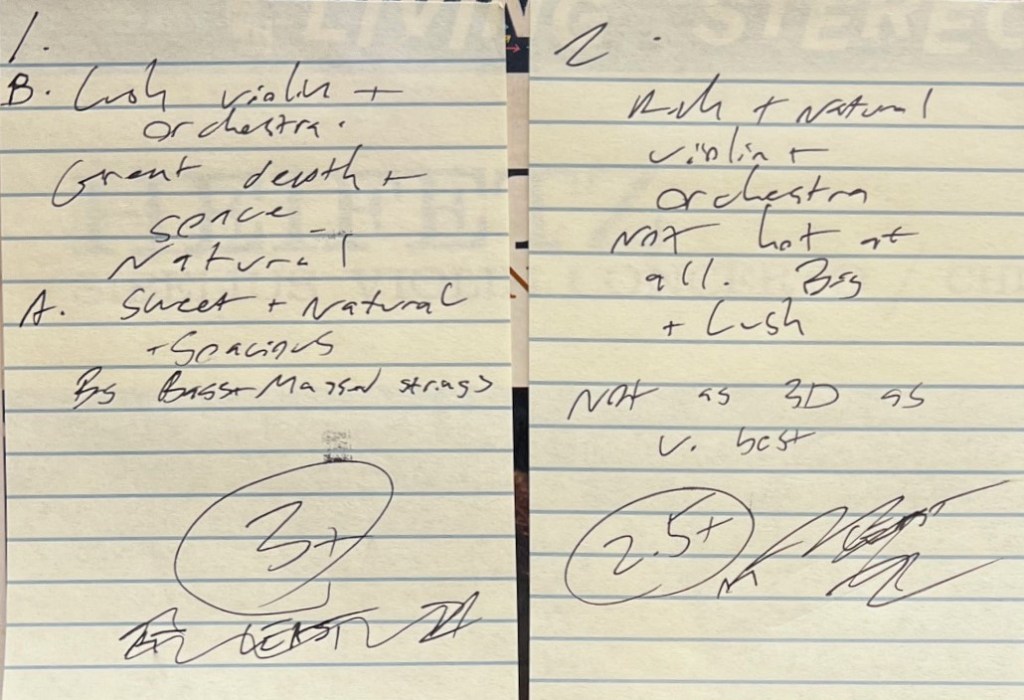
As you can see from the notes, side one of a recent shootout winning copy was doing everything right.

However, we had a side two that was slightly better than the side two you see here. When we played the two best copies back to back, this side one came out on top, earning a grade of 3+, but the side two of another copy showed us there was even more three-dimensionality to be discovered in the recording than we thought. Consequently this side two was dropped a half grade to 2.5+.

This is exactly why we do shootouts. If you really want to be able to recognize subtle (and not so subtle!) differences between pressings, you must learn to do them too.

(more…)

Specific Critiques of All Four Sides of 4 Way Street

Hot Stamper Pressings of the Music of Crosby, Stills, Nash and (Sometimes) Young

If you want to hear Crosby, Stills, Nash and Young rock out live in your listening room, this copy will let you do it. It’s not easy to find good sound on even one side of this album, let alone all four.

Three Shootout Winning White Hot Stamper sides out of four! These three sides handily blow other copies out of the water, with the size, space, presence and energy that only the finest pressings are capable of. If you want to hear Crosby, Stills, Nash and Young rock out live in your listening room, this is the only copy that will let you do it. No other copy we’ve ever played rocked the way this one rocked! For three quarters of the “concert”, YOU ARE THERE.

If the singers get hard and shrill in the louder passages, then what you have is a pretty typical pressing. Add grit and grain, smeared transients, opacity, surface noise and a lack of weight down low and you’ll know why it takes us years to find enough copies to shoot out — because this is what most pressings sound like.

As you have surely read on the site by now, this band has put out more bad pressings of good recordings than practically any I can think of. Here is an excerpt from our review of their first album that discusses the issue in more depth.

Wrong Sound

95% of all the pressings of this album I’ve ever played have been disappointing. They’re almost always wrong, each in their own way of course. Some are dull, some are shrill, some are aggressive, some have no bass — every mastering fault you can imagine can be heard on one copy or another of this record. The bottom line? If you want to buy them and try them from your local record store, plan on spending hundreds of dollars and putting in years of frustrating effort, perhaps with little to show for it in the end. This is one tough nut to crack; it’s best to know that going in.

Sound So Real

The song “Triad”, for example, presents us with a lone David Crosby and acoustic guitar. It’s as real sounding as anything I’ve ever heard from this band. Listening to that natural guitar tone brings home the fact that their studio recordings (and studio recordings in general) are processed and degraded significantly relative to what the original microphones picked up.

This live album gives you the “naked” sound of the real thing — the real voices and the real guitars and the real everything else, in a way that would never happen again. (Later CSN albums are mostly dreadful. Fortunately later Neil Young albums, e.g., Zuma, are often Demo Discs of the highest quality.)


More records for which we’ve detailed the strengths and weaknesses of a specific shootout copy.

Side One

Big, clear, present, dynamic — what’s not to like? It shows you what few copies can: how well-recorded the album is. Halverson did a great job but you have to work your tail off to find a copy that does his brilliant engineering justice. Sad, isn’t it?

(more…)

Workin’ And Steamin’ – We Were Dead Wrong about the Originals

davismiles

Hot Stamper Pressings of the Music of Miles Davis Available Now

This review is for a pressing we put up around 2010.

Up to that time we had never played a clean, early pressing, and when we finally were able to put some in our shootout, one of them had sound that was out of this world.

In the commentary below we discuss what we think the early pressings probably sound like. Now, having heard how good the best of them can sound, we admit we clearly needed to do more research and development.

The record pictured above can have superb sound, much better than any modern Heavy Vinyl reissue you care to name.

However, the right properly-cleaned early pressings have the potential to take the sound of this music to the next level, a level we had no idea could exist until that right record came our way.

(more…)

Pros and Cons from a Long-Ago Shootout for Everything But the Beer

Living Stereo Titles Available Now

This shootout was probably done about ten years ago.

This VERY RARE 2 LP Shaded Dog pressing has Super Hot Stamper sound. Much of what’s good about Golden Age recordings is heard here, with side one for example having the sound of a HUGE hall and that Three-Dimensional quality that the best vintage recordings are able to convey so well.

We constantly knock Heavy Vinyl here at Better Records for the simple reason that we play vintage recordings such as this by the score every month and can hear what they do so well.

Unfortunately the huge hall and the 3-D soundstaging they effortlessly reproduce cannot be found on any Heavy Vinyl pressing we know of.

Such qualities allow this record to sound — in some ways, to be sure not all — like live music.

Side One

Pomp and Circumstance March No. 1 – Elgar
Mignon Overture – Thomas
Largo from Xerxes – Handel
Prelude to Act III of Lohengrin – Wagner

Sound

A++, with the huge hall and 3-D sound we mentioned above. Very clear, especially when quiet. There’s a big bass drum on one of these tracks that is killer. A little more Tubey Magic would have been nice. As it is, this side sounds REALISTIC, like a real live concert.

(more…)

Thoughts on a Direct to Disc Recording, Its Strengths and Weaknesses

Hot Stamper Pressings of Direct-to-Disc Recordings Available Now

Reviews and Commentaries for Direct to Disc Recordings

In a shootout we conducted more than ten years ago, two White Hot Stamper pressings tied for the best side two we had ever heard.

In the final round it simply came down to the fact that the other copy was a little more clear, this one is a little richer.

They were both so amazing we couldn’t decide which we preferred so we gave them both White Hot Stamper grades.

In our experience this rarely happens.

Most of the time one side of one of the records in the shootout will show itself to be the clear winner, doing everything — or almost everything; there is no such thing as a perfect record — right.

When you play enough copies, eventually you run into the one that shows you how the music wants to be heard, what kind of sound seems to work for it the best. The two side twos we liked were variations, and fairly subtle ones at that, on a theme — a little richer here, a little clearer there, but both so good.

To be honest, most copies of this title were quite good. Few didn’t do most things at least well enough to earn a Hot Stamper grade. This has not been the case with many of the Sheffield pressings we’ve done shootouts for in the past. Often the weaker copies have little going for them. They don’t even sound like Direct Discs.

Some copies lack energy, some lack presence, most suffer from some amount of smear on the transients.

But wait a minute. This is a direct disc. How can it be compressed, or lack transients? Aren’t those tape recorder problems that are supposed to be eliminated by the direct to disc process?

(more…)

Our First Shootout for The Voice from 2007

More of the Music of Frank Sinatra

By 2007 we were doing regular shootouts for albums such as Sinatra’s The Voice (1955) whenever we had the stock, and of course we naturally would throw the Classic Records pressing in the mix to see how it compared to the real thing.

I was selling the Classic when it was in print back in 1999 although it had never impressed me much at the time. It was a “good enough” record for $30 back then.

We used to tolerate the differences between good vintage pressings and Classic Records reissues, but by 2007 the sound of many of these remastered titles was just too second- and third-rate to ignore, when they weren’t just awful as in the case of most of their orchestral titles.

By 2007 we had much better equipment, a better sounding room due to the room treatments we had purchased, and others we had developed, better cleaning technologies with our discovery of the Enzyme Record Cleaning System, and probably a lot of other things to go with them.

Looking back, 2007 seems to have been a milestone year for us here at Better Records, although we certainly did not know it at the time.

Our review from 2007 follows.

This is a Six Eye Mono Original Columbia pressing. These originals have the Tubey Magical Midrange that is missing from the Classic Records heavy vinyl pressing.

In our experience these Six Eye Mono Original Columbia pressings are the only ones with any hope of having the Midrange Magic that is fundamental to the sound of Frank’s early Columbia LPs — and is clearly missing from the Classic Records heavy vinyl pressing. The Classic is clean and clear and tonally correct like a CD. Without the warmth and sweetness of analog and, in this case, tube mastering, the sound just isn’t “the real Frank”.

(more…)

Side One of Ritual Fire Dance Had Tubey Colorations Missing from Side Two

Hot Stamper Pressings of Vintage Columbia Albums Available Now

An undiscovered gem from 1967 on the 360 Columbia label.

Side two of this record blew our minds with its White Hot Stamper sound.

Musically and sonically this record is nothing short of wonderful.

Who knew? You could play fifty vintage piano recordings and not find one as good as this.

Tchaikovsky, Liszt, Beethoven, Debussy, Mozart — these shorter pieces and excerpts were composed by those with the greatest gift for melody, men who’ve produced works that have stood the test of time, enchanting audiences over the centuries with works of such beauty and charm.

Here at Better Records we have never been fans of Columbia classical LPs. Years ago we noted that:

Columbia classical recordings have a tendency to be shrill, upper-midrangy, glary and hard sounding. The upper mids are often nasally and pinched; the strings and brass will screech and blare at you in the worst way. If Columbia’s goal was to drive the audiophile classical music lover screaming from the room (or, more realistically, induce a strong desire to call it a day record-playing wise), most of the time one would have to grant they’ve succeeded brilliantly. Occasionally they fail. When they do we call those pressings Hot Stampers.

To be clear, the fault more often than not has to be in the mastering, not the recording. We’ve raved about so many great copies of titles in the past, only to find that the next three or four LPs we pick up of the very same titles sound just godawful. There are some amazing Bernstein recordings out there, but the the amount of work it takes to find the one that sounds good is overwhelming — how can such great recordings be regularly mastered so poorly?

Side One

A++, with a huge, rich, sweet, natural sounding piano. The more you listen, the more apparent it becomes that, as natural as it may seem at first blush, there are still some old school tubey colorations that make the sound not quite as lifelike and real as one might wish.

And the confirmation of that finding comes as soon as you flip the record over.

(more…)

El Amor Brujo – Brilliant Decca Remastering from 1967

Hot Stamper Pressings of Orchestral Spectaculars Available Now

UPDATE 2022

In 2012 we were knocked out by this Stereo Treasury Budget Reissue pressing.

We had the temerity to charge $175 for our Hot Stamper copy, a record we’d probably picked up locally for five or ten bucks. Nowadays of course it would go for even more than that, and still be worth every penny, assuming the buyer was looking for wonderful music with top quality sound regardless of the vinyl’s trade-in value, which in this case would probably be a dollar.

It is our strongly held belief that records are for playing and enjoying, not trading-in. Some records (like this one) are perfect for collectors, but their appeal is lost on us and has been since I soured on Mobile Fidelity records back in the 80s. It would take us another twenty years before we were done with other pressings that promised so much and delivered so little.

Decca released this title on their London label as a budget reissue, but that didn’t keep them from mastering it properly and pressing it on high quality vinyl.  The same cannot be said for RCA, which kept many of their golden age recordings in print on the RCA red label as well as others, but with sound that was most of the time clearly inferior to those earlier releases.


Our 2012 Review

Our current favorite El Amor Brujo for sound and performance is this Decca recording from 1967 with De Burgos conducting the New Philharmonia.

The best sound on this album is on side two, where El Retablo de Maese Pedro can be found.

(more…)

Our Old Prediction for LSC 2563 Came True

Hot Stamper Pressings that Feature the Violin

Many years ago we wrote:

This is a very old review and it’s doubtful we would not prefer the right Shaded Dog pressing these days.

That turned out to be the case, as we had two late-label 70s Red Seal pressings in the shootout we just did and only one of them was even passable.

A few things about the new pressings and the old commentary caught my eye.

First off, 3s is a fairly low number. The Shaded Dogs that win the shootout must be lower, which means they are either 1s or 2s. Not much to choose from there!

Secondly, the commentary you see below goes into great detail regarding what each piece found on the pressing was doing right and wrong.

It makes us sound like we knew what we were talking about when it came to this specific Red Seal pressing of the album we had played.

I assure you that we did not.

On the web I come across lots of reviews for audiophile pressings in which the writers go on for page after page about how much better the new Heavy Vinyl pressing is compared to the old record the reviewer owns.

This is no longer hard for me to understand. They are simply as lost as I used to be.

(more…)

Bruch & Mozart Violin Concertos / Heifetz in 2010

Years ago we wrote:

This is a very old review, probably from the early 2010s, so take it for what it’s worth. I suspect we could find a much better sounding copy of the album today than we could back then, before we had the cleaning systems and playback equipment we do now.

All that turned out to be true.

In 2024 we did another shootout for the album, our first in more than ten years! I am happy to say the sound was a knockout on the best copies, some of the finest violin concerto sound we have ever heard.

Live and learn is our motto, and progress in audio is a feature, not a bug, of record collecting at the most advanced levels. (“Advanced” is a code word for having little to no interest in any remastered pressing marketed to the audiophile community. If you want to avoid the worst of them, we are happy to help you do that.)

Our comments from 2010:

(more…)