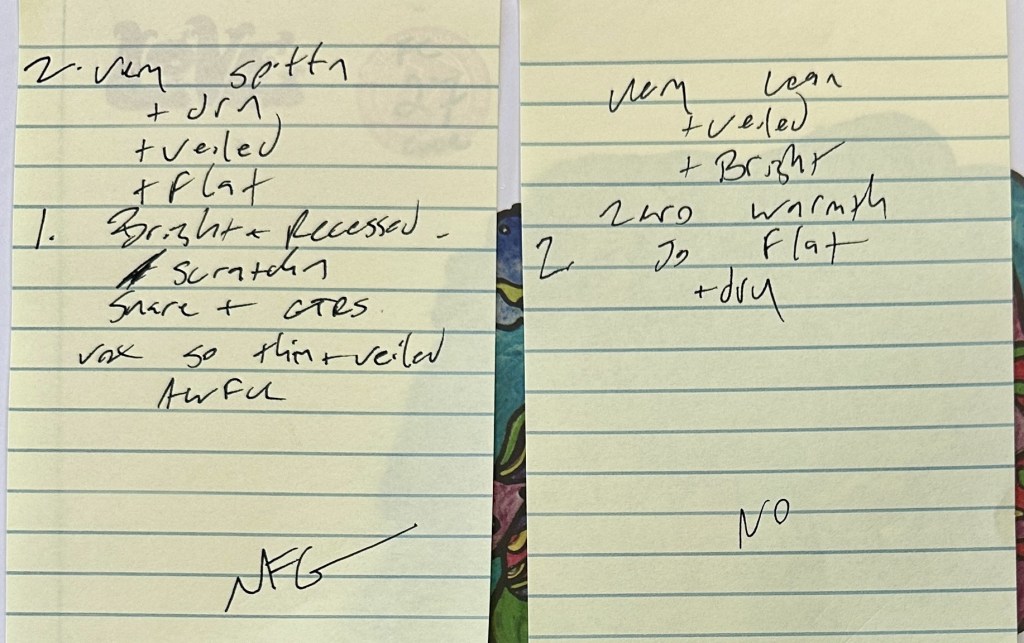
post-its

Bones Howe Knocked Windy Right Out of the Park

More Hot Stamper Pressings of Tubey Magical Rock Recordings Available Now

We describe the 2-pack currently on the site (as of 4/2025) this way:

The Tubey Magical sound, the lively, tight playing by The Wrecking Crew, not to mention some killer chart-topping 60s pop, make this THE Association album to own.

With these copies the Sound of the Sixties will fill your room like never before – wall to wall, floor to ceiling, with layers upon layers of analog depth.

These original Gold Label stereo pressings are have the potential to be the best sounding, with the ideal balance of richness and clarity.

Potentially is the key concept when it comes to understanding this and every other record. Again, the label is no guarantee of top quality sound. Only proper cleaning, revealing stereos and careful shootouts make it possible to recognize the best sounding pressings.

As you can see by the notes for a different, but equally good copy below, many aspects of the sound caught our attention on side one of this particular copy. (It turned out to have unacceptable amounts of noise on one of its side, hence the 2-pack.)
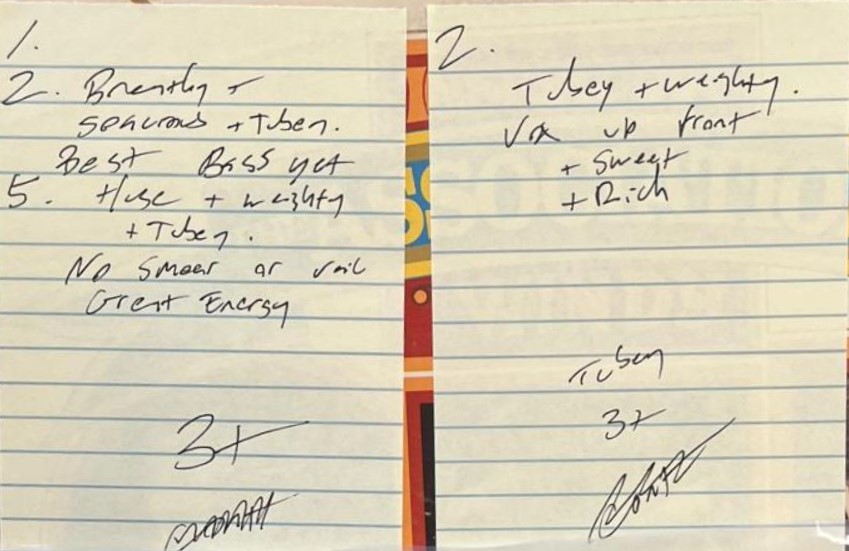
I have boldened three that I think did the most heavy lifting to put it over the top:

  • Breathy
  • Spacious and tubey
  • Best bass yet
  • Huge and weighty and tubey
  • No smear or veil
  • Great energy

Side two was every bit as good:

  • Tubey and weighty
  • Vocals up front and sweet and rich
  • Tubey (I tell you!)

The master of Tubey Magical pop recording is, of course, a Mr. BONES HOWE.

 You would be very hard pressed to find a pop or rock recording from 1967 that sounds as good as a Hot Stamper Insight Out. (Sgt. Pepper comes to mind, as well as some of these other Must Own titles, but Insight Out sets a fairly high bar most of them will have trouble getting over.)

Can you imagine the Mamas and the Papas or The Jefferson Airplane with this kind of rich, sweet, open, textured, natural, tonally correct sound quality?

The midrange is pure Tubey Magic. If you have the kind of system that brings out that quality in a recording, you will go wild over this one. In fact, it’s so good it made me appreciate some of the other songs on the album which I had previously dismissed as filler. When you hear them sound this good, you may change your mind about them too.

Hal, Joe and Bones

The real stars of Windy (and the album itself) are Hal Blaine and Joe Osborne, the famous session drummer/ bass player team. It is they who create the driving force behind these songs. Osborne’s website puts Windy front and center as the first track demonstrating what a top rhythm section can do for a pop song. This whole album can be enjoyed simply for the great drum and bass work, not to mention the sound that both of those instruments are given by the pop recording master Bones Howe.

He produced and engineered the show here; Bones is a man who knew his way around a studio as well as practically anybody in the 60s. He’s the one responsible for all the Tubey Magic of the recording. That’s his sound. If you are a fan of that sound, will find much to like here.

Bouncing Tracks

Never My Love is clearly the best sounding track on the album. Those of you with better front ends will be astonished at the quality of the sound. Windy also sounds excellent, but I hear some sub-generation harmonic distortion, probably caused by bouncing down some of the tracks to make room for others.

This is the era of the four track machine, and when four of the tracks are used up they are bounced down to one track, making available three new tracks. Some of the albums from this era — the Mamas and the Papas come to mind — have multiple bounces, three and four deep, which accounts for the distortion that you hear all through their recordings. The two-track finished master might have upwards of five tape generations or more on some instruments or vocal parts.


UPDATE 2025:

In our shootout notes, no mention was made of any problems with the sound of the song Windy.  The harmonic distortion we mentioned above may be an artifact of some of our previous limitations in cleaning and playback. Those of you with a top quality copy may want to listen for yourself and see if you hear the harmonic distortion we describe.


(more…)

A Killer Reissue Pressing of Jazz Samba Won Our Shootout

Hot Stamper Pressings of Bossa Nova Albums Available Now

A killer copy of Jazz Samba (the first to hit the site in over four years) with INSANELY GOOD Shootout Winning Triple Plus (A+++) sound from first note to last – exceptionally (and exceptionally rare) quiet vinyl too.

This is by far the best copy of the album we have ever played — we had no idea a copy could possibly sound this good and be pressed on vinyl this quiet.

Remarkably spacious and three-dimensional, as well as relaxed and full-bodied – this pressing was a big step up over all of the other pressings we played in our recent shootout.

No other copy earned a better grade than 2+ on either side, and some of the originals were godawful (watch for the “wrong” stampers coming to the blog soon).

As you can see from the notes, both sides of our most recent White Hot stamper shootout winning copy were doing everything right. This copy was so good that it qualified to be in our Top Shelf section, for records with two shootout winning sides.

You know what’s unusual about these notes?

They’re the kind of notes we’ve never written for any Heavy Vinyl reissue, even for the one that won our shootout not long ago.

They are the kind of notes that make it clear to us what a sham the modern Heavy Vinyl pressing tends to be, even those that are done right.

No modern record we’ve ever played has ever had anything even approaching this kind of big as life sound, and we doubt one ever will.

Records like this vintage vinyl pressing are thrilling in a way that very, very few records ever are.

Once you hear sound like this, you are not likely to forget it.

It sets a standard that modern remastered records simply cannot meet.

Hey, want to find your own top quality copy?

Consider taking our moderately helpful advice concerning the pressings that consistently win our shootouts.

This record has been sounding its best for many years, in shootout after shootout, this way:

(more…)

Which Side Lacked Space, and How Did You Figure That Out?

Hot Stamper Pressings of the Music of Linda Ronstadt Available Now

Big, rich, smooth, and sweet, how did George Massenburg pull off this kind of analog sound in 1987?

We don’t know, but we do know good sound when we hear it, and we heard remarkably good sound on this copy.

The first track on side one was big and rich, with vocals that were breathy and present, just the way we like ’em.

The third track was every bit as good, with sound that was rich and weighty. The vocals wer so present and open, sweet and silky. This is exactly what you want on this album.

And the way we know that is we played a bunch of copies and nothing could beat it. This side one took top honors for having sound we described above.

Side two is another matter. We came across a side two that was slightly better than the side one you see here.

How did that kind of thing happen, you ask?

Well, when we played the two best copies back to back, side one of this copy came out on top, earning a grade of 3+, but the side two of another pressing showed us there was even more space in the recording than we noticed the first time around.

We knew side two was “at least 2+,” the crossed-out text you see in the notes.

With another copy earning a better grade, 3 pluses, we felt the right grade for this side two was 2.5+.

(more…)

Doesn’t Anyone Know What Love Is (Supposed to Sound Like)?

Click Here to See Our Most Recent Review for a Real Gold Label Stereo Pressing of Forever Changes 

The one person we can say for sure who must have absolutely no idea what a vintage pressing of the album is supposed to sound like is Chris Bellman. Allow us to make the case.

Below you can see our notes for the Rhino Heavy Vinyl pressing of Forever Changes cut by Chris for Bernie Grundman Mastering in 2012.

We recently got hold of a copy locally and figured why not give it a spin and see how one of the most respected mastering engineers of the day, CB, fared with this apparently difficult to master title. (Others have tried and failed. See here and here.)

The Gold Label pressings are the only ones we buy these days. The Big Red E Elektras are passable at best, and everything after them is terrible, including imports and all the Heavy Vinyl reissues that we’ve had the misfortune to play over the years. We hope to be posting some of the stampers to avoid (we call them bad stamps) before too long.

Let’s get right into the sound of this 2012 remaster. We played the two tracks on each side that we’re most familiar with from doing shootouts for the title.

As the record played, to the best of our ability we made notes of the sound we were hearing:

(more…)

Leonard Cohen Sure Sounds Better than He Used to

Hot Stamper Pressings of the Music of Leonard Cohen Available Now
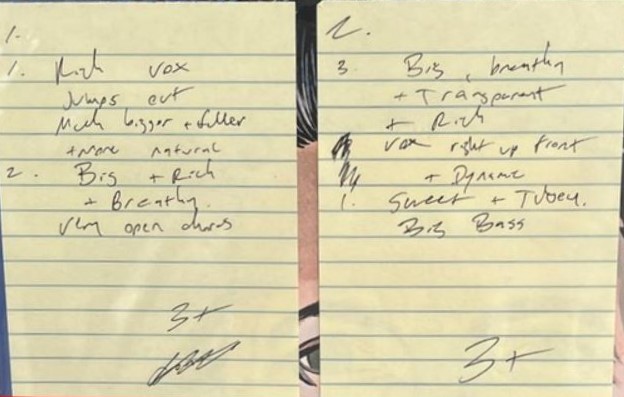
Insanely good Shootout Winning Triple Plus (A+++) sound on both sides AND fairly quiet vinyl – the best copy to ever hit the site bar none.

Unbeatable richness and freedom from artificiality in the midrange allowed this one to tower over the rest of the field.

As you can see from the notes, both sides of our most recent White Hot stamper shootout winning copy were doing everything right. We marvelled at these specific qualities in the sound:

Side One

Track one

    • Rich vocals
    • Jumps out
    • Much bigger and fuller and more natural

Track two

    • Big and rich and breathy
    • Very open chorus

Side Two

Track three

    • Big, breathy and transparent and rich
    • Vocals are right up front and dynamic

Track one

    • Sweet and tubey
    • Big bass

Midrange presence is one of the most important qualities of any rock or pop recording we might be evaluating, and for a Leonard Cohen album it is absolutely essential.

You want Cohen to be front and center, neither recessed in space nor behind a veil.

The notes for track three on side two say it all:

Vocals are right up front and dynamic

That is what gets this music to sound the way it is supposed to. You can be very sure that no Heavy Vinyl remastered pressing is going to put Leonard Cohen front and center. They practically never do. (Here is an especially offensive remaster with a bad case of recessed vocals. Funny how none of the audiophile reviewers noticed. What does that say about the quality of their playback, or the standards to which they hold their records?)

DIY Advice

To aid you in doing your own evaluations, here is a list of records that we’ve found to be good for testing midrange presence.

This is exactly why we do shootouts. If you really want to be able to recognize subtle (and not so subtle!) differences between pressings, you must learn to do them too.

And make sure to take notes about what you are hearing, good and bad.

We love Cohen’s albums here at Better Records. No, they’re not audiophile spectaculars, but much like the best Dylan recordings, when they work the sound fits the music perfectly.


UPDATE 2025

In previous listings we had noted:

The vocals are right up front and fairly dry, throwing the words and phrasing into high relief.

But we would no longer agree with the vocals being dry. On the best copies they are rich, full-bodied and tubey.

What does that say about the quality of our playback? How about: It’s better now than it used to be!

(more…)

The Thrill of Discovering Great Recordings

Hot Stamper Classical and Orchestral Pressings Available Now

This shootout was many years in the making – we’d been trying to do these wonderful overtures for about five years, which just goes to show how hard it is nowadays to find records like these in audiophile playing condition.

We also just debuted a Decca recording with Ansermet at the helm under the title French Overtures featuring two of the pieces found here, and it’s every bit as good.

Which one is better is probably a matter of taste as they are both head and shoulders better than any other recordings of the music that we’ve come across in the last five or ten years. This is often what you are paying for when you buy a White Hot Stamper pressing — the best sound we know of for the music.

We admit that “we know of” is doing a good deal of heavy lifting in the preceding sentence, but the world is full of records and we can’t have played them all, so in the unlikely event that we find something better down the road, do not be too surprised, it happens.

Side One

  • So huge and tubey
  • 3D and spacious and extending high and low
  • Lush strings
  • More realistic and dynamic
  • Big low end
  • Tubey

Side Two

  • 3D, tubey and lush
  • Huge low end and brass
  • Realistic space and cymbals
  • Not hot at all

Let Me Ask You This

Who else is finding incredible Demo Discs like this EMI from 1972 nowadays?

(more…)

An Amazing Pressing of Latin Rendezvous – Complete with Notes!

Hot Stamper Pressings of Records from 1963 Available Now

We offered a White Hot stamper copy of this album many years ago, but our customers were not the least bit interested in it at the time, and we suspect that not much has changed since then.

It’s been tagged a never again record, meaning that although we like the music and the sound, we can’t devote the resources — in this case, mostly studio time — to finding top quality copies if there are not going to be any buyers for them.

We think it’s well worth seeking out, and one thing you can be sure of, you won’t have to pay too much for it. If you see one locally on the early label, in stereo, pick it up.

There’s a high probability it will sound at least very good, and you might even luck into one that is downright amazing the way we did, assuming you can clean it right.

More amazing finds like it can be found here.

NOTE: On side two, track three, the initialism ROTM stands for Right On The Money. See if you agree with me that the second track on side one is “kind of dry and thin.”


Our Review

A wonderful Latin jazz collection, with the unbeatable combination of the quintet’s “celebrated piano-vibes, liltingly embellished by Latin percussion and occasional flute.”

“In this collection, you’ll find Latin at its most alluring, as a musical language interpreted by Shearing.”

Clean, clear and dynamic, this copy has huge amounts of bass and tremendous space around the keyboards and percussion.

If you’re a fan of the kind of music Cal Tjader was making in the 60s, this album should be right up your alley. Plenty of Latin Percussion, with vibes and flutes to add color to the proceedings, all anchored by Shearing on the piano.

It’s lounge music but it’s fun lounge music — and it sounds like a very well recorded album from Capitol in 1963 should sound: big and rich.

1963 was a phenomenal year for audiophile quality recordings. We’ve auditioned and reviewed more than a hundred  titles to date, and there are undoubtedly a great many more that we’ve yet to discover.

Some of the best titles released in 1963 can be found here.

This link will take you to the 25+ titles recorded or released in 1963 that we think belong in any music-loving audiophile’s record collection.

(more…)

An Amazingly Good Nashville Skyline, But Side Two Fell Short in One Area

Hot Stamper Pressings of the Music of Bob Dylan Available Now

You just can’t beat a well-produced, well-engineered Columbia from this era. There’s a richness and a naturalness to the sound that’s almost completely disappeared from the modern world of music, and by “modern world” we mean both modern recordings and modern remasterings of vintage recordings.

Practically none of them ever have the qualities of this wonderful record from 1969.

You really do have to go back to these old originals to find it. And then you have to find just the right old originals for it to be there. Here are the notes for one we played not long ago.

As you can see from the notes, side one of our most recent White Hot stamper shootout winning copy was doing everything right. We marvelled at these specific qualities in the sound:

Track three

  • Big and spacious and lively
  • The vocals and guitars are big and weighty and jumping

Track one

  • Spacious and great size and detail
  • Vocals jump out
  • Realistic acoustics

However, we had a side two that was slightly better than the side two you see here.

When we played the two best copies back to back, side one of this copy came out on top, earning a grade of 3+, but the side two of another copy showed us there was potentially even more presence to Dylan’s vocals in the recording than we had assumed. As a consequence, we felt it best to drop side two’s grade a half plus to 2.5+.

Track one

  • Tubey bass
  • Weighty
  • Very full vocals
  • A bit veiled but better than most

Track one on side two was doing practically everything right, but it slightly lacked presence, and for that we dropped the grade one half plus to 2.5+.

Midrange presence is one of the most important qualities of any rock or pop recording we might evaluate, and for a Bob Dylan album it is absolutely essential.

You want Dylan to be front and center, neither recessed nor behind a veil.

To aid you in doing your own evaluations, here is a list of records that we’ve found to be good for testing midrange presence.

(more…)

This Sibelius Violin Concerto Was Big and Lush but…

Hot Stamper Pressings Featuring the Violin Available Now
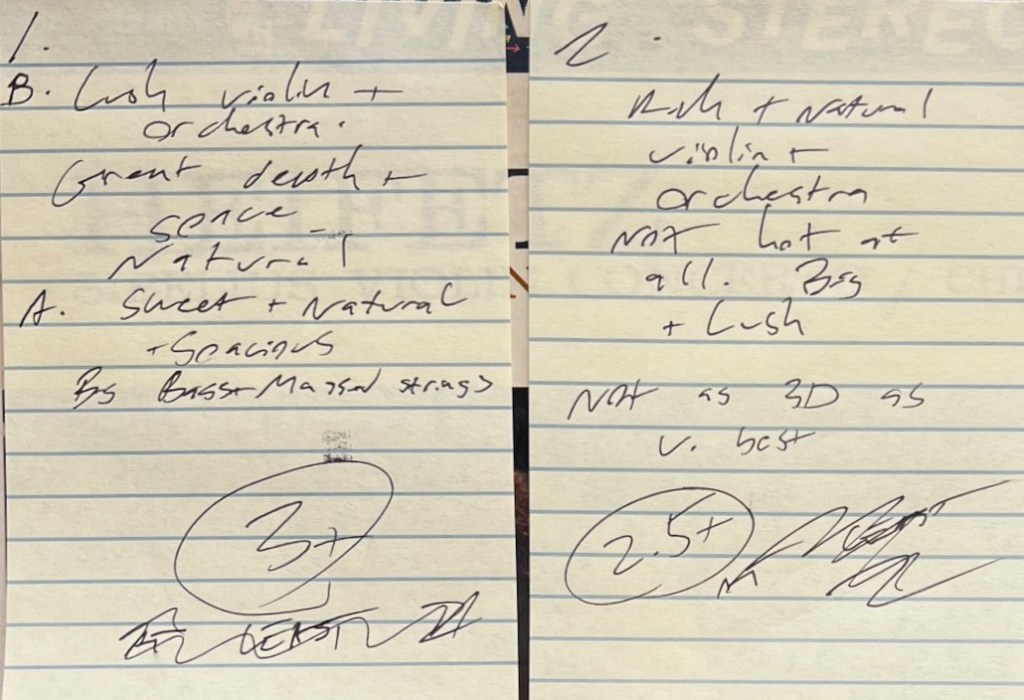
We love the way RCA recorded Heifetz back in the day, the day in this case being 1960. We usually have a good supply of vintage Heifetz titles on the site at all times. They often have our favorite performances, and the best copies, as the notes for the one below make clear, can have absolutely amazing sound.

As you can see from the notes, side one of a recent shootout winning copy was doing everything right.

However, we had a side two that was slightly better than the side two you see here. When we played the two best copies back to back, this side one came out on top, earning a grade of 3+, but the side two of another copy showed us there was even more three-dimensionality to be discovered in the recording than we thought. Consequently this side two was dropped a half grade to 2.5+.

This is exactly why we do shootouts. If you really want to be able to recognize subtle (and not so subtle!) differences between pressings, you must learn to do them too.

(more…)

Silky Sound? Everybody Knows That’s Impossible

Hot Stamper Pressings of the Music of Neil Young Available Now

This early pressing of EKTIN IS an amazing find, the kind of record the thrillseekers who work here at Better Records live for.

As I was reading the notes, I saw a word there that I had never associated with the sound of the album: “silky.” Since when does Everybody Knows This Is Nowhere have silky vocals?

But there it was, describing the first track on side one (Cinnamon Girl) as well as both the third track on side two (Cowgirl in the Sand) and track one (Losing End (When You’re On)).

We don’t have a tag for silky sound. About the closest we could come would be “glossy sound,” the kind of sound you might find on a Toto album, or Gauch0, or Mirage, or Gorilla, or Abbey Road. Starting in the mid-70s, anything produced by Ted Templeman and engineered by Donn Landee would be sure to have glossy sound.

But this album is from 1969. Silky vocals are not easy to find on recordings from that year, Abbey Road being the obvious exception.

And they’re not easy to find on the vast majority of copies we have played over the years. I doubt that the other copies in the shootout have notes mentioning silky vocals.

But if your equipment is good enough, and you know how to clean your records right, and you dial in your setup to a T, with a big enough stack of copies you may be able to find an Everybody Knows… with silky vocals. Twenty years ago I wrote a commentary about diminishing returns in audio being a myth. Now, finding this amazing pressing of Everybody Knows, is just one more piece of evidence to support just how precient that idea was.

Hey, want to find your own top quality copy?

(more…)