brook-think

Think pieces brought to you by Robert Brook, the man behind The Broken Record.

Challenging Our Assumptions for Better Sound

Robert Brook runs a blog called The Broken Record, with a subtitle explaining what the aim of his blog is:

A GUIDE FOR THE DEDICATED ANALOG AUDIOPHILE

Here is Robert’s latest posting.

CHALLENGING Our ASSUMPTIONS For BETTER SOUND

We’ve written about the lessons to be learned from the misguided exploits of the late Mr. Fritz ourselves, and you can read all about them here.

(more…)

Others May Help, But Most of the Time We Make Our Own Mischief

Robert Brook runs a blog called The Broken Record, with a subtitle explaining that the aim of his blog is to serve as:

A GUIDE FOR THE DEDICATED ANALOG AUDIOPHILE

We know of none better, outside of our own humble attempt to enlighten that portion of the audiophile community who love records and are looking to understand them and reproduce them better.

Here is Robert’s latest posting. I changed the title a bit from his, since the dictionary definition of the term mischief-making implies “deliberately creating trouble for other people,” and it is not quite right that the purveyors of these products are in any way purposely going about screwing up the sound of perfectly good stereos.

The way I see it, these products are designed to do something positive for some stereos under some conditions when playing some recordings for audiophiles who prize some qualities more than others.

Knowing what these kinds of things are doing, on what kinds of stereos, under what operating conditions, when playing what specific recordings, for what sound qualities a particular audiophile might be listening for, is more than the work of a lifetime. It is, in fact, impossible.

ISOACOUSTICS and the Un-MAKING of Audio MISCHIEF

After reading Robert’s story, I was inspired to write a long piece detailing my own lessons learned as I first embraced, then rejected, one tweak or piece of gear after another, starting in 1975 or thereabouts. (Many such stories are chronicled here. The picture of me you see was taken in the late-70s. I was in an audio cult at the time, but, of course, like today’s similarly-situated audiophiles, I had no way of knowing it.)
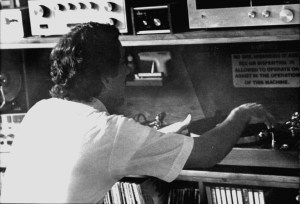
I am still working on the commentary mentioned above, but I expect it should be ready before long. The short version goes like this:

Dramatic limitations and massive amounts of colorations are endemic to home audio systems.

The only way to get rid of them is by doing the unimaginably difficult work it takes to learn how to identify them and then figure out ways to root them out.

This, in my experience, is a process that will rarely be accomplished, even by the truly dedicated. It unfolds slowly, over the course of decades, and only for a very small percentage of audiophiles. Most will simply give up at some point and choose to enjoy whatever sound quality they have managed to achieve up to that time. To attempt to go further feels like banging your head against a wall.

To push on in this devilishly difficult hobby we have chosen for ourselves is for the few, not the many.

(It helped that we got paid to do it. An undiagnosed but all-too-real obsessive personality disorder also played a part, as did certain records that I fell in love with a long time ago.)

The completed post can be found here.

(more…)

Is Music Poorly Reproduced More Like Noise or More Like Music?

Robert Brook runs a blog called The Broken Record, with a subtitle explaining that the aim of his blog is to serve as:

A GUIDE FOR THE DEDICATED ANALOG AUDIOPHILE

We know of none better, outside of our own humble attempt to enlighten that portion of the audiophile community who love records and are looking to understand them better.

Here is one of Robert’s more recent postings you may find of interest.

The ART OF NOISE at SFMOMA: Where is the MUSIC?


More on Robert’s system here. You may notice that it has a lot in common with the one we use. This is clearly not an accident.

And it is also no accident that these two systems just happen to be very good at showing their owners the manifold shortcomings of the modern remastered LP, as well as the benefits to be gained by doing shootouts in order to find dramatically better sounding pressings to play.

(more…)

Testing with Good Records Is the Only Kind of Testing that Works

Robert Brook runs a blog called The Broken Record, with a subtitle explaining what the aim of this blog is:

A GUIDE FOR THE DEDICATED ANALOG AUDIOPHILE

We know of none better, outside of our own humble attempt to enlighten that portion of the audiophile community who love records and are looking to understand them better.

Here is Robert’s latest posting.

FERRITES and the Limits of SCIENCE (theory?) in AUDIO


More on Robert’s system here. You may notice that it has a lot in common with the one we use. This is clearly not an accident.

And it is also no accident that these two systems just happen to be very good at showing their owners the manifold shortcomings of the modern remastered LP, as well as the benefits to be gained by doing shootouts in order to find dramatically better sounding pressings to play.

(more…)

Robert Brook Has a Question for the Audiophile Community

Are Hot Stampers for real, or are they for the birds?

(That’s a question I see asked a lot by audiophiles. You will have no trouble guessing what the answer tends to be.)

Below you will find some of the text from an email exchange I had with Robert, one of hundreds we’ve sent to each other as we found ourselves winding through the thicket of records and audiophile equipment.

It’s one we are constantly struggling to understand, in my case even after 40 years.

In this email he recounts a personal story about a yoga friend, exploring his reaction to an incident that occurred with a fellow yoga practioner and some of the psychological lessons he learned from it. What he learned, he has now come to realize, helped him see more clearly some of the things that are going on in analog audio, especially when it comes to the credibility of yours truly.

He also points out that I am not always as tactful as I should be, and I don’t doubt for a minute that he is right about that. Not my strong suit. I’m more in favor of the “tough love” approach, but after rereading some of my old emails, it’s often shocking — even to me — how blunt I can be. I’ll try to do better.

Please to enjoy Robert’s story.

TOM PORT and Why More Audiophiles Don’t Take His Advice

A GUIDE FOR THE DEDICATED ANALOG AUDIOPHILE

Robert has approached the various problems he’s encountered methodically and carefully along these three fronts:

(more…)