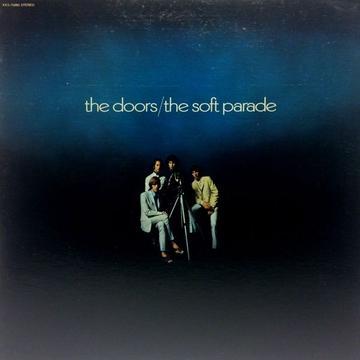
Our shootout from way back (2014) included a minty Gold Label pressing, which did reasonably well, but not great, on side one. Side two however was OFF THE CHARTS and won the shootout on that side handily. The fact that side one wasn’t a knockout is yet more evidence that individual pressings with the same label — even the “right” label — vary dramatically in sound.
In-Depth Track Commentary
Side One
Tell All the People
Jim Morrison, a man with no professional experience as a singer before he formed The Doors, was blessed with one of the most beautiful baritones in the history of Rock and Roll. If his voice isn’t rich, full and Tubey Magical on this track, the sound on side one isn’t likely to be either. If that’s the case you are not in for an easy ride my friend. Chuck that sucker in the trade-in pile and move on.
Touch Me
There’s big bass on this track; you need to be able to hear it right from the start or this track is going to sound like it’s playing through a car radio.
Listen also for the texture on the strings. If you have that rare, tonally correct early pressing with a real top end, the strings won’t sound steely, strident or smeared (the three S’s, don’t you know).
Shaman’s Blues
Do It
Easy Ride
Side Two
Wild Child
Runnin’ Blue
Fiddle and mandolin (we thought it might be a banjo at first but we’re pretty sure it’s a mandolin; listen for strumming at the end) accompaniment on a Doors song? Hey, why not? Let the guys stretch out a bit.
That’s what this album is all about. They’re not trying to be Blood Sweat and Tears. They’re trying to add some new colors to their palette, and I for one am glad they did. (When they went back to the basics for Morrison Hotel, they turned in one of their weakest efforts ever, if not The Weakest.)
Wishful Sinful
Bruce Botnick Tubey Magic To Die For! Does it get any better for audiophiles than this?
Listen for the lovely timbre of the oboe, a featured element of this track. The orchestral arrangements here rival those of the legendary George Martin (himself an accomplished oboist). If large scale orchestral arrangements are good enough for The Beatles, how can The Doors be criticized for incorporating them into their music?
The Soft Parade
Ya gotta love that spoken word intro. Once you’ve heard it you’ll never forget it as long as you live. The best early copies (gold label or big red E) have echo bouncing off every wall of the studio endlessly.
The weight the best copies have below 250 cycles is where much of the studio ambience is. Play the typical leaned-out copy and all that space collapses.
 Hot Stamper Pressings of the Music of The Rolling Stones Available No