Top Artists – The Weavers

The Weavers At Carnegie Hall, Vol. 2 Is Bad News in Mono

Hot Stamper Pressings of Live Recordings Available Now

We recently did a shootout for this famous Weavers album. These are just a few of the things we had to say about our shootout winner in the notes:

“Tubey and 3D and weighty”…”very full and detailed vox”…”sweet and tubey and present”…”so much space and bass.” Both of these sides are rich and full, Tubey Magical, and tonally correct from top to bottom. The sound is big and open, with the performers front and center (as well as left and right).

Our notes for the early red label mono pressing we played noted that it was “crude, congested and awful.” There are plenty of mono pressings on Vanguard with excellent sound, but this is not one of them.

Here is an extract from the stamper sheet showing the sonic notes and the stamper numbers of the mono pressing we played.

Crude and congested vocals? On a Weavers record? What could be worse?

We didn’t even bother to play side two. Why waste any more time on such an awful sounding record?

When the voice is wrong, you my friend have yourself a completely worthless piece of vinyl.  (Other titles that get the voice wrong and therefore should be avoided by audiophiles of all stripes can be found here.)

The world is full of old records that just sound like old records. We’ve suffered through them by the tens of thousands. (Yes, you read that right. We play thousands of records every year, and we’ve been doing it for more than two decades . They add up!)

Our website, as well as this blog, are devoted to helping audiophiles find pressings that don’t sound anything like the millions of run-of-the-mill LPs that were stamped out with little regard for sound quality for more than seven decades.

Even a million dollar stereo can’t make the average record sound good, and the more accurate and revealing the system, the more limited and lifeless the average record will show itself to be.

(more…)

The Weavers – At Carnegie Hall, Vol. 2

More Live Recordings of Interest

  • The Weavers At Carnegie Hall, Vol. 2 appears on the site for only the second time ever, here with KILLER Shootout Winning Triple Plus (A+++) grades or close to them throughout this original Stereo Vanguard pressing
  • These are just a few of the things we had to say about this stunning copy in our notes: “tubey and 3D and weighty”…”very full and detailed vox”…”sweet and tubey and present”…”so much space and bass”
  • Both of these sides are rich and full, Tubey Magical, and tonally correct from top to bottom
  • The sound is big and open, with the performers front and center (as well as left and right)
  • Our notes for the early red label mono pressing we played noted that it was “crude, congested and awful.”
  • There are plenty of mono pressings on Vanguard with excellent sound, but this is not one of them
  • 4 1/2 stars: “By April 1, 1960 [at the time of the album’s recording]…the Weavers had overcome the loss of Pete Seeger and fully integrated his replacement, Erik Darling, who proved a banjo virtuoso and exuberant humorist (listen to his kazoo solo on “Bill Bailey Come Home”). They had an excellent act, mixing old favorites dating back to the days of the Almanac Singers (“The Sinking of the Reuben James”) and newer songs that would become standards of the folk boom (“Last Night I Had the Strangest Dream).”

(more…)

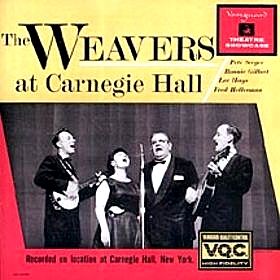
The Weavers – The Weavers At Carnegie Hall

This is a wonderful Weavers album, recorded in Carnegie Hall on Christmas Eve, 1955 — when and if you can find one that’s properly mastered and not too scratched up. This is not easy, as most copies of the album — now fifty plus years old — have not survived in very good condition. This copy is the exception to that rule, with reasonably quiet surfaces (Mint Minus to Mint Minus Minus, about as quiet as they come) and EXCELLENT SOUND.  

What do we listen for on this album? Pretty much the same things we listen for on most albums (with the exception of Whomp Factor I suppose; acoustic guitars, banjos and voices don’t produce much whomp in real life).

You clearly need transparency to make all the vocal and instrumental parts clear. There is not a trace of phony Hi-Fi sound anywhere to be found on the album, so bringing out as much information as possible from the record has to be an important goal. (On phony records a bit of smear or opacity can actually be a good thing.)

Those of you with very highly resolving speaker systems — electrostatics, screens and the like — will find this record much easier to reproduce than others. (Including us: Our big dynamic speakers do many things well but no speaker can do everything right. We have had to sacrifice some transparency for other qualities necessary to play the wide range of recordings we must evaluate.) (more…)

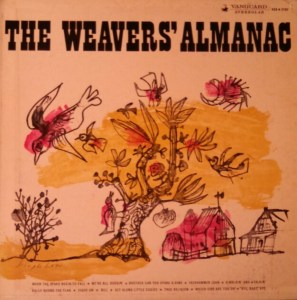
The Weavers – The Weavers’ Almanac

White Hot stamper sound on side two – a Demo Disc for acoustic folk music. Better than Super Hot on side one – sound that’s sweeter than wine. This copy is stereo, and for good reason: the mono pressings are full of vocal distortion. Reasonably quiet vinyl for an early Vanguard pressing.

This early pressing on the early Black and Silver Vanguard label has glorious sound! It’s right up there with the best we have ever heard The Weavers.

Side One

Superb air and space, with a very extended top. Sweet vocals. Big, rich, tubey and clear, this side will be hard to beat. Play track three to hear the kind of guitar harmonics and vocal intimacy that are simply no longer possible on modern vinyl.

Side Two

The huge reverb sounds just right – very rich and tubey and smooth.

Listen to how rich the bass is on the third track. It’s not perfect but it’s right for this era and right for this music.

What did we listen for on this album? Pretty much the same things we listen for on most albums (with the exception of Whomp Factor I suppose; acoustic guitars, banjos and voices don’t produce much whomp).

Obviously you need transparency to allow all the vocal and instrumental parts to be heard clearly. There is not a trace of phony Hi-Fi sound anywhere to be found on the album, so finding a copy with the most information in its grooves is our main goal.

On phony records a bit of smear or opacity can actually be a good thing. Here we want none.

All Tube

Some copies are going to be thick and opaque to some degree. Such is the nature of vinyl. More often than not some of the transient information is smeared, making the banjo and guitar lose their pluck and voices their breathiness. This recording is all tube — a single microphone with tube preamp, a tube tape recorder, an all-tube mastering chain; it’s tubes, more tubes and nothing but tubes, which means that there is plenty of Tubey Magic and warmth.

Fortunately, on this copy these qualities do not come at the expense of clarity and transparency. The best copies give you plenty of both.

(more…)