*Arcana – Stamper Info

Some audiophiles complain that our reluctance to give out stamper information is selfish. We think that’s not fair.

We admit that we rarely give out the stamper numbers for the pressings that win shootouts — we paid a high price in time and effort to discover them — but we do give out a great deal of information for records that did not sound especially good to us, a free – and valuable! — service from your friends at Better Records.

Always wanted to have a Plum and Orange pressing? Here’s your chance!

Hot Stamper Pressings of the Music of Led Zeppelin Available Now

We should have titled this one “here was your chance,” since this pressing sold very quickly.

Over the years most Plum and Orange pressings were disposed by us of on ebay for the benefit of collectors and those audiophiles who might be ill-informed enough to think that early British pressings would have the best sound for Led Zeppelin III.

They do not. They can, however, sound reasonably good in some cases with the proper cleaning.

However, they are not even Double Plus (A++) good, which sounds like something from the novel 1984 but is in fact a Very Good grade and guaranteed to trounce any and all copies of the album you have ever heard.

No, the best Zeppelin album we have played to date with the early label in this case earned a grade of Single Plus to Double Plus, which we describe as “[a] wonderful sounding side with many impressive qualities, notably better than a Single Plus copy. A big step up from the typical pressing.”


UPDATE:

We do not even offer Single Plus copies on the site anymore. Although their faults would be less obvious to anyone who went through the shootout process with the album, such faults are much too bothersome to us precisely because we did go through that process.

Once you know what is right, it’s very easy to spot what is wrong.

This is the foundational principle of Hot Stampers.

(more…)

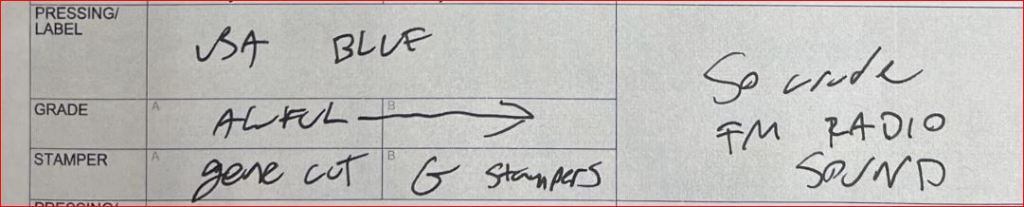
FM Radio Sound on Blue Vinyl, Courtesy of a Mr. Gene Thompson

Hot Stamper Pressings of the Music of The Beatles Available Now

Here is how we described a recent Shootout Winning copy of 1967-1970:

This vintage import 2-LP compilation set boasts STUNNING Shootout Winning Triple Plus (A+++) sound or close to it on all FOUR sides. These pressings are rich, smooth and sweet, with plenty of Tubey Magic and little of the grain and grunge of most Brits (and don’t get us started on the domestics).

You get clean, clear, full-bodied, lively and musical ANALOG sound from first note to last. Like most compilations, some songs sound better than others, but “Don’t Let Me Down” and “Come Together” are two that really stand out here. For those of you out there who have never tried one of our Hot Stamper Beatles records, this may be the best sound you’ve ever heard from them. The CDs — even the new ones — sure don’t sound like this!

We are on record as finding the British pressings of 1967-1970 too bright; certainly most of them are anyway. The original domestic pressings, as anyone who has ever played one can attest, mastered at Sterling no less, are absolutely godawful.

Allow us to add one more to that group of pressings to avoid, the blue vinyl domestic pressings mastered by Gene Thompson. Based on how awful this pressings sounds, it would probably be wise to avoid his work in general.

The only artists who have earned the honor (ahem) of having their very own page on this blog are The Beatles. For those of you interested in learning more about their often amazing recordings, feel free to dig in to your heart’s delight.

(more…)

Could This Be More of the Sound Audiophiles Complain About with RVG’s Mastering?

Hot Stamper Pressings of the Music of John Coltrane Available Now

Some of the Rudy Van Gelder cuttings of this album were decent, but had you bought a copy with these stampers, you could be forgiven for using the man’s name in vain.

VAN GELDER in the dead wax is no guarantee of high quality sound, on any record. Records don’t work like that.

The 1+ grade found on side one of both discs means the sound for those two sides may be passable, but the NFG sound on side two of record one means you have at best only half an album with decent sound, and what good is that?

As you can see from our notes, the sound is way too hot and messy and thin.

Note that side two of the second record wasn’t played at all. Why waste more time on a record that clearly did not come off the press properly, whether from bad mastering or bad vinyl? Or bad something else, who can say?

We do not sell records with 1+ grades. You should have no trouble finding those on your own. The world is full of them.

Poor Rudy

Rudy Van Gelder comes in for a lot of criticism from the audiophile community, especially from audiophiles who tend to prefer the remastered Heavy Vinyl pressings made from his recordings.

Unsurprisingly, much of the criticism comes from some of the very same engineers responsible for the remastering those records.

Those who produce reissues of his recordings are notable critics as well.

Perhaps we will quote some of the opinions of these mastering experts and label owners at a later date. We take issue with a great deal of what they’ve said, especially Joe Harley’s defense of his rather lackluster Tone Poets records.

Having recently played some of Rudy’s absolutely amazing recordings — here’s one that blew our minds, along with a quite a few more that can be found here — it seems that there are indeed folks out there who know how to make records from his tapes that put to shame anything being made today.

How they do it is a mystery to me, but when you have the physical record in hand that makes the case by its irrefutably superior sound, how can there be an argument at all?

(more…)

It’s Already So Good, How Could It Get Any Better?

Hot Stamper Pressings of the Music of Berlioz Available Now

You may have noticed that most of the time when we give out the stampers for the top copies of an album, we do not identify the title of the record that has the Shootout Winning stampers.

As you can imagine, our huge investments in research and development make up a big part of our costs, costs that accrue over the course of years, decades even, and that must eventually be passed on to our customers.

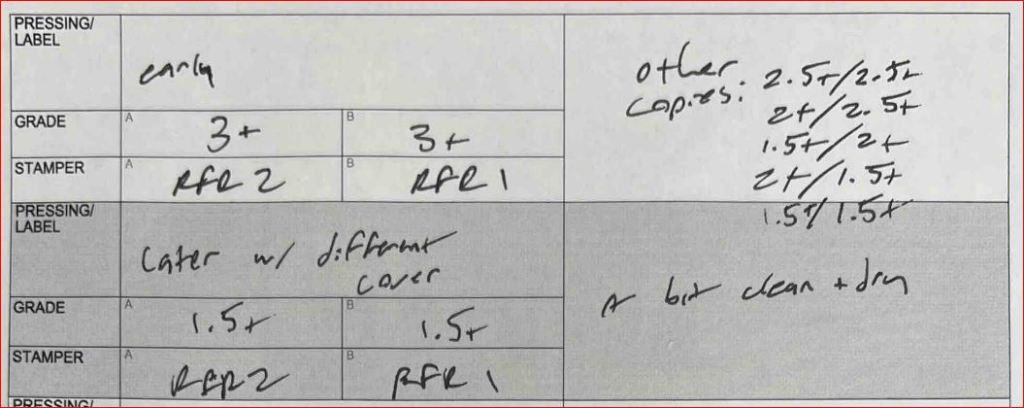
But this title is an exception, because we are telling you straight out that the 1K pressings for CS 6101 are the way to go.

It turns out that both the early Decca pressings (SXL 2134) and the London Bluebacks were cut by Tony Hawkins.

It’s unfortunate that this record did not sell well when it came out in 1959, which explains why we could find no evidence of copies with any stampers other than 1K.

Not that the work of any other mastering engineers was in any way needed. Mr. Hawkins did a wonderful job on the copies we played than managed to reproduce the glorious, Golden Age All Tube analog sound of the master tape, which may sound  tautological as all get out but I assure you is not.

No, sadly for us, that glorious sound could be found on one and only one pressing, the one we graded 3+/3+.

No other pressing earned a top grade on either side. Whatever caused the amazing pressings to come out differently from the very good ones happened in the plating and pressing stages of manufacturing, an area that did not involve the work of any of the Decca mastering engineers.

When we first dropped the needle on a copy of this album, we heard the classic Decca Kenneth Wilkinson sound that we’ve come to know and love from the scores of other titles of his we’ve played.

At the time we would not have had any way to know how good the sound could get, or if it could get any better at all.

Knowing that only a  shootout could tell us that, we proceeded to round up as many clean copies of the album as we could find and get one going.

The Question of the Day

Now imagine you are a record collector of the audiophile persuasion. (Notice we rarely use the term “audiophile record collector” if we can avoid it — it leaves a bad taste in our mouths and has since 1987 when we started our little record business.) Any of the copies you see graded above could have been the one you might have auditioned in order to “test” the record’s bona fides for sound, music, vinyl quality, etc.

(more…)

Why Are the Earliest Stampers on 461 Ocean Boulevard So Bad Sounding on Side Two?

Hot Stamper Pressings of the Music of Eric Clapton Available Now

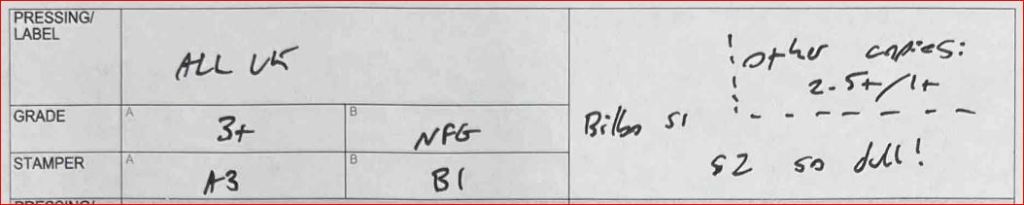
The UK pressings with the side two stampers shown below have not done well in our shootouts for a number of years now. If you own a copy with B-1 stampers on side two, the good news is that we can get you a much better sounding copy of 461 Ocean Boulevard than you have ever heard.

Stamper numbers are not the be-all and end-all in the world of records, a subject we discuss below, but after hearing too many copies with these stampers and substandard sound, from now on we are going to focus our attention on the stampers that do well and avoid copies with the B-1 marking on side two.

Bilbo cut the A-3 side one and did a great job; his side one won our most recent shootout.

Whoever cut side two really screwed it up, as you can see from our notes for our last two shootouts.

When it comes to stampers, labels, mastering credits, country of origin and the like, we make a point of revealing very little of this information on the site, for a number of good reasons we discuss here.

The idea that the stampers are entirely responsible for the quality of any given record’s sound is a mistaken one, and a rather convenient one when you stop to think about it. Audiophiles, like most everybody else on this planet, want answers.

In the world of records, there aren’t many, but B-1 for side two of this album is a clear exception to the rule that the stamper numbers are one part of a multi-faceted puzzle. In this case, B-1 is awful and is best avoided at all costs.

The Biz

Being in the shootout business means we have no way to avoid such realities, which is why it is so easy for us to accept them.

The amateurs and professionals alike who review records for audiophiles want there to be clear-cut answers for every album they write about. Uncertainty and trade-offs upset them no end.

We recognized twenty years ago that the empirical pursuit of record knowledge, practiced scientifically, must be understood as incomplete, imperfect, and provisional.

That is not going to change no matter how upsetting anyone may find it.

(more…)

Helpful Stamper Information You Can Use – Episode 108

Hot Stamper Pressings of the Music of Genesis Available Now

British Pressing? Check.

Pink Label? Check.

Sound Quality?  Side One:: 1+ (dubby). Side Two: NFG (no good).

What could have possibly gone wrong?

Apparently something went wrong, but exactly what, nobody really knows.

And if for some reason somebody actually believes they know what went wrong, we tell them that that kind of thinking is detrimental to whatever success they hope to achieve in finding better sounding records, if our experience over the last fifty years has any bearing.

We don’t know it all and we’ve never pretended to. All our knowledge is provisional. We may not be the smartest guys in the room, but we’re sure as hell smart enough to know that much.

If somehow we did know it all, there would be no need for the two hundred entries in our live and learn section about all the mistakes we’ve made in trying to understand record pressings at the sonic level.

We take a different approach to searching out the best sounding pressings. Instead of reading about them — who made them, how they were made, where they were made, all that sort of thing — we instead devoted our efforts to cleaning and playing them, so that we could make our own judgments about the sound and the music we heard.

Our experiments, conducted using the shootout process painstakingly developed over the course of the last twenty years, produce all the data we need: the winners, the losers, and the ranking for all the records in-between.

Free Stamper Info

By my count this is the 108th stamper sheet we have posted on The Skeptical Audiophile.

In the case of this title, these are what we would call “bad stampers for Genesis’s 1973 Prog album Selling England by the Pound (a record we rarely have in stock because the best stampers are just too hard to find, at least on copies in audiophile playing condition).

If you are looking for top quality sound — and seriously, what else would you be looking for on this blog? —  then make sure not to buy any old early Pink Label UK pressing of the album. You may end up with one that sounds as bad as this one did.

(more…)

RE-2 Wins Our Shootouts for this Jimmy Smith Recording

Hot Stamper Pressings of Large Group Jazz Recordings Available Now

What happens when all the stampers are RE-2?

This is precisely the problem we were faced with on the Jimmy Smith Verve album you see pictured to the left and whose stamper sheet is shown below.

What information can you rely on when trying to find the best sounding pressings? The stamper numbers are no help.  There were some markings in the dead wax for the 3+ copies that were different from the copies that earned lower grades, but they are hard to read and most sellers we buy from would struggle to identify them.

No, on this record there was really nothing to go by other than the sound.

From our shootout panel’s point of view, this is how it always is.

Our listening guys never know what pressing is playing. We don’t tell them and they know better than to ask.

Only later do we learn which labels and stamper numbers correspond with the best and worst sonic grades (assuming they actually correspond at all. Some don’t.)

To see the other titles whose Shootout Winning stampers have been revealed, please click here. The list we’ve compiled to date is short but not to worry, more are on their way.

(more…)

The Yellow Label Reissues Can Sound Very Good, But Great? Not a Chance

Hot Stamper Pressings of Contemporary Jazz Albums Available Now

The earlier pressing on the site as of this writing is an amazingly well recorded album with many fine qualities:

Boasting seriously good grades from top to bottom, this vintage Contemporary pressing is doing just about everything right.

These sides are bigger and more open, with more bass and energy, than most others we played – the saxes and trumpets are immediate and lively.

Mr. Earl Hines himself showed up, a man who knows this music like nobody’s business – Leroy Vinnegar and Shelly Manne round out the quartet.

“Great musicians produce great results, and most of the LP’s tracks were done in one or two takes. The result is ‘a spontaneous, swinging record of what happened’ when Carter met Hines ‘for the first time. . . .'”

Our notes for the Yellow Label reissues point out that they are always more compressed, with some added upper midrange. The intro benefits from this but the peaks can get congested.

The earlier pressings, especially the originals on the Black Label, are the most likely to sound right, but they are tough to find in audiophile playing condition.

If you see a copy on the site with these grades — less than 2+ on both sides — it will proabably have a Yellow Label and some of the shortcomings we mention above.

Correct, In This Case

Some people like to search for relationships between the sound of the pressing and the label it has, but in our experience that is more often than not a fool’s errand once confirmation biases and other kinds of mistaken audiophile thinking are taken into account.

When the conventional wisdom turns out to be correct — in other words, when it comports with reality, at least for the six copies of this album that we played — we are happy to temporarily put aside our skepticism and learn the lessons playing a stack of copies of this title has taught us.

Why? Because the experimental evidence supports it.

(more…)

So You Think You Know the Sound of the Best Stampers of Paris 1917-1938?

Hot Stamper Pressings of Mercury Living Presence Records Available Now

You may have noticed that when we give out the stampers for the top copies, we rarely identify the title of the record with those Shootout Winning stampers.

As you can well imagine, our sizable investments in research and development over the course of decades make up a big part of the costs we must pass on to our customers.

However, in the case of Mercury SR 90435, knowing the Shootout Winning stamper numbers is not going to get you very far (which is of course the only reason we can afford to give out this information).

You will actually need a pile of copies with those stampers in order to find one worthy of a 3+ White Hot stamper grade.

Obviously, knowing the “right” stamper information in this case gets you in the ballpark, but it won’t help you hit the grand slam home run you were hoping for. To do that you have to clean and play at least five copies the way we did.

Hot Stamper shootouts may be expensive, they may be a lot of work, but our experience tells us there is simply no other way to find the highest quality pressings. They’re the ones that earn the 3+ grades, not the 1.5+ grades, regardless of their stamper numbers, labels, mastering engineer credits or country of origin.

As we have been saying for more than twenty years, for title after title, when you clean them right and play them right, they might all look the same, but rarely if ever will they sound the same.


Changes for 2024

Beginning in 2024 we decided to make available to our readers a great deal of the pressing information we’ve compiled over the last twenty years, under these headings:

(more…)

On Security, Robert Ludwig Let Us Down, Big Time

Hot Stamper Pressings of the Music of Peter Gabriel Available Now

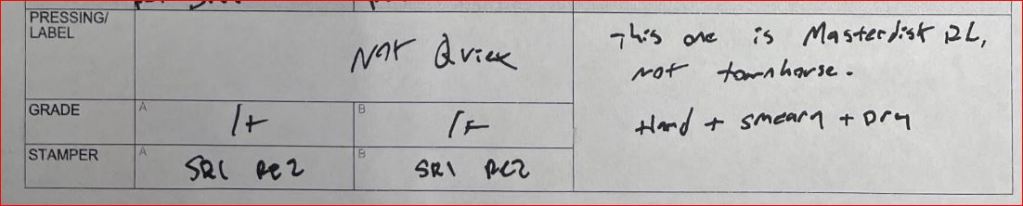
All the copies we had in our shootout were pressed domestically, and none of them were mastered by the legendary Robert Ludwig except for the one whose stampers you see below.

We awarded both sides of RL’s cutting a sub-Hot Stamper grade of 1+, which means the sound is passable at best, even after a good cleaning. (Without a good cleaning it would probably not even earn that single plus.)

We do not sell records with 1+ grades. We figure you can find those on your own. The world is full of them, as are most audiophile record collections.

1+ is actually a fairly good grade for many of the Heavy Vinyl pressings being made today. Some of the ones we’ve reviewed can be found in our Heavy Vinyl mediocrities section.

Any version of the album we sell will be noticeably — and probably dramatically — better sounding.

If you own any of those titles and didn’t pay much for them, you didn’t get ripped off too badly. You got something for your money. Not much, but something, and it would surprise us no end if any of them have been played much. Mediocre records tend to spend most of their lives sitting on record shelves. They’re not good enough sounding to bother with.

If you have any of these specific Heavy Vinyl pressings, something is wrong somewhere and it would be a good idea for you to figure out what before you flush any more money down the drain.

General Advice

On this title, forget the Brits. Every British pressing we played was badly smeared and veiled.

This took us somewhat by surprise because we happen to like the British PG pressings. However, So on British vinyl is awful too, so it’s clear (to us anyway) that the later PG records are bad on British vinyl and the early ones are better.

We are limiting our comments here to albums up through So. Anything after that is more or less terra incognita for us simply because we don’t care for any of the music he was making after 1986.

(more…)