*Robert Brook’s Guide

Robert Brook’s Guide for the Dedicated Analog Audiophile

Big Star’s #1 Record – Is All Analog Better?

Robert Brook runs a blog called The Broken Record, with a subtitle explaining that the aim of his blog is to serve as:

A GUIDE FOR THE DEDICATED ANALOG AUDIOPHILE

We know of none better, outside of our own humble attempt to enlighten that portion of the audiophile community who love records and are looking to understand them better.

Here is one of Robert’s postings from way back in 2021. The reason it is going up today is that the fellow who remastered the record for Craft, Jeff Powell, also remastered the Born Under a Bad Sign we reviewed recently here. Small world, right?

Back in the 90s I played an import pressing that was in print at the time. As I recall it was very bright, but that seems to be the sound the band was going for. I like Power Pop as much as the next guy, but the bright sound put me off and that was that. I never offered the record for sale, figuring that most customers would not be happy with the sound.

Chris Bellman cut the record for Classic Records in 2009, reportedly on an “All Tube” cutting system. Based on the man’s previous work I would not expect it to be to my liking. He cut a serviceable version of Brothers in Arms years ago, which I thought was quite good for anything pressed on Heavy Vinyl. It would probably earn a grade of 1.5+. Eventually I will get around to posting a review on this blog about it. To say Chris Bellman is no Robert Ludwig may be a massive understatement, but is there anyone today who can begin to match the mastering skills of the great RL?

By the way, the cheapest copy on Discogs is $163.04 if you are interested.

Big Star’s #1 Record Reissues: Is ALL ANALOG Better?


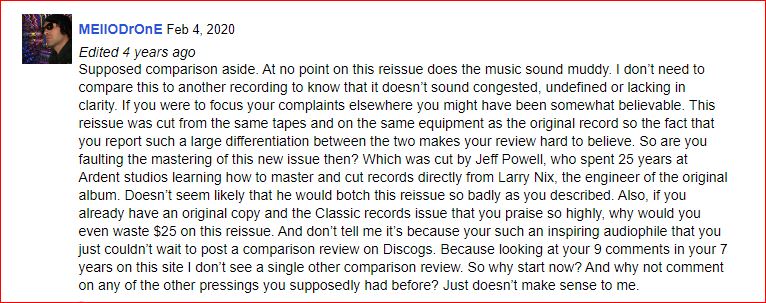
Most of the reviews on Discogs are of the Five Star “I can’t believe how good this record sounds” variety, something that is both tiresome and somewhat sickening considering that the quality is sure to be as poor as Robert says it is, if not worse.

One guy had the temerity to stick his head up, offering a dissent from the lovefest being thrown for a record he found of dubious quality. Naturally, a bunch of Discogers jumped all over him for his apostasy.

It’s just now dawning on me that this sort of behavior is not limited to the Steve Hoffman forum.

Here he “risks eternity” by speaking his mind. If they could find a way to burn him at the stake for the crime of questioning the quality of a Heavy Vinyl pressing they happen to like, you can be sure they would be organizing the gathering of the kindling at this very moment. They call him an “elitist goof, ” “a wanker,” and question his bona fides as an audiophile, the standard-issue audiophile forum approach to those who waver from the true path.

This is my favorite reply, offering little more than an appeal to authority. These guys are pros. How could they possibly make a bad sounding record? That’s not what they do, you idiot!
Why anyone would choose to associate with such intolerant, ill-mannered, small-minded people is beyond me.

The true believers at the Hoffman forum are even worse. There, if you write something upsetting to the delicate sensibilities of its members, they simply delete the post and send it down the memory hole where it can no longer do harm to the faithful.

(more…)
Challenging Our Assumptions for Better Sound

Robert Brook runs a blog called The Broken Record, with a subtitle explaining what the aim of his blog is:

A GUIDE FOR THE DEDICATED ANALOG AUDIOPHILE

Here is Robert’s latest posting.

CHALLENGING Our ASSUMPTIONS For BETTER SOUND

We’ve written about the lessons to be learned from the misguided exploits of the late Mr. Fritz ourselves, and you can read all about them here.

(more…)

Cartridge Break-In and Setting Azimuth

Robert Brook runs a blog called The Broken Record, with a subtitle explaining that the aim of his blog is to serve as:

A GUIDE FOR THE DEDICATED ANALOG AUDIOPHILE

We know of none better, outside of our own humble attempt to enlighten that portion of the audiophile community who love records and are looking to understand them better.

Here is one of Robert’s most recent postings.

Cartridge BREAK-IN and Setting AZIMUTH

More of Robert’s advice on equipment and setup:

(more…)

Others May Help, But Most of the Time We Make Our Own Mischief

Robert Brook runs a blog called The Broken Record, with a subtitle explaining that the aim of his blog is to serve as:

A GUIDE FOR THE DEDICATED ANALOG AUDIOPHILE

We know of none better, outside of our own humble attempt to enlighten that portion of the audiophile community who love records and are looking to understand them and reproduce them better.

Here is Robert’s latest posting. I changed the title a bit from his, since the dictionary definition of the term mischief-making implies “deliberately creating trouble for other people,” and it is not quite right that the purveyors of these products are in any way purposely going about screwing up the sound of perfectly good stereos.

The way I see it, these products are designed to do something positive for some stereos under some conditions when playing some recordings for audiophiles who prize some qualities more than others.

Knowing what these kinds of things are doing, on what kinds of stereos, under what operating conditions, when playing what specific recordings, for what sound qualities a particular audiophile might be listening for, is more than the work of a lifetime. It is, in fact, impossible.

ISOACOUSTICS and the Un-MAKING of Audio MISCHIEF

After reading Robert’s story, I was inspired to write a long piece detailing my own lessons learned as I first embraced, then rejected, one tweak or piece of gear after another, starting in 1975 or thereabouts. (Many such stories are chronicled here. The picture of me you see was taken in the late-70s. I was in an audio cult at the time, but, of course, like today’s similarly-situated audiophiles, I had no way of knowing it.)

I am still working on the commentary mentioned above, but I expect it should be ready before long. The short version goes like this:

Dramatic limitations and massive amounts of colorations are endemic to home audio systems.

The only way to get rid of them is by doing the unimaginably difficult work it takes to learn how to identify them and then figure out ways to root them out.

This, in my experience, is a process that will rarely be accomplished, even by the truly dedicated. It unfolds slowly, over the course of decades, and only for a very small percentage of audiophiles. Most will simply give up at some point and choose to enjoy whatever sound quality they have managed to achieve up to that time. To attempt to go further feels like banging your head against a wall.

To push on in this devilishly difficult hobby we have chosen for ourselves is for the few, not the many.

(It helped that we got paid to do it. An undiagnosed but all-too-real obsessive personality disorder also played a part, as did certain records that I fell in love with a long time ago.)

The completed post can be found here.

(more…)

Is Music Poorly Reproduced More Like Noise or More Like Music?

Robert Brook runs a blog called The Broken Record, with a subtitle explaining that the aim of his blog is to serve as:

A GUIDE FOR THE DEDICATED ANALOG AUDIOPHILE

We know of none better, outside of our own humble attempt to enlighten that portion of the audiophile community who love records and are looking to understand them better.

Here is one of Robert’s more recent postings you may find of interest.

The ART OF NOISE at SFMOMA: Where is the MUSIC?


More on Robert’s system here. You may notice that it has a lot in common with the one we use. This is clearly not an accident.

And it is also no accident that these two systems just happen to be very good at showing their owners the manifold shortcomings of the modern remastered LP, as well as the benefits to be gained by doing shootouts in order to find dramatically better sounding pressings to play.

(more…)

Go Nude for Even Better Sound

Robert Brook runs a blog called The Broken Record, with a subtitle explaining what the aim of this blog is:

A GUIDE FOR THE DEDICATED ANALOG AUDIOPHILE

We know of none better, outside of our own humble attempt to enlighten that portion of the audiophile community who love hearing music reproduced with higher fidelity and are willing to go the extra mile to make that happen.

Nothing will bring you as much joy as when you manage, by whatever means, probably against all odds, to make significant audio progress.

The more progress you make, the more you will enjoy your favorite music. At least that’s what happened to me over the course of the last fifty years as I set about working on my system, room and a great deal more.

Here is Robert’s latest posting.

“NUDE” Your Dynavector KARAT 17DX Cartridge for EVEN BETTER Sound


More on Robert’s system here. You may notice that it has a lot in common with the one we use. This is not an accident.

And it is also no accident that these two systems just happen to be very good at showing their owners the manifold shortcomings of the modern remastered LP, as well as the benefits to be gained by doing shootouts in order to find dramatically better sounding pressings to play.

(more…)

Testing with Good Records Is the Only Kind of Testing that Works

Robert Brook runs a blog called The Broken Record, with a subtitle explaining what the aim of this blog is:

A GUIDE FOR THE DEDICATED ANALOG AUDIOPHILE

We know of none better, outside of our own humble attempt to enlighten that portion of the audiophile community who love records and are looking to understand them better.

Here is Robert’s latest posting.

FERRITES and the Limits of SCIENCE (theory?) in AUDIO


More on Robert’s system here. You may notice that it has a lot in common with the one we use. This is clearly not an accident.

And it is also no accident that these two systems just happen to be very good at showing their owners the manifold shortcomings of the modern remastered LP, as well as the benefits to be gained by doing shootouts in order to find dramatically better sounding pressings to play.

(more…)

There’s Something Not Quite Right about MoFi’s Blue

Robert Brook has a blog which he calls

A GUIDE FOR THE DEDICATED ANALOG AUDIOPHILE

Below is a link to a review Robert Brook wrote recently for the MoFi One-Step pressing of one of our favorite albums of all time, Joni Mitchell’s Blue, originally released in 1971.

BLUE: What’s the RIGHT SOUND For Joni Mitchell’s CLASSIC?

Blue Sounds Funny Now

Based on everything I am reading these days from Robert Brook, he has a good stereo, two working ears, and knows plenty about records and what they are supposed to sound like.

This was not always the case as he himself would tell you. His stereo used to be much better at hiding the faults of a record like the MoFi One-Step of Blue than the stereo he has now. He got rid of most of his audiophile electronics, got a better phono stage, cartridge and arm, improved the quality of his electricity, found some sophisticated vibration controlling platforms for his vintage gear and did lots of other things to make his playback more accurate and — we cannot stress this too strongly — more fun, more exciting and more involving.

When your stereo is doing a better job of reproducing what’s in the grooves of your records, the first thing you notice when playing a Mobile Fidelity or other Heavy Vinyl pressing is that the sound is funny and wrong. (Please excuse the technical jargon; those of you who have been audiophiles as long as we have will understand what I mean, the rest of you can just play along. All of this will make sense eventually.)

When you use colored-sounding audiophile equipment — but I repeat myself — then your colored-sounding audiophile records don’t sound nearly as colored as they would under other conditions.

For example, other conditions obtain if you have — again, sorry about the jargon — revealing, accurate, tonally correct, natural-sounding equipment, free from the colorations — euphonic and otherwise — that allow one piece of audiophile equipment to sound so different from another.

(more…)

Robert Brook Has a Question for the Audiophile Community

Are Hot Stampers for real, or are they for the birds?

(That’s a question I see asked a lot by audiophiles. You will have no trouble guessing what the answer tends to be.)

Below you will find some of the text from an email exchange I had with Robert, one of hundreds we’ve sent to each other as we found ourselves winding through the thicket of records and audiophile equipment.

It’s one we are constantly struggling to understand, in my case even after 40 years.

In this email he recounts a personal story about a yoga friend, exploring his reaction to an incident that occurred with a fellow yoga practioner and some of the psychological lessons he learned from it. What he learned, he has now come to realize, helped him see more clearly some of the things that are going on in analog audio, especially when it comes to the credibility of yours truly.

He also points out that I am not always as tactful as I should be, and I don’t doubt for a minute that he is right about that. Not my strong suit. I’m more in favor of the “tough love” approach, but after rereading some of my old emails, it’s often shocking — even to me — how blunt I can be. I’ll try to do better.

Please to enjoy Robert’s story.

TOM PORT and Why More Audiophiles Don’t Take His Advice

A GUIDE FOR THE DEDICATED ANALOG AUDIOPHILE

Robert has approached the various problems he’s encountered methodically and carefully along these three fronts:

(more…)

Can Chris Bellman Cut Records As Well As Artisan Used to?

Robert Brook has a blog which he calls

A GUIDE FOR THE DEDICATED ANALOG AUDIOPHILE

Robert’s story begins:

Recently a friend and a frequent reader of my website suggested I review the 50th Anniversary Edition of David Crosby’s debut. He’d read my article from a while back in which I made comparisons between two different Hot Stamper copies of the record, and he knew I was a fan the album.

I’m sure he also knew, as any of my regular readers would, that I’m extremely skeptical of modern reissues. You can find many examples on this site of reissues I’ve written about that have failed miserably to impress me. But this friend was pretty insistent that this one, remastered by long time engineer Chris Bellman, was different. He also told me it was on par with original Monarch pressing of …My Name he also owned.

Bellman was responsible for cutting one of the few heavy vinyl reissues that my friend Tom Port has liked and recommended – a European pressing from 2020 of the Dire Straits record Brothers In Arms. Tom likes precious few “audiophile” reissues. He’s mentioned maybe 4 or 5 over the years as being worthy of any consideration. Given that, and the fact that my friend was so insistent, I figured why not give Bellman’s recut of . . .My Name a shot?

Click on the link to read the whole thing. I left some comments at the end you may enjoy reading. I hope to be able to address some of the other issues Robert brings up at a later date.

IF ONLY I COULD REMEMBER MY NAME: 50th Anniversary Edition

If you are interested in picking up an amazing Hot Stamper pressing of the album, we currently (as of 2/24) have some in stock. Click on this link to see what is available: If I Could Only Remember My Name.

On the website, we talk about just how much we love this album:

(more…)