More of the Music of Dvorak
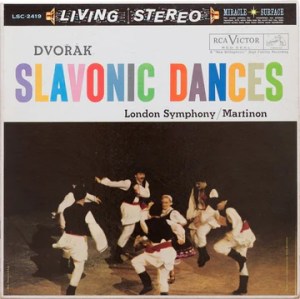
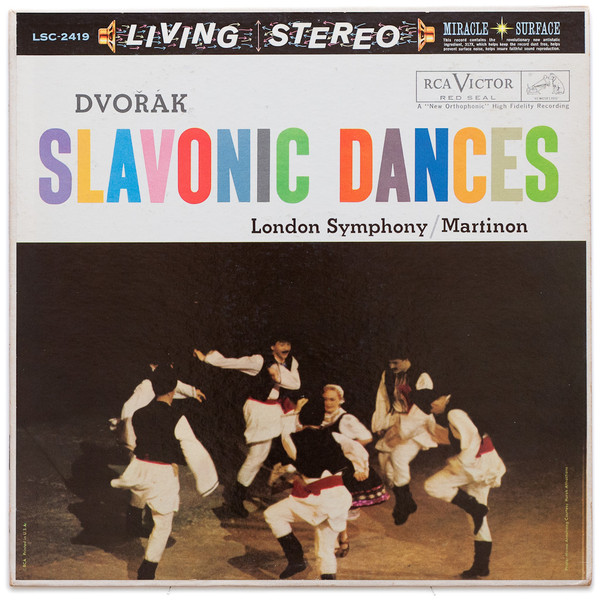
- Martinon and the LSO’s lively performance of Slavonic Dances debuts on the site with big, rich and Tubey Magical Shootout Winning Triple Plus (A+++) Living Stereo sound throughout this original Shaded Dog pressing
- These sides are clear, full-bodied and present, with plenty of space around the players, the unmistakable sonic hallmark of the properly-mastered, properly-pressed vintage analog LP
- We’ve been trying to get this shootout going for many years – some of the pressings we’ve come across have been absolutely some of the best sounding Living Stereo titles we’ve ever played
- If we ever create a Living Stereo Top Ten, this album will be a serious contender of the honor
- This record will have you asking why so few Living Stereo pressings actually do what this one does. The more critical listeners among you will recognize that this is a very special copy indeed. Everyone else will just enjoy the hell out of it.
- Marks and problems in the vinyl are sometimes the nature of the beast with these early pressings, but once you hear just how incredible sounding this copy is, you might be inclined, as we were, to stop counting ticks and pops and just be swept away by the music
This vintage Shaded Dog pressing has the kind of Tubey Magical Midrange that modern records can barely BEGIN to reproduce. Folks, that sound is gone and it sure isn’t showing signs of coming back. If you love hearing INTO a recording, actually being able to “see” the performers, and feeling as if you are sitting in the studio with the band, this is the record for you. It’s what vintage all analog recordings are known for — this sound.
If you exclusively play modern repressings of vintage recordings, I can say without fear of contradiction that you have never heard this kind of sound on vinyl. Old records have it — not often, and certainly not always — but maybe one out of a hundred new records do, and those are some pretty long odds.
What The Best Sides Of Slavonic Dances Have To Offer Is Not Hard To Hear
- The biggest, most immediate staging in the largest acoustic space
- The most Tubey Magic, without which you have almost nothing. CDs give you clean and clear. Only the best vintage vinyl pressings offer the kind of Tubey Magic that was on the tapes in 1960
- Tight, note-like, rich, full-bodied bass, with the correct amount of weight down low
- Natural tonality in the midrange — with all the instruments having the correct timbre
- Transparency and resolution, critical to hearing into the three-dimensional studio space
No doubt there’s more but we hope that should do for now. Playing the record is the only way to hear all of the qualities we discuss above, and playing the best pressings against a pile of other copies under rigorously controlled conditions is the only way to find a pressing that sounds as good as this one does.
Copies with rich lower mids and nice extension up top did the best in our shootout, assuming they weren’t veiled or smeary of course. So many things can go wrong on a record. We know, we’ve heard them all.
Top end extension is critical to the sound of the best copies. Lots of old records (and new ones) have no real top end; consequently, the studio or stage will be missing much of its natural air and space, and instruments will lack their full complement of harmonic information.
Tube smear is common to most vintage pressings. The copies that tend to do the best in a shootout will have the least (or none), yet are full-bodied, tubey and rich.
A Big Group of Musicians Needs This Kind of Space
One of the qualities that we don’t talk about on the site nearly enough is the SIZE of the record’s presentation. Some copies of the album just sound small — they don’t extend all the way to the outside edges of the speakers, and they don’t seem to take up all the space from the floor to the ceiling. In addition, the sound can often be recessed, with a lack of presence and immediacy in the center.
Other copies — my notes for these copies often read “BIG and BOLD” — create a huge soundfield, with the music positively jumping out of the speakers. They’re not brighter, they’re not more aggressive, they’re not hyped-up in any way, they’re just bigger and clearer.
And most of the time those very special pressings are just plain more involving. When you hear a copy that does all that — a copy like this one — it’s an entirely different listening experience.
What We’re Listening For On Slavonic Dances
- Energy for starters. What could be more important than the life of the music?
- The Big Sound comes next — wall to wall, lots of depth, huge space, three-dimensionality, all that sort of thing.
- Then transient information — fast, clear, sharp attacks, not the smear and thickness so common to these LPs.
- Powerful bass — which ties in with good transient information, also the issue of frequency extension further down.
- Next: transparency — the quality that allows you to hear deep into the soundfield, showing you the space and air around all the instruments.
- Extend the top and bottom and voila, you have The Real Thing — an honest to goodness Hot Stamper.
Hi-Fidelity
What do we love about these Living Stereo Hot Stamper pressings? The timbre of every instrument is Hi-Fi in the best sense of the word. The instruments here are reproduced with remarkable fidelity. Now that’s what we at Better Records mean by “Hi-Fi,” not the kind of audiophile phony BS sound that passes for Hi-Fidelity these days. There’s no boosted top, there’s no bloated bottom, there’s no sucked-out midrange. There’s no added digital reverb (Patricia Barber, Diana Krall, et al.). The microphones are not fifty feet away from the musicians (Water Lily) nor are they inches away (Three Blind Mice).
This is Hi-Fidelity for those who recognize the real thing when they hear it. I’m pretty sure our customers do, and whoever picks this one up is guaranteed to get a real kick out of it.
Side One
Slavonic Dances Op. 46
No. 1 in D-Presto
No. 2 in E-Minor – Allegretto Scherzando
No. 3 in A-Flat – Poco Allegro
No. 4 in F – Tempo Di Minuetto
Side Two
Slavonic Dances Op. 46
No. 5 in A – Allegro Vivace
No. 6 in D – Allegretto Scherzando
No. 7 in C-Minor – Allegro Assai
No. 8 in G-Minor – Presto
Slavonic Dances, Op. 72
No. 7 in C – Allegro Vivace
About this Piece
In the 19th century, an age of widespread amateur performance, the face of composition changed dramatically: more and more pieces were being written not only with the concert hall, but also with the amateur’s drawing room, in mind. It was not a new tactic – Mozart, after all, wrote concerti for his students – but with the growth of commercial music publishing, a host of instruction books appeared and a new generation of amateur musicians demanded music to fit their newly developing skills. Antonín Dvorák was among the crop of composers who recognized this, and as a result tailored some of his catalog for amateur performance.
The composer’s Slavonic Dances, Op. 46, originally scored for piano duo, are among this body of works suitable for everyday performance. The set of eight folk dances was written in 1878 at the request of publisher Fritz Simrock. Simrock was Johannes Brahms’ publisher – Brahms and Dvorák became good friends early in the younger composer’s career – and he had nearly a year before helped launch a career for Dvorák by accepting the virtually unknown composer’s Moravian Duets. But it was the Slavonic Dances that introduced Dvorák to the European concert scene; after their 1878 Dresden premiere, renown for the composer increased dramatically. (It must be noted that Dvorák, still in relative obscurity, received just 300 marks from Simrock – less than $100 – for the work that exposed him to the public eye.)
Soon after completing the original piano duet, Dvorák arranged the dances for full orchestra (the form in which they were premiered in Dresden), resulting in a single work presented in two different color palettes. The piano version is simple enough for student performance, but shows a brilliance in condensing Dvorák’s varied coloristic and rhythmic skills into a more limited format. The orchestral version lacks such economy of scale, but makes up for it with a hefty dose of vibrant instrumentation and rhythmic verve.
Although labeled under the catch-all description of “Slavonic” dances, seven of the eight sketches are Bohemian in origin, with only the second dance being native to Serbia. (His sequel to this work, 1886’s Op. 72, rounded out the international balance with music from Poland, Slovakia, and the Ukraine.) The overall flavor is vigorous, witty, and highly rhythmic. While the majority of the pieces resemble, at least in overall structure, traditional dances of symphonic form, there are departures. The fourth dance, for example, is a strongly accented version of a minuet. Of course, Dvorák’s characteristic folk melodies and colorful harmonies can be heard throughout, making the work a lively, vigorous vignette of the composer’s style.
– Jessica Schilling, LAPhil.com
xxxxxx