More Eric Clapton
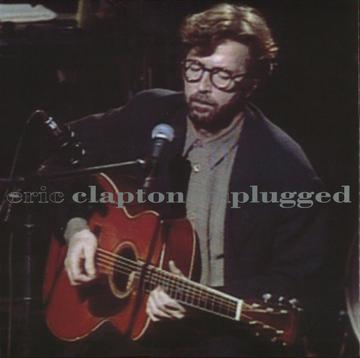
- With incredible Nearly Triple Plus (A++ to A+++) grades on both sides, this copy of Clapton’s latter day masterpiece is practically as good as we have ever heard, right up there with our Shootout Winner – exceptionally quiet vinyl too
- The sonics of this stunning import are rich, full-bodied, lively, and warm, with solid bass and breathy, clear vocals
- There are a number of records that Eric Clapton has made over the years that are Must Own titles, and we would have no problem putting this album on that list
- Consistency has never been the man’s strong suit, but you will simply not be able to find a bad track on this live album from 1992
- 4 1/2 stars: “Unplugged is the concert and album that established the MTV program as a classy, tony showcase for artists eager to redefine themselves via reexamination of their catalogs, which is what Clapton cannily did here.”
- If you’re a Clapton fan, this unplugged album from 1992 surely belongs in your collection.
This vintage Reprise import pressing has the kind of Tubey Magical Midrange that modern records can barely BEGIN to reproduce. Folks, that sound is gone and it sure isn’t showing signs of coming back. If you love hearing INTO a recording, actually being able to “see” the performers, and feeling as if you are sitting in the studio with the band, this is the record for you. It’s what vintage all analog recordings are known for — this sound.
If you exclusively play modern repressings of vintage recordings, I can say without fear of contradiction that you have never heard this kind of sound on vinyl. Old records have it — not often, and certainly not always — but maybe one out of a hundred new records do, and those are some pretty long odds.
What The Best Sides Of Unplugged Have To Offer Is Not Hard To Hear
- The biggest, most immediate staging in the largest acoustic space
- The most Tubey Magic, without which you have almost nothing. CDs give you clean and clear. Only the best vintage vinyl pressings offer the kind of Tubey Magic that was on the tapes even as late as 1992
- Tight, note-like, rich, full-bodied bass, with the correct amount of weight down low
- Natural tonality in the midrange — with all the instruments having the correct timbre
- Transparency and resolution, critical to hearing into the three-dimensional studio space
No doubt there’s more but we hope that should do for now. Playing the record is the only way to hear all of the qualities we discuss above, and playing the best pressings against a pile of other copies under rigorously controlled conditions is the only way to find a pressing that sounds as good as this one does.
Pop and Rock Shootouts
What are the sonic qualities by which a Pop or Rock record — any Pop or Rock record — should be judged?
Pretty much the ones we discuss in most of our Hot Stamper listings: energy, vocal presence, frequency extension (on both ends), transparency, spaciousness, harmonic textures (freedom from smear is key), rhythmic drive, tonal correctness, fullness, richness, three-dimensionality, and on and on down the list.
When we can hear a good many of the qualities mentioned above on the side we’re playing, we provisionally award it a Hot Stamper grade. This grade is often revised over the course of the shootout, as we come to more fully appreciate just how good some of the other copies are.
Once we’ve been through all our side ones, we then play the best of the best against each other and arrive at a winner. Other copies have their grades raised or lowered depending on how they sounded relative to the shootout winner.
Repeat the process for the other side and the shootout is officially over. All that’s left is to see how the sides of each pressing match up.
Record shootouts may not be rocket science, but they’re a science of a kind, one with strict protocols developed over the course of many years to ensure that the sonic grades we assign to our Hot Stampers are as accurate as we can make them.
The result of all our work speaks for itself, on this very record in fact. We guarantee you have never heard this music sound better than it does on our Hot Stamper pressing — or your money back.
What We’re Listening For On Unplugged
- Energy for starters. What could be more important than the life of the music?
- Then: presence and immediacy. The vocals aren’t “back there” somewhere, lost in the mix. They’re front and center where any recording engineer worth his salt would put them.
- The Big Sound comes next — wall to wall, lots of depth, huge space, three-dimensionality, all that sort of thing.
- Then transient information — fast, clear, sharp attacks, not the smear and thickness so common to these LPs.
- Tight punchy bass — which ties in with good transient information, also the issue of frequency extension further down.
- Next: transparency — the quality that allows you to hear deep into the soundfield, showing you the space and air around all the instruments.
- Extend the top and bottom and voila, you have The Real Thing — an honest to goodness Hot Stamper.
A Must Own Record, from 1992 No Less
We consider this Eric Clapton album a latter day Masterpiece. It’s a recording that should be part of any serious Popular Music Collection.
Others that belong in that category can be found here.
Side One
Signe
Before You Accuse Me
Hey Hey
Tears In Heaven
Lonely Stranger
Nobody Knows You When You’re Down & Out
Layla
Side Two
Running On Faith
Walkin’ Blues
Alberta
San Francisco Bay Blues
Malted Milk
Old Love
AMG 4 1/2 Star Review
Its massive success — it is one of the rare albums to be certified as diamond in the U.S. and it went platinum all over the world; it also won the Album of the Year Grammy for 1992 — makes it difficult to place Eric Clapton’s 1992 MTV Unplugged in context, but it’s important to do so. It arrived three years into MTV Unplugged’s run — 1989 also being the year Clapton stirred artistically with the assured AOR of Journeyman — and a year after Paul McCartney established the practice of an official album release of an Unplugged session with his own Unplugged (The Official Bootleg).
The album’s hit was a slow crawl through Derek & the Dominos’ “Layla,” turning that anguished howl of pain into a cozy shuffle and the whole album proceeds at a similar amiable gait, taking its time and enjoying detours into old blues standards. Clapton is embracing his middle age and the pleasure of Unplugged is to hear him opt out of the pop star game as he plays songs he’s always loved. Tellingly, it’s these blues and folk covers — Jesse Fuller’s “San Francisco Bay Blues,” Big Bill Broonzy’s “Hey Hey,” the standard “Alberta,” Muddy Waters’ “Rollin’ and Tumblin’,” two songs from Robert Johnson (“Walkin’ Blues,” “Malted Milk”) — that are the best performances here; they’re alternately lively and relaxed, Clapton happily conforming to the contours of the compositions. These capture a moment in time, when EC was settling into his age by reconnecting with the past, whereas the originals — whether it’s the revised versions of “Layla” and “Old Love,” “Tears in Heaven,” or the debut of “My Father’s Eyes,” originally heard here (and on the 2013 expanded anniversary edition) but released as a single much later in the decade — point forward to the sharply tailored adult contemporary crooner of the ’90s, one who turned out to be very comfortable existing in a world of high thread counts and designer duds.
These are the tunes that belong to the ’90s… but the rest of MTV Unplugged manages to transcend its time because it does cut to the quick of Clapton’s musical DNA.
Testing with Unplugged
Unplugged is good for testing a number of aspects of sound reproduction.
Here are some links to other titles that also make good test records for those of you looking to improve the quality of your analog playback:
- More records that are good for testing transparency
- More records that are good for testing midrange presence
- More records that are good for testing ambience, size and space
Here are some other rock and pop records that we’ve found are good for testing, including plenty of advice on what to listen for.
Further Reading
- How to go about collecting better sounding records
- Do I already have some Hot Stamper pressings in my collection?
- More reviews, letters and commentaries for the music of Eric Clapton
