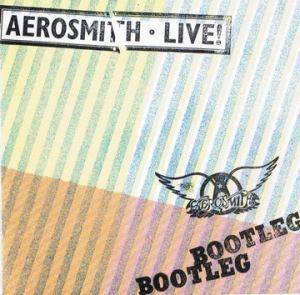
- Seriously good sound for this 2-LP live album, with all FOUR sides earning solid Double Plus (A++) grades or close to them – fairly quiet vinyl too
- Sides one, two and four are doing just about everything right – they’re big, full-bodied, dynamic and present with a huge punchy bottom end, and side three is not far behind in all those areas
- “Unlike other live albums at the time, it’s obvious that not a lot of overdubbing was involved to fix up the tracks, which results in a refreshingly authentic representation of Aerosmith at the group’s most drugged-out and rocking… Live Bootleg is an excellent representation of one of rock & roll’s elite live acts.”
These vintage Columbia pressings have the kind of Tubey Magical Midrange that modern records can barely BEGIN to reproduce. Folks, that sound is gone and it sure isn’t showing signs of coming back. If you love hearing INTO a recording, actually being able to “see” the performers, and feeling as if you are listening live in the audience, these are the records for you. It’s what vintage all analog recordings are known for — this sound.
If you exclusively play modern repressings of vintage recordings, I can say without fear of contradiction that you have never heard this kind of sound on vinyl. Old records have it — not often, and certainly not always — but maybe one out of a hundred new records do, and those are some pretty long odds.
What The Best Sides Of Live Bootleg Have To Offer Is Not Hard To Hear
- The biggest, most immediate staging in the largest acoustic space
- The most Tubey Magic, without which you have almost nothing. CDs give you clean and clear. Only the best vintage vinyl pressings offer the kind of Tubey Magic that was on the tapes in 1978
- Tight, note-like, rich, full-bodied bass, with the correct amount of weight down low
- Natural tonality in the midrange — with all the instruments having the correct timbre
- Transparency and resolution, critical to hearing into the three-dimensional studio space
No doubt there’s more but we hope that should do for now. Playing these records is the only way to hear all of the qualities we discuss above, and playing the best pressings against a pile of other copies under rigorously controlled conditions is the only way to find pressings that sound as good as these two do.
Moving Product
Classic Rock is the heart and soul of our business. Finding quiet, good sounding pressings of Classic Rock albums is what we devote the bulk of our resources (time and money) to, and if we can be indulged a self-compliment, it’s what we do best.
No one is even bothering to attempt the kind of shootouts we immerse ourselves in every day. And who can blame them? It’s hard to assemble all the resources it takes to pull it off. There are a huge number of steps a record must go through before it finds itself for sale on our site, which means there are about twenty records in the backroom for every one that can be found on the site.
If the goal is to move product this is a very bad way to go about it. Then again, we don’t care about moving product for the sake of moving product. Our focus must be on finding, cleaning and critically evaluating the best sounding pressings, of the best music, we can get our hands on.
What We’re Listening For On Live Bootleg
- Energy for starters. What could be more important than the life of the music?
- Then: presence and immediacy. The vocals aren’t “back there” somewhere, lost in the mix. They’re front and center where any recording engineer worth his salt would put them.
- The Big Sound comes next — wall to wall, lots of depth, huge space, three-dimensionality, all that sort of thing.
- Then transient information — fast, clear, sharp attacks, not the smear and thickness so common to these LPs.
- Tight punchy bass — which ties in with good transient information, also the issue of frequency extension further down.
- Next: transparency — the quality that allows you to hear deep into the soundfield, showing you the space and air around all the instruments.
- Extend the top and bottom and voila, you have The Real Thing — an honest to goodness Hot Stamper.
Side One
Back In The Saddle
Sweet Emotion
Lord Of The Thighs
Toys In The Attic
Side Two
Last Child
Come Together
Walk This Way
Sick As A Dog
Side Three
Dream On
Chip Away The Stone
Sight For Sore Eyes
Mama Kin
S.O.S.
Side Four
I Ain’t Got You
Mother Popcorn
Train Kept A Rollin’ / Strangers In The Night
AMG Review
Since Aerosmith had become one of America’s premier rock & roll concert attractions by 1978, it was only natural that an in-concert collection was issued that year, the double album, Live Bootleg. Unlike other live albums at the time, it’s obvious that not a lot of overdubbing was involved to fix up the tracks, which results in a refreshingly authentic representation of Aerosmith at the group’s most drugged-out and rocking. All of the performances were taken from Tyler and company’s 1977-1978 U.S. tour (with the exception of a couple from 1973), while the album’s packaging and title were a joke on all the poor-sounding, unauthorized live recordings that were in circulation at the time.
Just about every classic is included — “Back in the Saddle,” “Sweet Emotion,” “Walk This Way,” “Come Together,” “Last Child,” “Mama Kin,” “Train Kept A’Rollin,” etc. — as well as key album tracks (“Sick as a Dog,” “S.O.S.,” etc.). But the album’s high point has to be the aforementioned pair of long-lost tracks from 1973 — loose and groovy covers of the Yardbirds’ “I Ain’t Got You” and James Brown’s “Mother Popcorn.” Although the performances may lack the fire of the shorter Classics Live II set from 1988, Live Bootleg is an excellent representation of one of rock & roll’s elite live acts. Note: to tie in with the careless bootleg theme of the album, the track “Draw the Line” is unlisted.