 Hot Stamper Pressings of the Music of Michael Jackson Available Now
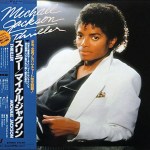
A letter we received not long ago made the point that the Japanese pressing of Thriller the owner had been listening to for years, even decades, fell well short of the mark set by the sound of the White Hot Stamper pressing he now owned.
To think, I spent all those years playing and re-playing a record that was bright and edgy, none the wiser to matrix numbers and pressing variations.
I agreed, saying that I myself learned the hard way, having wasted some of my own money on them. that Japanese pressings were almost always a crock, writing:
Most Japanese pressings cater to what a mid-fi system would need to sound good and a hi-fi system would find ruinous. They are almost always made from dubbed tapes, which are then brightened up in the mastering phase since that is the sound that appeals to the Japanese market for some reason unknown to me. Old school audio equipment — horn speakers and vintage tube electronics — would be my guess.
A fellow who saw an opening to set me straight and take me down a peg, all without having to learn how to use that pesky shift key on his computer, left the following comment in that post:
the japanese pressings were mastered by BG. the only difference being the quality of the material. nice try though, snakeoil salesman.
I immediately went to battle stations. I doubted whether Bernie Grundman has mastered any pressings for the Japanese market, but I couldn’t say for sure. It’s a question that had never come up. We ourselves had discovered a very good sounding pressing of Tusk that was mastered by Ken Perry and pressed in Japan, so I knew it was possible that the original mastering engineer could have sent metalwork to Japan for the Japanese to produce properly-mastered records for their market.
Fortunately, Discogs makes checking such things fairly easy. I went right up to the listing for Thriller and clicked on all the Japanese original pressings to see if there was any evidence to show that he had mastered them.
Bernie Grundman’s name was credited on the back cover as the mastering engineer, but I didn’t put much stock in that. I assumed that he did not master the album for their market, since that is hugely impractical. I surmised that removing his credit would have badly defaced the jacket, something I doubted the Japanese would have found acceptable. They seem to be very particular about these things.
Sure enough, here is what the stampers look like for the typical Japanese pressing that supposedly would have been mastered by BG:

There are about half a dozen original Japanese pressings for the album on Discogs and all the stamper listings look like the one above.
If you know anything about records, you know that these markings could not have been created by Bernie Grundman’s mastering operation here in the states.
But if you know very little about records, you might think that what it says on the back of the jacket of your Japanese pressing about who mastered the album carries more weight than all these little numbers do.
And you might even make a statement as ridiculous as “the only difference being the quality of the material” when you have not an iota of evidence to back up such a claim. (This blog is devoted to disproving such mistaken thinking.)
The main reason I even bother to reply is that it gives me another chance to bash Japanese pressings for those who might not have taken the time to read the letter ab_ba sent. At the end he summed up the nature of his complaint this way:
My Japanese pressing was clear and full. But too smooth. The guitars don’t bite. Also, it fatigued me by about halfway through the side. This is energetic music. It might exhaust you, but it doesn’t have to fatigue you. This is an example of where if you don’t have a hot stamper to compare it to, you’ll just assume your version sounds as good as it can get.
I replied:
What you’re describing is the smeary, distorted sound you get from a second-generation and possibly even a third-generation tape.
Less bite on the guitars, more fatiguing harmonic distortion everywhere else, these records are only playable on less-than-revealing systems. I actually liked some Japanese pressings back in the 90s, and I take pride in the fact that I’ve learned a thing or two since then.
After getting my system to a higher level and playing the imports I owned head to head against good domestic and British, Dutch and German import LPs, I said goodbye to most of my Japanese pressings, including all the rock and pop ones I had purchased before I knew better. Thankfully there weren’t many of those.
Some Japanese pressings can be amazing sounding, and those I kept. You can find a short list of Japanese pressings we’ve played with potentially –you may have noticed that word shows up a lot on this blog — top quality sound here.
All this happened more than 30 years ago. When put up against good vintage pressings, it was simply no contest, the Japanese came up short time and time again. I was actually embarrassed to have them in the house. What a fool I had been to believe what I was told and not to notice how second- and third-rate they were.
Later I added:
Thriller is a tough record to master. Lots of boosted EQ in places, hard to get right. Bernie can take great pride in a job well done on his mastering of the originals.
On a final note, normally an ignorant — if I can use such a word, it seems appropriate, no insult intended — comment like the one made by this gentleman would get deleted. It serves no purpose on a blog whose job it is to inform the public about records and audio.
As I say, I felt it gave me a chance to bash some records that a great many audiophiles have been foolishly wasting their money on for decades.
Including at least one audiophile even older than I am who you would think would know better by now.
Further Reading