More of the music of Joaquín Rodrigo (1901-1999)
More Classical and Orchestral Music

- Both sides of this wonderful classical guitar masterpiece on lovely boxed Decca UK vinyl boast outstanding Double Plus (A++) grades or BETTER
- The sound of the orchestra is as rich and sweet as would be expected from the Decca engineers, yet the guitar is clear, present and appropriately placed relative to the ensemble around it
- Glorious sound from the first note to the last, brimming with the wonderful qualities that make listening to classical music in analog on top quality audiophile equipment so involving and pleasurable
- Marks in the vinyl are sometimes the nature of the beast with these vintage LPs – there simply is no way around them if the superior sound of vintage analog is important to you
If you were only to be allowed one Guitar Concerto recording, the Concierto De Aranjuez would probably be the one to own. You will recognize the main theme instantly; it’s the one Miles Davis appropriated for the astonishingly innovative Sketches of Spain album he did with Gil Evans.
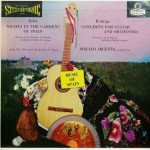
The second picture in this listing is the original London, CS 6046, from which the piece is taken. It is a longtime member of the TAS List, and deservedly so.
 This vintage Decca pressing has the kind of Tubey Magical Midrange that modern records can barely BEGIN to reproduce. Folks, that sound is gone and it sure isn’t showing signs of coming back. If you love hearing INTO a recording, actually being able to “see” the performers, and feeling as if you are sitting in the studio with the band, this is the record for you. It’s what vintage all analog recordings are known for — this sound.
If you exclusively play modern repressings of vintage recordings, I can say without fear of contradiction that you have never heard this kind of sound on vinyl. Old records have it — not often, and certainly not always — but maybe one out of a hundred new records do, and those are some pretty long odds.
What The Best Sides Of This Superb Classical Release Have To Offer Is Not Hard to Hear
- The biggest, most immediate staging in the largest acoustic space
- The most Tubey Magic, without which you have almost nothing. CDs give you clean and clear. Only the best vintage vinyl pressings offer the kind of Tubey Magic that was on the tapes in 1959
- Tight, note-like, rich, full-bodied bass, with the correct amount of weight down low
- Natural tonality in the midrange — with all the instruments having the correct timbre
- Transparency and resolution, critical to hearing into the three-dimensional studio space
No doubt there’s more but we hope that should do for now. Playing the record is the only way to hear all of the qualities we discuss above, and playing the best pressings against a pile of other copies under rigorously controlled conditions is the only way to find a pressing that sounds as good as this one does.
The Sound of the Strings
On some copies of this album the strings are dry, lacking the full measure of Tubey Magic we expect the tape to have. If you have a rich sounding cartridge, perhaps with that little dip in the upper midrange that so many moving coils have these days, you will not notice this tonality issue nearly as much as we do. Certainly you are less likely to be bothered by it. Our 17DX is ruler flat and quite unforgiving in this regard. While it certainly makes our shootouts much easier, it does bring out the flaws in all but the best pressings — exactly the job we require it to do.
What We’re Listening For On This Wonderful Recording
- Energy for starters. What could be more important than the life of the music?
- The Big Sound comes next — wall to wall, lots of depth, huge space, three-dimensionality, all that sort of thing.
- Then transient information — fast, clear, sharp attacks, not the smear and thickness so common to these LPs.
- Tight punchy bass — which ties in with good transient information, also the issue of frequency extension further down.
- Next: transparency — the quality that allows you to hear deep into the soundfield, showing you the space and air around all the instruments.
- Extend the top and bottom and voila, you have The Real Thing — an honest to goodness Hot Stamper.
Joaquín Rodrigo / Fantasìa Para Un Gentilhombre (Fantasia for a Gentleman)
- I. Villano y ricercar
- II. Españoleta y fanfarria de la caballería de Nápoles
- III. Danza de las hachas
- Canario
… Rodrigo’s second most popular work after the famous Concierto de Aranjuez.
The four movements were based on six short dances for solo guitar by the 17th-century Spanish composer Gaspar Sanz, taken from a three-volume work (1674, 1675, 1697) now commonly known as Instrucción de música sobre la guitarra española (Musical Instruction on the Spanish Guitar) (Donis 2005:75). Most of the movements retain the names that Sanz originally gave them. Rodrigo expanded on Sanz’s themes to produce a work lasting more than 20 minutes.
Rodrigo composed the concerto in 1954 at the request of guitarist Andrés Segovia, who was evidently the gentilhombre referenced in the title.[1] Segovia took the solo part at the premiere performance on March 5, 1958, in San Francisco.[2] The San Francisco Symphony was conducted by Enrique Jordá. – Wikipedia
A Must Own Orchestral Record
This Demo Disc Quality recording should be part of any serious Orchestral Music Collection. Others that belong in that category can be found here.
Side One
Concerto For Guitar And Orch. (Concierto De Aranjuez) – Joaquín Rodrigo
Allegro Con Spirito
Adagio
Allegro Gentile
Side Two
Nights In The Gardens Of Spain (Noches En Los Jardines De España) – Manuel de Falla
In The Generalife
Distant Dance
In The Gardens Of The Sierra De Cordoba