More of the music of J.S. Bach (1685-1750)
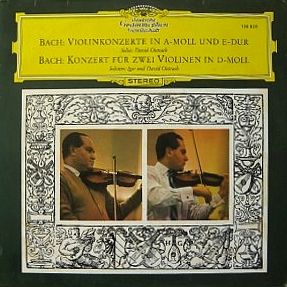
This Minty looking Deutsche Grammophon LP has rich, smooth sound. We didn’t have any other copies to compare it to, but we’ve played enough DG LPs around here to know that the average DG record is nothing to get excited about.
Nowadays we would not be able to sell a record such as this.
Without a proper cleaning and shootout, no record can go up on the site.
It’s the only way we know of to guarantee that the quality would be superior to whatever pressing you have or have heard.
Wikipedia on Bach
Bach was best known during his lifetime as an organist, organ consultant, and composer of organ works in both the traditional German free genres—such as preludes, fantasias, and toccatas—and stricter forms, such as chorale preludes and fugues.
At a young age, he established a reputation for his great creativity and ability to integrate foreign styles into his organ works. A decidedly North German influence was exerted by Georg Böhm, with whom Bach came into contact in Lüneburg, and Dieterich Buxtehude, whom the young organist visited in Lübeck in 1704 on an extended leave of absence from his job in Arnstadt. Around this time, Bach copied the works of numerous French and Italian composers to gain insights into their compositional languages, and later arranged violin concertos by Vivaldi and others for organ and harpsichord.
During his most productive period (1708–14) he composed several pairs of preludes and fugues and toccatas and fugues, and the Orgelbüchlein (“Little organ book”), an unfinished collection of 46 short chorale preludes that demonstrates compositional techniques in the setting of chorale tunes. After leaving Weimar, Bach wrote less for organ, although his best-known works (the six trio sonatas, the “German Organ Mass” in Clavier-Übung III from 1739, and the Great Eighteen chorales, revised late in his life) were all composed after his leaving Weimar. Bach was extensively engaged later in his life in consulting on organ projects, testing newly built organs, and dedicating organs in afternoon recitals.
This is an Older Classical/Orchestral Review
Most of the older reviews you see are for records that did not go through the shootout process, the revolutionary approach to finding better sounding pressings we started developing in the early 2000s and have since turned into a veritable science.
We found the records you see in these older listings by cleaning and playing a pressing or two of the album, which we then described and priced based on how good the sound and surfaces were. (For out Hot Stamper listings, the Sonic Grades and Vinyl Playgrades are listed separately.)
We were often wrong back in those days, something we have no reason to hide. Audio equipment and record cleaning technologies have come a long way since those darker days, a subject we discuss here.
Currently, 99% (or more!) of the records we sell are cleaned, then auditioned under rigorously controlled conditions, up against a number of other pressings. We award them sonic grades, and then condition check them for surface noise.
As you may imagine, this approach requires a great deal of time, effort and skill, which is why we currently have a highly trained staff of about ten. No individual or business without the aid of such a committed group could possibly dig as deep into the sound of records as we have, and it is unlikely that anyone besides us could ever come along to do the kind of work we do.
The term “Hot Stampers” gets thrown around a lot these days, but to us it means only one thing: a record that has been through the shootout process and found to be of exceptionally high quality.
The result of our labor is the hundreds of titles seen here, every one of which is unique and guaranteed to be the best sounding copy of the album you have ever heard or you get your money back.
What Exactly Are Hot Stamper Pressings?
Reviews and Commentaries for Other Recordings by Decca
Basic Concepts and Realities Explained