Kenneth Wilkinson, Engineer – Reviews and Commentaries

Witches’ Brew – Reviewed in 2007

Hot Stamper Pressings of Living Stereo Titles Available Now

This review from 2007 is way off the mark. We see now just how wrong we were.

To be honest, in 2007 we had a lot to learn. We’ve worked very hard to learn it over the ensuing years, and we have no intention of stopping as long as people keep buying our Hot Stamper pressings.

2007, Here Goes

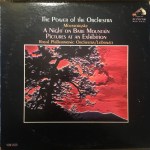
DEMONSTRATION QUALITY SOUND, of a sort. As I’ve said elsewhere on the site, this is not my idea of natural tonality. It’s not trying to be a realistic recreation of music performed in the concert hall. It’s a blockbuster to be impressive when played on an audio system in your home. On that level is succeeds.

As for the music, I have long held that the Danse Macabre on this album is the best ever. I probably still agree with that [not anymore, here’s a better one], but so much of the material on this record is amazingly good that that’s actually kind of a left-handed compliment. The entire side 2 is outstanding from start to finish.

The excerpt on side 1 from Pictures at an Exhibition and the complete A Night on Bare Mountain are both played with a kind of energy and orchestral technical quality that makes these pieces come alive right in your living room.
(more…)

Mussorgsky / The Power of the Orchestra / Leibowitz – Awesome In Mono

Hot Stamper Pressings of Pictures at an Exhibition

More on Mussorgsky’s (and Ravel’s) Masterpiece – Pictures at an Exhibition

This review dates from 2007. We recently played a stereo copy of the album and did not much care for the sound of it, which you can read about here.

This is the kind of record that the mono cartridge owners of the world worship. And for good reason. But you don’t need to have a mono cartridge to hear how good — in fact, how much BETTER — this copy sounds than most of the stereo pressings out there.

I found out about mono classical records one day when I got a mono copy of The Power Of The Orchestra, VCM 2659. It sounded better than any stereo recording of that work I had ever heard. All the instruments were so much more solid sounding, so palpable, so free from distortion, that it made me recognize for the first time what the mono record lovers of the world were talking about.

That was well over ten years ago. Since then many high end mono cartridges have come on the market, specifically to bring out that sound.

(more…)

The Sound You Might Expect from Decca in 1967

More of the Music of Modest Mussorgsky

Released as Romantic Russia by Decca in 1967, this London can also be found with a different cover and a different catalog number, CS 6503.

DEMO QUALITY SOUND on side one — in some ways. Don’t go looking for the Tubey Magic of an earlier era. What you get instead is super-low distortion, full-bandwidth sound with deep powerful bass and more transparency than most later Londons.

Solti is clearly the man for this music! He’s on fire with this fiery material. THIS is the way you want to hear Russian orchestral showpieces — played with verve and dynamically ALIVE. (more…)

Sibelius / Symphony No. 2 – An Overview

More of the Music of Jean Sibelius

A truly extraordinary recording mastered beautifully but pressed on vinyl that has never been known for its quiescence (if I can get by with that ten cent word).

The strings are clear and textured, yet rich and full-bodied. The bottom is big and weighty. The horns are tubey and full-bodied and never screech through even the most difficult passages.

My notes mention that it’s

  • rich and tubey but clear and lively;
  • big, with great energy;
  • superbly spacious and
  • never harsh or shrill.

(It can be a bit dark in places; as you know this is much preferable to the alternative.)

About as close to live music as I think this piece can sound in my listening room.

This shootout has been many years in the making. Some time around 2014 we surveyed the recordings of the work we had on hand, close to a dozen I would think, and found them all wanting, save two: this one and the 1964 reading by Ansermet for Decca (CS 6391).

So many recordings failed to capture the size, weight and power of the orchestra. Too much multi-miking was ruinous to some; screechy strings and horns to others.

Most recordings we played were profoundly unnatural, lacking transparency and the relaxed sense of involvement that eases one’s ability to be tricked into thinking “you (really) are there.”

(more…)