More of the Music of Chet Atkins
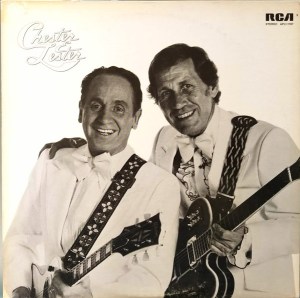
- Chester & Lester makes its Hot Stamper debut with INSANELY GOOD Shootout Winning Triple Plus (A+++) grades on both sides of this vintage RCA pressing
- Huge, rich, present, with an abundance of energy and great depth and room around the guitars — it’s all here
- The notes for this copy rave about the sound — apparently, this live in the studio recording from 1975 has the sound that RCA and Chet Atkins were famous for back in the 50s and 60s. Who knew?
- Chester & Lester won the Grammy Award for Best Country Instrumental Performance in 1976
- Les Paul’s recordings from back in the day can be off the charts Tubey Magical, but the music is rarely compelling, so we don’t do shootouts for his records anymore, but you can be sure this wonderful sounding title will be a regular on the site from now on
- 4 stars: “After eight years away from the microphones, Les Paul joined forces with country music’s Chet Atkins in a marvelously relaxed, tasty session of cross-cultural jamming. You won’t have any problem telling Chester and Lester apart on these tracks; Les’ bright, almost metallic sound and twirling, yet now more economical flurries are a world away from Chet’s mellow fingerpicking, lightly tarted with echo. Yet the two styles play brilliantly off each other….”
This vintage RCA pressing has the kind of Tubey Magical Midrange that modern records can barely BEGIN to reproduce. Folks, that sound is gone and it sure isn’t showing signs of coming back. If you love hearing INTO a recording, actually being able to “see” the performers, and feeling as if you are sitting in the studio with the band, this is the record for you. It’s what vintage all analog recordings are known for — this sound.
If you exclusively play modern repressings of vintage recordings, I can say without fear of contradiction that you have never heard this kind of sound on vinyl. Old records have it — not often, and certainly not always — but maybe one out of a hundred new records do, and those are some pretty long odds.
What The Best Sides Of Chester & Lester Have To Offer Is Not Hard To Hear
- The biggest, most immediate staging in the largest acoustic space
- The most Tubey Magic, without which you have almost nothing. CDs give you clean and clear. Only the best vintage vinyl pressings offer the kind of Tubey Magic that was on the tapes in 1976
- Tight, note-like, rich, full-bodied bass, with the correct amount of weight down low
- Natural tonality in the midrange — with all the instruments having the correct timbre
- Transparency and resolution, critical to hearing into the three-dimensional studio space
No doubt there’s more but we hope that should do for now. Playing the record is the only way to hear all of the qualities we discuss above, and playing the best pressings against a pile of other copies under rigorously controlled conditions is the only way to find a pressing that sounds as good as this one does.
Learning the Record
For our shootout, we had at our disposal a variety of pressings that had the potential for Hot Stamper sound. We cleaned them carefully, then unplugged everything in the house we could, warmed up the system, Talisman’d it, found the right VTA for our Triplanar arm (by ear of course) and proceeded to spend the next hour or so playing copy after copy on side one, after which we repeated the process for side two.
If you have five or more copies of a record and play them over and over against each other, the process itself teaches you what’s right and what’s wrong with the sound of the album. Once your ears are completely tuned to what the best pressings do well that the other pressings do not do as well, using a few carefully chosen passages of music, it quickly becomes obvious how well a given copy can reproduce those passages. You’ll hear what’s better and worse — right and wrong would be another way of putting it — about the sound.
This approach is simplicity itself. First, you go deep into the sound. There you find a critically important passage in the music, one which most copies struggle — or fail — to reproduce as well as the best. Now, with the hard-won knowledge of precisely what to listen for, you are perfectly positioned to critique any and all pressings that come your way.
It may be a lot of work but it sure ain’t rocket science, and we’ve never pretended otherwise. Just the opposite: from day one we’ve explained step by step precisely how to go about finding the Hot Stampers in your own collection. Not the good sounding pressings you happen to own — those may or may not have Hot Stampers — but the records you actually cleaned, shot out, and declared victorious.
What We’re Listening For On Chester & Lester
- Energy for starters. What could be more important than the life of the music?
- Then: presence and immediacy. The vocals aren’t “back there” somewhere, lost in the mix. They’re front and center where any recording engineer worth his salt would put them.
- The Big Sound comes next — wall to wall, lots of depth, huge space, three-dimensionality, all that sort of thing.
- Then transient information — fast, clear, sharp attacks, not the smear and thickness so common to these LPs.
- Tight punchy bass — which ties in with good transient information, also the issue of frequency extension further down.
- Next: transparency — the quality that allows you to hear deep into the soundfield, showing you the space and air around all the instruments.
- Extend the top and bottom and voila, you have The Real Thing — an honest to goodness Hot Stamper.
Side One
It’s Been A Long, Long Time
Medley: Moonglow / Picnic
Caravan
It Had To Be You
Out Of Nowhere
Side Two
Avalon
Birth Of The Blues
Someday Sweetheart
Deed I Do
Lover Come Back To Me
AMG 4 Star Review
After eight years away from the microphones, Les Paul joined forces with country music’s Chet Atkins in a marvelously relaxed, tasty session of cross-cultural jamming. The sound of the backup band may be Nashville country, but the tunes, mostly drawn from Paul’s repertoire, are jazz and pop standards (“Caravan,” “It’s Been a Long, Long Time,” “Avalon,” etc.).
Both players improvise, duel and converse with the spontaneity of jazz always in the air — and unlike almost all of Les’ recordings since 1947, there is no overdubbing except on “Caravan” and “Lover, Come Back to Me.” You won’t have any problem telling Chester and Lester apart on these tracks; Les’ bright, almost metallic sound and twirling, yet now more economical flurries are a world away from Chet’s mellow fingerpicking, lightly tarted with echo. Yet the two styles play brilliantly off each other; one potent example occurs as Chet superimposes the theme from “Picnic” from his repertoire over Les’ statement of “Moonglow.”
A lot of the between-takes session chatter is intentionally left in, with Les’s hotfoot voice trading quips with Chet’s Tennessee drawl. On “Avalon,” heard in two consecutive takes at different speeds, the dialogue is particularly funny, as Atkins mockingly tries to browbeat his old idol. This album had the effect of putting Les Paul well on the road toward canonization by young rock guitarslingers who noticed his name on Gibson instruments.