 Hot Stamper Pressings of the Music of Bela Bartok Available Now
Every last one of our London pressings of Concerto for Orchestra was a disaster: smeary strings, blary brass and painfully shrill throughout, with no top or bottom to speak of, the very definition of boxy sound.
The entire group of CS 6086 we had on hand — whether on Blueback or Whiteback, we had a good selection of both — were much too unpleasant to be played on high quality modern equipment.
Why had I been buying them for years?
I made the mistake of assuming that the phenomenally talented Decca engineering and producing team who worked on this project could be relied upon to produce a top quality recording of the Concerto for Orchestra.
As it turns out, my guess turned out to be wrong.
I had made the mistake of believing in the infallability of experts.
I talk about the team of producers and engineers seen below in listing after listing, raving about the amazing sound of the recordings produced by them in the 50s and 60s, many of which are right at the top of the best sounding recordings I have ever had the privilege to play.
James Walker was the producer, Roy Wallace the engineer for these sessions from April of 1959 in Geneva’s glorious Victoria Hall. It’s yet another remarkable disc from the golden age of vacuum tube recording.
The hall the Suisse Romande recorded in was possibly the best recording venue of its day, possibly of all time. More amazing sounding recordings were made there than in any other hall we know of. There is a solidity and richness to the sound beyond all others, yet clarity and transparency are not sacrificed in the least.
How could men such as these, men with arguably the best track record in the history of analog recording, let me down?
I don’t know. Nobody does. Nobody can predict how good a record sounds. Only playing it can tell you that.
What Might Have Happened
Maybe I dropped the needle on a copy way back when and heard decent enough sound to think that the potential for even higher quality was there, and that all I really needed were more copies. With a larger sample, I would be able to find the killer copies that would eventually go on to win the shootout years later.
Maybe the sound was not great, and rather than be skeptical, I put my faith in Ansermet, Walker, Wallace and the Suisse Romande, knowing they were very unlikely to let me down.
But being let down is something we should expect. A recent example:
Mercury Messes Up
The Mercury recording, producing and mastering team released an awful sounding pressing when they brought out a certain famous album, name withheld, the first time around.
Did anybody at Mercury notice? Before it came out? After it came out?
Did the record buying public complain? Did they notice how bad the sound was? If they did notice, did they just assume that Mercury had simply made a bad recording and there was nothing more to be done? There was no way to fix it?
Who could possibly be in a position to know any of this?
This is why we don’t speculate much about records. We play them, and when they sound good, we sell them.
The why’s and what-for’s we leave to those who seem interested in those sorts of things.
Thank God for the Reissues
Eventually reissues of this mystery Mercury came out that managed to properly encode the amazing sound of the tape onto a vinyl disc.
If we were stuck selling originals, we would have no copies of the album to sell, because they do not meet our standards for sound quality. Fortunately for those who love the way the piece is played, and how well recorded it is by the Mercury team, we have amazing sounding pressings of the album to offer our customers now that we know which ones they are.
We don’t pretend to know things that can’t be known. To learn about the sound quality or musical quality of a title, all we need is a good turntable feeding a good stereo.
When our thinking is in error, when it does not align with reality, we will surely make costly and foolish mistakes, as we did in the case of this London. We wasted a lot of money and a lot of time on a record that wasn’t worth the trouble.
Live and learn, that’s our motto. Clear thinking and careful evaluation is the foundation of our approach. In this case, we didn’t think clearly — we relied on the experts, something we should have known better than to do — and we didn’t evaluate their work with enough care early on, when it should have been clear that this London was not going to cut it.
If you want to collect better sounding records, clear thinking and critical listening are essential.
And if you want a good Concerto for Orchestra, the one we like best for both performance and sound is the Solti recording for Decca from 1965. We know of none better.
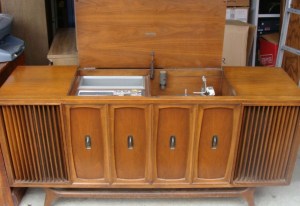 A stereo that looks like the console pictured — or one that sounds like an old console even though it has new components, there are plenty of those out there in audiophile land — is perfect for all your bad golden age recordings.
Or you could get that old console sound by powering your system with the Mac 30s you see below. They are very good at hiding the faults of old records (and plenty of new ones too).
Our Pledge of Service to You, the Discriminating Audiophile
We play mediocre-to-bad sounding pressings so that you don’t have to, a free service from your record-loving friends at Better Records.
 You can find this one in our hall of shame, along with others that — in our opinion — are best avoided by audiophiles looking for hi-fidelity sound.
We also have an audiophile record hall of shame for records that were marketed to audiophiles with claims of superior sound. If you’ve spent much time on this blog, you know that these records are some of the worst sounding pressings we have ever had the misfortune to play.
We routinely put them in our Hot Stamper shootouts, head to head with the vintage records we offer. We are often more than a little surprised at just how bad an “audiophile record” can sound and still be considered an “audiophile record.”
If you own any of these so-called audiophile pressings, let us send you one of our Hot Stamper LPs so that you can hear it for yourself in your own home, on your own system. Every one of our records is guaranteed to be the best sounding copy of the album you have ever heard or you get your money back.
Further Reading
- More entries in our critical thinking series
- Record collecting for audiophiles from A to Z
- I couldn’t learn much until I figured out how to train my ears
