More of the Music of Edvard Grieg
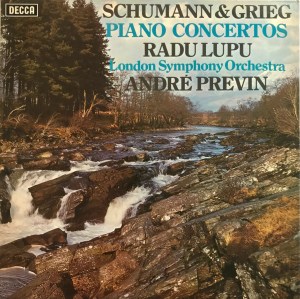
- A superb UK Decca pressing of this wonderful classical masterpiece with Double Plus (A++) sound from start to finish
- Both sides boast full brass and an especially clear, solid, present piano, one with practically no trace of vintage analog tube smear
- Dynamic, huge, lively, transparent and natural – with a record this good, your ability to suspend disbelief will require practically no effort at all
- Back in the days when the TAS Super Disc List meant something, this record was on it and deservedly so
- The London pressings of the same album can be very good in their own right, but they don’t win shootouts – only the best of these Decca pressings do, a subject we discuss in some of these listings
- Our two favorite recordings of the Grieg Piano Concerto are this one and Rubinstein’s for RCA in 1962
- There are about 150 orchestral recordings we think offer the best performances with the highest quality sound. This record is certainly deserving of a place on that list.
This vintage British Decca pressing has the kind of Tubey Magical Midrange that modern records can barely BEGIN to reproduce. Folks, that sound is gone and it sure isn’t showing signs of coming back. If you love hearing INTO a recording, actually being able to “see” the performers, and feeling as if you are sitting in the studio with the band, this is the record for you. It’s what vintage all analog recordings are known for — this sound.
If you exclusively play modern repressings of vintage recordings, I can say without fear of contradiction that you have never heard this kind of sound on vinyl. Old records have it — not often, and certainly not always — but maybe one out of a hundred new records do, and those are some pretty long odds.
What Amazing Sides Such as These Have to Offer Is Not Hard to Hear
- The biggest, most immediate staging in the largest acoustic space
- The most Tubey Magic, without which you have almost nothing. CDs give you clean and clear. Only the best vintage vinyl pressings offer the kind of Tubey Magic that was on the tapes in 1973
- Tight, note-like, rich, full-bodied bass, with the correct amount of weight down low
- Natural tonality in the midrange — with all the instruments having the correct timbre
- Transparency and resolution, critical to hearing into the three-dimensional studio space
No doubt there’s more but we hope that should do for now. Playing the record is the only way to hear all of the qualities we discuss above, and playing the best pressings against a pile of other copies under rigorously controlled conditions is the only way to find a pressing that sounds as good as this one does.
Copies with rich lower mids and nice extension up top did the best in our shootout, assuming they weren’t veiled or smeary of course. So many things can go wrong on a record! We know, we’ve heard them all.
Top end extension is critical to the sound of the best copies. Lots of old records (and new ones) have no real top end; consequently, the studio or stage will be missing much of its natural air and space, and instruments will lack their full complement of harmonic information.
Tube smear is common to most vintage pressings and this is no exception. The copies that tend to do the best in a shootout will have the least (or none), yet are full-bodied, tubey and rich.
What We’re Listening For on Schuman and Grieg’s Piano Concertos
- Energy for starters. What could be more important than the life of the music?
- The Big Sound comes next — wall to wall, lots of depth, huge space, three-dimensionality, all that sort of thing.
- Then transient information — fast, clear, sharp attacks, not the smear and thickness so common to these LPs.
- Next: transparency — the quality that allows you to hear deep into the soundfield, showing you the space and air around all the instruments.
- Extend the top and bottom and voila, you have The Real Thing — an honest to goodness Hot Stamper.
Side One
Schumann Piano Concerto
1st Mvt. Allegro Affetuoso
2nd Mvt. Intermezzo – Andantino Grazioso
3rd Mvt. Allegro Vivace
Side Two
Piano Concerto In A Minor
1st Mvt. Allegro Molto Moderato
2nd Mvt. Adagio
3rd Mvt. Allegro Moderato Molto E Marcato – Quasi Presto – Andante Maestoso
Grieg Piano Concerto
The work is among Grieg’s earliest important works, written by the 24-year-old composer in 1868 in Søllerød, Denmark, during one of his visits there to benefit from the climate, which was warmer than that of his native Norway.
Grieg’s concerto is often compared to the Piano Concerto of Robert Schumann — it is in the same key, the opening descending flourish on the piano is similar, and the overall style is considered to be closer to Schumann than any other single composer. Grieg had heard Schumann’s concerto played by Clara Schumann in Leipzig in 1858, and was greatly influenced by Schumann’s style generally, having been taught the piano by Schumann’s friend, Ernst Ferdinand Wenzel. Compact disc recordings often pair the two concertos.
Additionally, Grieg’s work provides evidence of his interest in Norwegian folk music; the opening flourish is based around the motif of a falling minor second (see interval) followed by a falling major third, which is typical of the folk music of Grieg’s native country. This specific motif occurs in other works by Grieg, including the String Quartet. In the last movement of the concerto, similarities to the halling (a Norwegian folk dance) and imitations of the Hardanger fiddle (the Norwegian folk fiddle) have been detected.
Instrumentation
The concerto was originally scored for 2 flutes, 2 oboes, 2 clarinets in A and B flat, 2 bassoons, 2 horns in E and E flat, 2 trumpets in C and B flat, 2 trombones, tuba, timpani and strings (violins, violas, cellos and double basses). He later added 2 horns and changed the tuba to a third trombone.
Wikipedia
Robert Schumann Mini-Biography
Robert Schumann (8 June 1810 – 29 July 1856) was a German composer, pianist, and influential music critic. He is widely regarded as one of the greatest composers of the Romantic era. Schumann left the study of law, intending to pursue a career as a virtuoso pianist. His teacher, Friedrich Wieck, a German pianist, had assured him that he could become the finest pianist in Europe, but a hand injury ended this dream. Schumann then focused his musical energies on composing.
In 1840, Schumann married Clara Wieck, after a long and acrimonious legal battle with her father, Friedrich, who opposed the marriage. A lifelong partnership in music began, as Clara herself was an established pianist and music prodigy. Clara and Robert also maintained a close relationship with German composer Johannes Brahms.
Until 1840, Schumann wrote exclusively for the piano. Later, he composed piano and orchestral works, and many Lieder (songs for voice and piano). He composed four symphonies, one opera, and other orchestral, choral, and chamber works. His best-known works include Carnaval, Symphonic Studies, Kinderszenen, Kreisleriana, and the Fantasie in C. Schumann was known for infusing his music with characters through motifs, as well as references to works of literature. These characters bled into his editorial writing in the Neue Zeitschrift für Musik (New Journal for Music), a Leipzig-based publication that he co-founded.
Schumann had mental disorder that first manifested in 1833 as a severe melancholic depressive episode—which recurred several times alternating with phases of “exaltation” and increasingly also delusional ideas of being poisoned or threatened with metallic items. What is now thought to have been a combination of bipolar disorder and perhaps mercury poisoning led to “manic” and “depressive” periods in Schumann’s compositional productivity. After a suicide attempt in 1854, Schumann was admitted at his own request to a mental asylum in Endenich (now in Bonn). Diagnosed with psychotic melancholia, he died of pneumonia two years later at the age of 46, without recovering from his mental illness.
— Wikipedia