More of the Music of Tchaikovsky
More of the Music of Rimsky-Korsakov
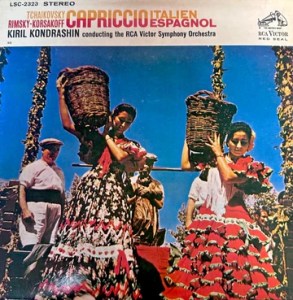
- Kondrashin and the RCA Victor Symphony Orchestra’s performance of these sublime orchestral works makes its Hot Stamper debut with solid Double Plus (A++) Living Stereo sound or BETTER throughout this vintage pressing of LSC 2323
- Capriccio Espagnol takes up all of this Nearly Triple Plus (A++ to A+++) side two and is practically as good as we have ever heard it, right up there with our Shootout Winner
- Our Shootout Winner was a White Dog pressing as well, with these same stamper numbers – lucky us!
- The Shaded Dog pressings can be excellent, but the one pressing that came in last in our shootout was — drum roll, please — a Shaded Dog with a 1s side one, if you can wrap your head around it
- Both of these sides are full, rich and clear, with more space and more three-dimensional staging than practically all of the other copies we played
- And of course it will completely destroy any pressing you may have on Heavy Vinyl, from any label, at any playback speed
- If you like orchestral spectaculars, this is the record for you!
This vintage RCA pressing has the kind of Tubey Magical Midrange that modern records can barely BEGIN to reproduce. Folks, that sound is gone and it sure isn’t showing signs of coming back. If you love hearing INTO a recording, actually being able to “see” the performers, and feeling as if you are sitting in the studio with the band, this is the record for you. It’s what vintage all analog recordings are known for — this sound.
If you exclusively play modern repressings of vintage recordings, I can say without fear of contradiction that you have never heard this kind of sound on vinyl. Old records have it — not often, and certainly not always — but maybe one out of a hundred new records do, and those are some pretty long odds.
What The Best Sides Of Capriccio Italien / Capriccio Espagnol Have To Offer Is Not Hard To Hear
- The biggest, most immediate staging in the largest acoustic space
- The most Tubey Magic, without which you have almost nothing. CDs give you clean and clear. Only the best vintage vinyl pressings offer the kind of Tubey Magic that was on the tapes in 1959
- Tight, note-like, rich, full-bodied bass, with the correct amount of weight down low
- Natural tonality in the midrange — with all the instruments having the correct timbre
- Transparency and resolution, critical to hearing into the three-dimensional studio space
No doubt there’s more but we hope that should do for now. Playing the record is the only way to hear all of the qualities we discuss above, and playing the best pressings against a pile of other copies under rigorously controlled conditions is the only way to find a pressing that sounds as good as this one does.
Copies with rich lower mids and nice extension up top did the best in our shootout, assuming they weren’t veiled or smeary of course. So many things can go wrong on a record. We know, we’ve heard them all.
Top end extension is critical to the sound of the best copies. Lots of old records (and new ones) have no real top end; consequently, the studio or stage will be missing much of its natural air and space, and instruments will lack their full complement of harmonic information.
Tube smear is common to most vintage pressings. The copies that tend to do the best in a shootout will have the least (or none), yet are full-bodied, tubey and rich.
A Big Group of Musicians Needs This Kind of Space
One of the qualities that we don’t talk about on the site nearly enough is the SIZE of the record’s presentation. Some copies of the album just sound small — they don’t extend all the way to the outside edges of the speakers, and they don’t seem to take up all the space from the floor to the ceiling. In addition, the sound can often be recessed, with a lack of presence and immediacy in the center.
Other copies — my notes for these copies often read “BIG and BOLD” — create a huge soundfield, with the music positively jumping out of the speakers. They’re not brighter, they’re not more aggressive, they’re not hyped-up in any way, they’re just bigger and clearer.
And most of the time those very special pressings are just plain more involving. When you hear a copy that does all that — a copy like this one — it’s an entirely different listening experience.
What We’re Listening For On Capriccio Italien / Capriccio Espagnol
- Energy for starters. What could be more important than the life of the music?
- The Big Sound comes next — wall to wall, lots of depth, huge space, three-dimensionality, all that sort of thing.
- Then transient information — fast, clear, sharp attacks, not the smear and thickness so common to these LPs.
- Powerful bass — which ties in with good transient information, also the issue of frequency extension further down.
- Next: transparency — the quality that allows you to hear deep into the soundfield, showing you the space and air around all the instruments.
- Extend the top and bottom and voila, you have The Real Thing — an honest to goodness Hot Stamper.
Hi-Fidelity
What do we love about these Living Stereo Hot Stamper pressings? The timbre of every instrument is Hi-Fi in the best sense of the word. The instruments here are reproduced with remarkable fidelity. Now that’s what we at Better Records mean by “Hi-Fi,” not the kind of audiophile phony BS sound that passes for Hi-Fidelity these days. There’s no boosted top, there’s no bloated bottom, there’s no sucked-out midrange. There’s no added digital reverb (Patricia Barber, Diana Krall, et al.). The microphones are not fifty feet away from the musicians (Water Lily) nor are they inches away (Three Blind Mice).
This is Hi-Fidelity for those who recognize the real thing when they hear it. I’m pretty sure our customers do, and whoever picks this one up is guaranteed to get a real kick out of it.
Side One
Capriccio Italien – Tchaikovsky
Tchaikovsky possessed a remarkable talent for instrumentation, instinctively scoring his works to obtain a maximum variety of color and the widest possible range of tonal effects. His “Capriccio Italien,” vibrant with the raw colors of its Italian song and dance rhythms, is one of his most popular works and shows the composer’s complete mastery of orchestration. Its music passes vigorously from the opening trumpet call (echoes of the Cuirassiers) through a slightly melancholy phase to a climax of power and brilliance reminiscent of the popular Italian dance, the Tarantella.
-from the liner notes of SPC21004
Side Two
Capriccio Espagnol – Rimsky-Korsakoff
Capriccio Espagnol, Op. 34, is the common Western title for an orchestral work based on Spanish folk melodies and written by Nikolai Rimsky-Korsakov in 1887. Rimsky-Korsakov originally intended to write the work for a solo violin with orchestra, but later decided that a purely orchestral work would do better justice to the lively melodies.
The Capriccio consists of five movements and is scored for 2 flutes, piccolo, 2 oboes (one doubling English horn), 2 clarinets, 2 bassoons, 4 horns, 2 trumpets, 3 trombones, tuba, timpani, percussion, harp and strings.
The piece is often lauded for its orchestration, which features a large percussion section and many special techniques and articulations, such as in the fourth movement when the violinists, violists, and cellists are asked to imitate guitars (the violin and viola parts are marked “quasi guitara”). Despite the critical praise, Rimsky-Korsakov was annoyed that the other aspects of the piece were being ignored. In his autobiography, he wrote:
The opinion formed by both critics and the public, that the Capriccio is a magnificently orchestrated piece — is wrong. The Capriccio is a brilliant composition for the orchestra. The change of timbres, the felicitous choice of melodic designs and figuration patterns, exactly suiting each kind of instrument, brief virtuoso cadenzas for instruments solo, the rhythm of the percussion instruments, etc., constitute here the very essence of the composition and not its garb or orchestration.
The Spanish themes, of dance character, furnished me with rich material for putting in use multiform orchestral effects. All in all, the Capriccio is undoubtedly a purely external piece, but vividly brilliant for all that. I was a little less successful in its third section (Alborada, in B-flat major), where the brasses somewhat drown the melodic designs of the woodwinds; but this is very easy to remedy, if the conductor will pay attention to it and moderate the indications of the shades of force in the brass instruments by replacing the fortissimo by a simple forte.
-Wikipedia