 Hot Stamper Pressings of Vintage Columbia Albums Available Now
Recently we conducted a shootout for one of our favorite Columbia recordings, one that we had auditioned many times before and for which we knew the music and the general quality of the sound well.
It’s not the record you see pictured.
For now we’re keeping the title a mystery, consistent with the idea that we give out plenty of stamper information on this blog, including some of the worst ones we’ve had the misfortune to run into, but rarely do we feel the need to give out the really good ones. After decades of doing this kind of work, the time and effort that has gone into finding them is beyond calculation.
When we do give out the best stampers, as is the case here (3BA baby!), we make a point of keeping the title under wraps.
We are not the least bit interested in putting ourselves out of business.
The discussion for today revolves around the idea held by a great many audiophiles that the original White Print 360 label pressings are going to be the best sounding for any title that was made starting with that label in the early-60s.
(The Black Print 360 mono is an example of the mono labels being a bit behind the times as far as I can tell.)
Note that we did not bother to put any of the 70s Red Label Columbia pressings in the shootout. We’ve been down that road with this title before, and we have yet to hear one worth the vinyl wasted on it.
Columbia, like most labels, seems to have made very little effort with the sound quality of their reissues. Perhaps it was the result of all the bad transistor equipment in the studios by the time the 70s rolled around, but that would be speculation on my part, as well as something that would be very hard to find evidence for one way or the other.
We did find one Monk record that sounded better on the Red Label reissue, and readers of this blog should easily be able to find out which one it is by reading our many reviews for Monk’s recorded output.
We have two new lists for those who would like to know which Columbia labels win shootouts — one for 6-Eye winners and one for 360 Label winners.
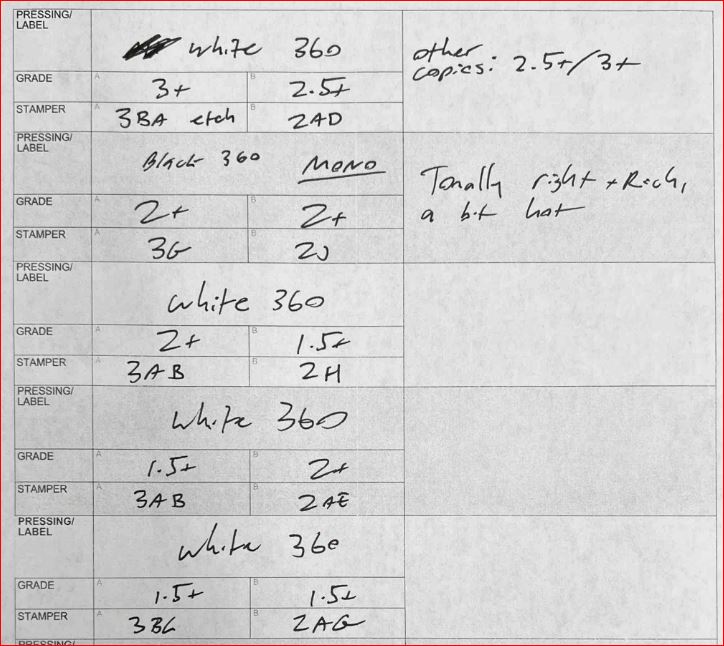
What interests me in these findings is the following:
- Both of our shootout winning copies had the same stampers. Can that really be a coincidence?
- The shootout winner for side one is 3BA.
- Two copies with stampers very similar to that one, 3AB, did noticeably worse, 2+ and 1.5+.
- And the worst of the White Print 360 Label pressings barely earned a Hot Stamper grade at all.
- They are on the same original label as the other copies, but for some reason they don’t sound as good. Why is that?
If an audiophile collector were to go to Discogs, find a nice clean copy on the early label and buy it, he might find that he know owns a top quality sounding copy, a pretty good sounding copy, or a not-nearly-as-good sounding copy as he’d hoped for, depending on his luck.
And what would he know about the quality of the recording? About that thing that audiophiles and record collectors seem to reference so often, “the master tape,” as if they have any way of knowing about the sound of a tape they have never come into contact with.
Just Assume
If he had a killer 3BA, wouldn’t he just assume that for some reason the recording must be amazing and consider himself lucky to find such a wonderful record to play.
Why one set of stampers sounds so much better than another set, or the same or a similar set on a different pressing, is a mystery, and it’s one that we confidently predict will never be solved.
Does anyone have a practical way to get around the reality that allows one set of stampers to sound great and the same or a similar set of stampers to sound no better than very good, if that?
Well, we can’t say there is a practical way, but we do know of an impractical one. We’ve been practicing and refining that one for more than twenty years.
We just play lots and lots of copies of the albums to find out how they sound.
Our Approach
Having the wherewithal to do this difficult work puts us in a unique position to help audiophiles looking for higher quality sound. Or, more accurately, that small subset of audiophiles looking for the highest quality pressings who also have a great deal of disposable income to devote to such pressings.
Yes, we have the obvious resources that would be needed, the staff and the budget.
More important than either of those, we came up with a new (sort of) and much more successful (definitely) approach.
We’ve learned through thousands and thousands of hours of experimentation that there is no reliable way to predict which pressings will have the best sound for any given album.
The impossibility of predicting the sound of individual pressings is one which we’ve learned to accept as axiomatic. As a scientifically-oriented person and a born skeptic, this was a concept I never had any difficulty wrapping my head around.
Early on in my audio career, sometime in the 80s, I realized it was in fact beyond dispute. (I owe a great deal to my friend Robert Pincus for showing me the light.) Like it or not — and, based on what I read on forums and such, there are apparently a goodly number of audiophiles who don’t like it — it was and is simply a fact.
We take the simplest possible approach to the problem, one that could be taught in a high school science class, if high school science classes were run by experimentally-minded record collectors.
- Guess what pressings might be good for a given album.
- Buy some of those pressings and others like them.
- Clean them up, play them and see if your guess about the sound of the pressing turns out to be right, wrong or somewhere in-between.
- Repeat steps one through three until you chance upon a pressing that sounds dramatically better than all the others.
- Get hold of as many of those as you can and play them against each other under rigorously controlled conditions.
- Continue to make other guesses and acquire other pressings to play against the pressing you believe to be the best.
- Keep making improvements to your playback system and never stop testing as many alternate pressings as possible.
That’s it. Nothing to it. It all comes down to experimenting at a sufficiently large enough scale to achieve higher rates of success.