More of the Music of Richard Strauss
Many of the later pressings of CS 6211 were not competitive with the earlier pressings, something we had no idea was true until we actually did the shootout.
This is why we do our shootouts with every kind of pressing we can find that has any hope of sounding good to us.
(This is of course something that cannot be predicted with much certainty. What we are saying is simply that we do not expect the German, Dutch, Japanese and such like pressings from other countries outside the UK to do well because they have almost never done well in the past, not for Decca recordings anyway.)
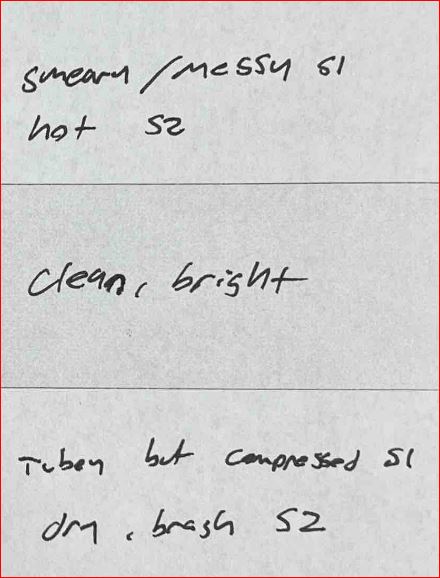 The notes on the left in the box are for the copies that did not do as well as our best copies.
If your copy of the album has any of the shortcomings we mention, and you would like a better pressing to play, rest assured we will have something for you down the road, as this is our favorite for both performance and sound.
Stamper Information
The stampers of the pressings that consistently came in last in our shootout had the mastering marking of L, which signifies the work of George Bettyes. He has done good work in the past, but odds are that any pressing of this title mastered by L is going to be inferior to those that are not.
Our advice: stick with E and G.
As is sometimes the case, there is one and only one set of stamper numbers that consistently wins our shootouts for CS 6211. Here are some of the others we’ve discovered through the shootout process.
Our notes for an exceptionally good sounding copy from the last shootout can be seen below.
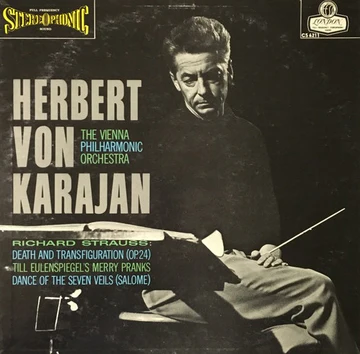
This original Stereo London pressing of Karajan and the Vienna Phil’s performance of these classical pieces boasts stunning Nearly Triple Plus (A++ to A+++) sound from first note to last – just shy of our Shootout Winner.
These are superb readings of the works, and we know of no others that can compete with the sound of this Decca recording.
Clear, transparent, rich, big, spacious, tonally correct, with Tubey Magical textured strings, this record is doing practically everything right, and that makes it a very special pressing indeed.
Some old record collectors (like me) say classical recording quality ain’t what it used to be – here’s all the proof anyone with two working ears and top quality audiophile equipment needs to make the case.
Side One
Till Eulenspiegel’s Merry Pranks
Dance Of The Seven Veils (“Salome”)
Side Two
Tod Und Verklärung (Death And Transfiguration)
Death and Transfiguration
Death and Transfiguration (German: Tod und Verklärung), Op. 24, is a tone poem for orchestra by Richard Strauss. Strauss began composition in the late summer of 1888 and completed the work on 18 November 1889. The work is dedicated to the composer’s friend Friedrich Rosch.
The music depicts the death of an artist. At Strauss’s request, this was described in a poem by his friend Alexander Ritter as an interpretation of Death and Transfiguration, after it was composed. As the man lies dying, thoughts of his life pass through his head: his childhood innocence, the struggles of his manhood, the attainment of his worldly goals; and at the end, he receives the longed-for transfiguration “from the infinite reaches of heaven.”
Critical reaction
English music critic Ernest Newman described this as music to which one would not want to die or awaken. “It is too spectacular, too brilliantly lit, too full of pageantry of a crowd; whereas this is a journey one must make very quietly, and alone.”
French critic Romain Rolland in his Musiciens d’aujourd’hui (1908) called the piece “one of the most moving works of Strauss, and that which is constructed with the noblest utility.”
In one of his last compositions, “Im Abendrot” from the Four Last Songs, Strauss poignantly quotes the “transfiguration theme” from his tone poem of 60 years earlier, during and after the soprano’s final line, “Ist dies etwa der Tod?” (Is this perhaps death?).
Just before his own death, he remarked that his music was absolutely correct; his feelings mirrored those of the artist depicted within; Strauss said to his daughter-in-law as he lay on his deathbed in 1949: “It’s a funny thing, Alice, dying is just the way I composed it in Tod und Verklärung.”
-Wikipedia
Further Reading
- Advice on doing your own shootouts
- More stamper and pressing information
- More imported pressings on Decca and London