More of the music of Johann Strauss II (1825-1899)
More Classical and Orchestral Recordings
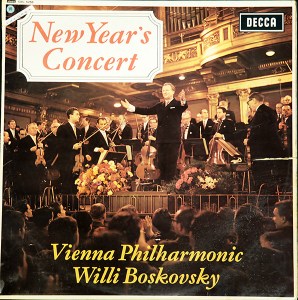
- New Year’s Concert makes its Hot Stamper debut with INCREDIBLE Shootout Winning Triple Plus (A+++) sound or close to it throughout this original unboxed Decca pressing
- Tons of musical energy, loads of rich detail and texture, superb transparency and excellent clarity – the very definition of DEMO DISC sound
- The orchestra is wide, tall, spacious, rich and tubey, yet the dynamics and transparency are first rate
This original Decca UK pressing has the kind of Tubey Magical Midrange that modern records can barely BEGIN to reproduce. Folks, that sound is gone and it sure isn’t showing signs of coming back. If you love hearing INTO a recording, actually being able to “see” the performers, and feeling as if you are sitting in the hall with the players, this is the record for you. It’s what vintage all analog recordings are known for — this sound.
If you exclusively play modern repressings of vintage recordings, I can say without fear of contradiction that you have never heard this kind of sound on vinyl. Old records have it — not often, and certainly not always — but maybe one out of a hundred new records do, and those are some pretty long odds.
What The Best Sides Of New Year’s Concert Have To Offer Is Not Hard To Hear
- The biggest, most immediate staging in the largest acoustic space
- The most Tubey Magic, without which you have almost nothing. CDs give you clean and clear. Only the best vintage vinyl pressings offer the kind of Tubey Magic that was on the tapes in 1966
- Tight, note-like, rich, full-bodied bass, with the correct amount of weight down low
- Natural tonality in the midrange — with all the instruments having the correct timbre
- Transparency and resolution, critical to hearing into the three-dimensional studio space
No doubt there’s more but we hope that should do for now. Playing the record is the only way to hear all of the qualities we discuss above, and playing the best pressings against a pile of other copies under rigorously controlled conditions is the only way to find a pressing that sounds as good as this one does.
What We’re Listening For On New Year’s Concert
- Energy for starters. What could be more important than the life of the music?
- The Big Sound comes next — wall to wall, lots of depth, huge space, three-dimensionality, all that sort of thing.
- Then transient information — fast, clear, sharp attacks, not the smear and thickness so common to these LPs.
- Powerful bass — which ties in with good transient information, also the issue of frequency extension further down.
- Next: transparency — the quality that allows you to hear deep into the soundfield, showing you the space and air around all the instruments.
- Extend the top and bottom and voila, you have The Real Thing — an honest to goodness Hot Stamper.
Learning the Record
For our shootout for New Year’s Concert we had at our disposal a variety of pressings that had the potential for Hot Stamper sound. We cleaned them carefully, then unplugged everything in the house we could, warmed up the system, Talisman’d it, found the right VTA for our Triplanar arm (by ear of course) and proceeded to spend the next hour or so playing copy after copy on side one, after which we repeated the process for side two.
If you have five or more copies of a record and play them over and over against each other, the process itself teaches you what’s right and what’s wrong with the sound of the album. Once your ears are completely tuned to what the best pressings do well that the other pressings do not do as well, using a few carefully chosen passages of music, it quickly becomes obvious how well a given copy can reproduce those passages. You’ll hear what’s better and worse — right and wrong would be another way of putting it — about the sound.
This approach is simplicity itself. First, you go deep into the sound. There you find a critically important passage in the music, one which most copies struggle — or fail — to reproduce as well as the best. Now, with the hard-won knowledge of precisely what to listen for, you are perfectly positioned to critique any and all pressings that come your way.
It may be a lot of work but it sure ain’t rocket science, and we’ve never pretended otherwise. Just the opposite: from day one we’ve explained step by step precisely how to go about finding the Hot Stampers in your own collection. Not the good sounding pressings you happen to own — those may or may not have Hot Stampers — but the records you actually cleaned, shot out, and declared victorious.
Side One
“Zigeunerbaron” (The Gypsy Baron) – Overture
Vergnügungszug – Polka
Wein, Weiß Und Gesang (Wine, Women And Song) – Waltz
Im Krapfenwald’l – Polka
Side Two
“Zigeunerbaron” (The Gypsy Baron) – Entrance March
Aquarellen – Waltz (Josef Strauss)
Tritsch–Tratsch – Polka
Seid Umschlungen Millionen – Waltz
Johann Strauss II Mini-Bio
Johann Baptist Strauss II (25 October 1825 – 3 June 1899), also known as Johann Strauss Jr., the Younger or the Son, was an Austrian composer of light music, particularly dance music and operettas. He composed over 500 waltzes, polkas, quadrilles, and other types of dance music, as well as several operettas and a ballet. In his lifetime, he was known as “The Waltz King,” and was largely responsible for the popularity of the waltz in Vienna during the 19th century. Some of Johann Strauss’s most famous works include “The Blue Danube”, “Kaiser-Walzer” (Emperor Waltz), “Tales from the Vienna Woods,” “Frühlingsstimmen,” and the “Tritsch-Tratsch-Polka.” Among his operettas, Die Fledermaus and Der Zigeunerbaron are the best known.
Strauss was the son of Johann Strauss I and his first wife Maria Anna Streim. Two younger brothers, Josef and Eduard Strauss, also became composers of light music, although they were never as well known as their brother.
Strauss made his debut at Dommayer’s in October 1844, where he performed some of his first works, such as the waltzes “Sinngedichte,” Op. 1 and “Gunstwerber,” Op. 4 and the polka “Herzenslust,” Op. 3. Critics and the press were unanimous in their praise of Strauss’s music. A critic for Der Wanderer commented that “Strauss’s name will be worthily continued in his son; children and children’s children can look forward to the future, and three-quarter time will find a strong footing in him.”
Despite the initial fanfare, Strauss found his early years as a composer difficult, but he soon won over audiences after accepting commissions to perform away from home. The first major appointment for the young composer was his award of the honorary position of “Kapellmeister of the 2nd Vienna Citizen’s Regiment,” which had been left vacant following Joseph Lanner’s death two years before.
Although Strauss was the most sought-after composer of dance music in the latter half of the 19th century, Carl Michael Ziehrer and Émile Waldteufel provided stiff competition; the latter held a commanding position in Paris. Also, Philipp Fahrbach denied the younger Strauss the commanding position of the KK Hofballmusikdirektor when the latter first applied for the post. The German operetta composer Jacques Offenbach, who made his name in Paris, also posed a challenge to Strauss in the operetta field.
Strauss was admired by other prominent composers: Richard Wagner once admitted that he liked the waltz “Wein, Weib und Gesang” (Wine, Women and Song) Op. 333. Richard Strauss (unrelated), when writing his Rosenkavalier waltzes, said in reference to Johann Strauss, “How could I forget the laughing genius of Vienna?”